Peptide research, explained.
Detailed guides to peptide identity, biological pathways, analytical methods and clinical evidence. Search the reading room or follow a research topic.
Browse 13 research topics
All guides & articles
 Peptide Fundamentals
Insulin Analogues: How Sequence and Formulation Change the Profile
Insulin analogues show why small sequence changes and formulation choices can alter a peptide medicine’s time profile.
Updated 2026-10-29 ↗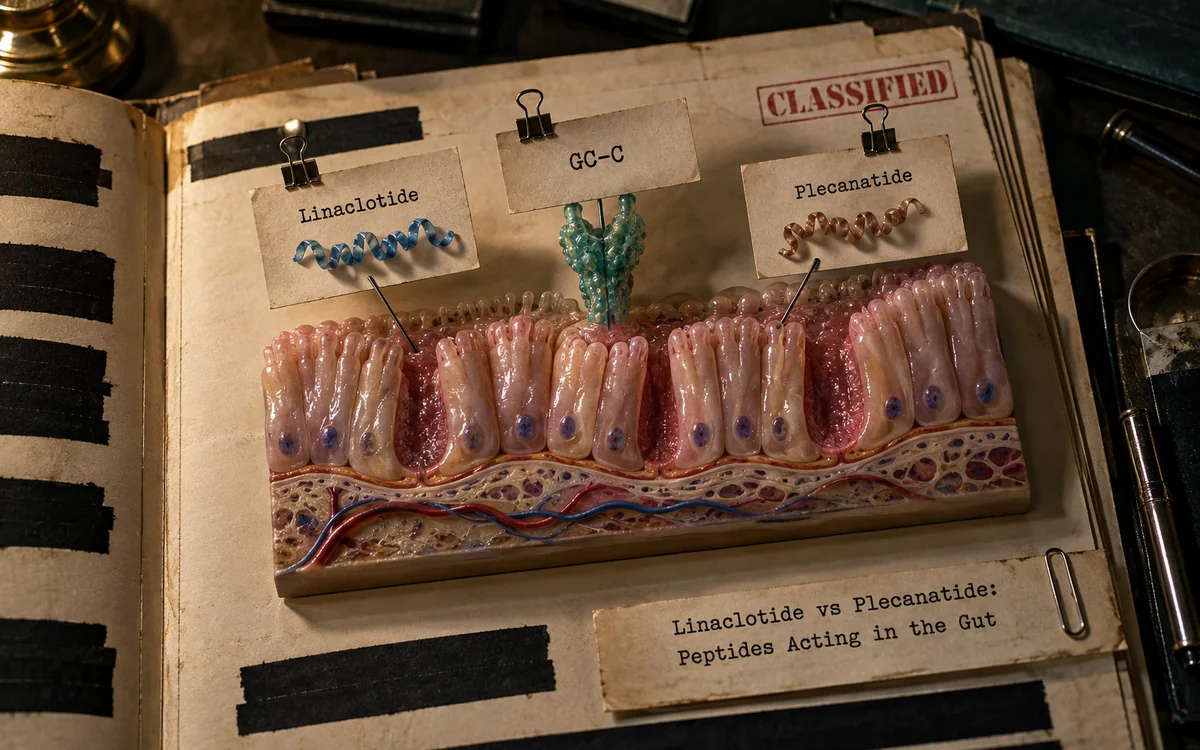 Peptide Fundamentals
Linaclotide vs Plecanatide: Peptides Acting in the Gut
Linaclotide and plecanatide are peptide GC-C agonists with product-specific gastrointestinal indications.
Updated 2026-10-29 ↗ Research Practice
MariTide: Why a Peptide–Antibody Conjugate Is a Different Design
MariTide, or maridebart cafraglutide, combines a peptide component with an antibody-based design. That architecture helps explain why it belongs in a discussion of metabolic peptides while differing from a standalone peptide analogue.
Updated 2026-10-29 ↗ Peptide Fundamentals
Lanreotide vs Octreotide: Formulations and Trial Evidence
Compare lanreotide and octreotide by formulation, half-life and trial endpoint. PROMID and CLARINET tested each medicine against placebo, rather than against each other.
Updated 2026-11-05 ↗ Peptide Fundamentals
Oral vs Injectable Peptides: Why Delivery Changes the Evidence
Oral and injectable describe routes, not two uniform classes of peptide evidence. A peptide may be intended to act locally in the gut or to reach a systemic target, and those aims require different delivery strategies.
Updated 2026-10-29 ↗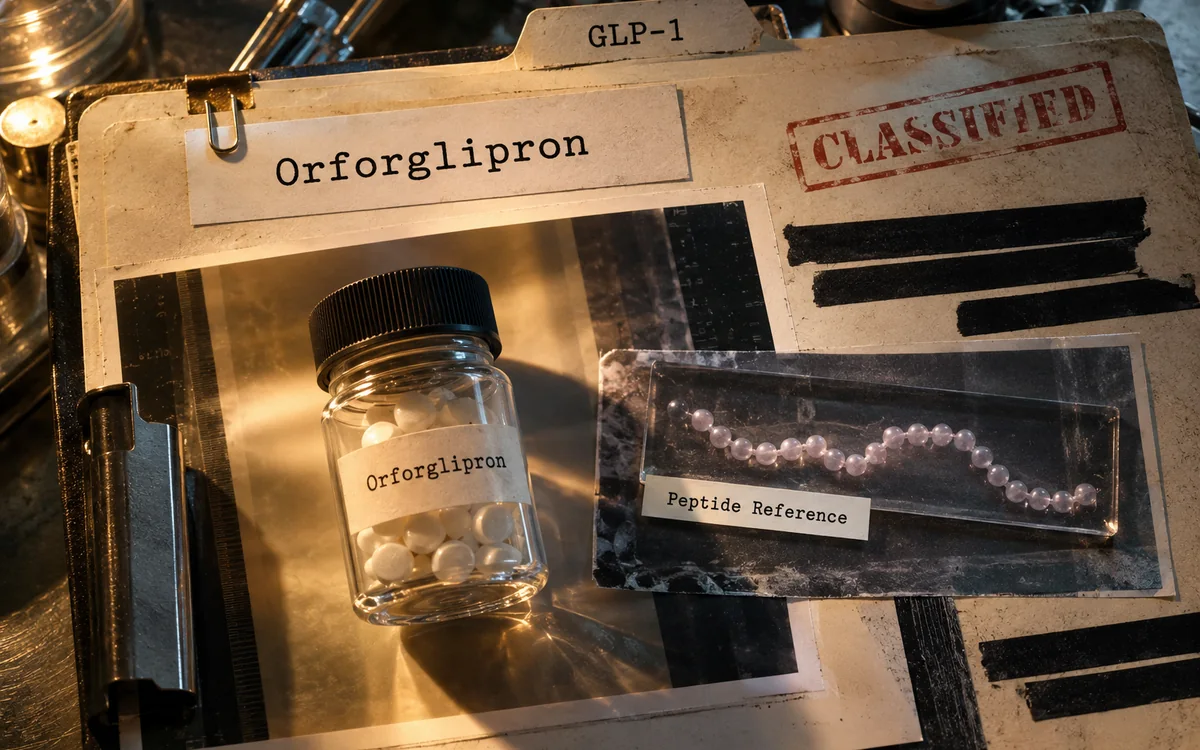 Peptide Fundamentals
Orforglipron: Why a GLP-1 Drug Does Not Have to Be a Peptide
Orforglipron activates the GLP-1 receptor, but it is a small molecule rather than a peptide. That distinction is useful because online discussions often use GLP-1, injectable and peptide as if they were the same classification.
Updated 2026-10-29 ↗ Peptide Fundamentals
Pegcetacoplan: C3 Inhibition Across Different Clinical Contexts
Pegcetacoplan binds complement C3 and C3b, but that target description does not make its different clinical settings equivalent.
Updated 2026-10-29 ↗ Research Practice
Pemvidutide and MASH: Liver Endpoints Beyond Weight Loss
Pemvidutide’s IMPACT report separates two liver-biopsy questions: MASH resolution without worsening fibrosis and fibrosis improvement without worsening MASH.
Updated 2026-10-29 ↗ Analytical Methods
Peptide Acetate vs TFA Salts: Identity, Content and Measurement
Acetate and trifluoroacetate describe counterion-related forms that need to be documented separately from a peptide’s sequence.
Updated 2026-10-29 ↗ Peptide Fundamentals
Peptide Half-Life: Duration of Action, Decay and PRRT
Half-life is the time for a measured quantity to fall by half. In PRRT, it can describe physical decay, biological clearance or their effective combination.
Updated 2026-11-15 ↗ Analytical Methods
Peptide Immunogenicity: What Anti-Drug Antibodies Can Tell You
Anti-drug antibodies are an assay-defined finding, not a complete diagnosis of harm or treatment failure.
Updated 2026-10-29 ↗ Analytical Methods
Peptide Purity, Sterility and Endotoxin: Three Different Questions
Chemical purity, sterility and bacterial endotoxin testing ask different questions. A chromatographic percentage cannot answer all three, and a clear-looking solution cannot replace any of them.
Updated 2026-10-29 ↗