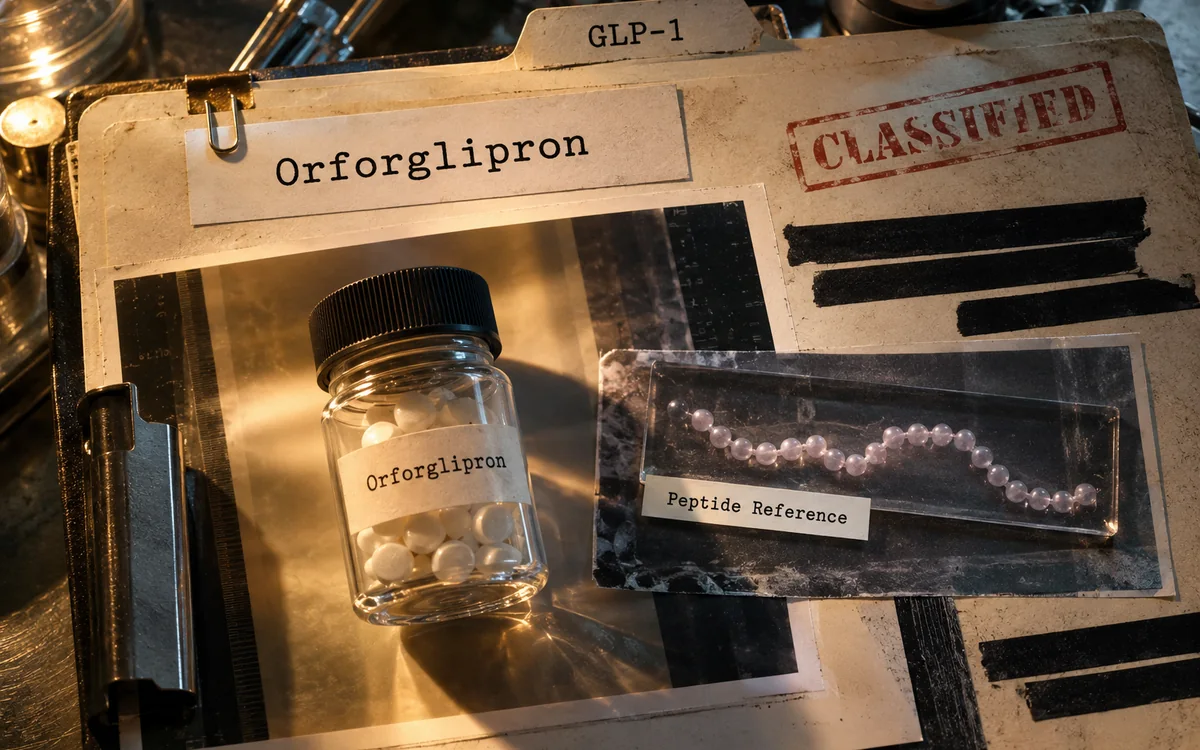
Orforglipron activates the GLP-1 receptor, but it is a small molecule rather than a peptide. That distinction is useful because online discussions often use GLP-1, injectable and peptide as if they were the same classification. They describe a target, a route and a chemical class. The U.S. FDA approved Foundayo, the orforglipron product, in 2026; its current product information and its clinical-trial records still need to be read separately from that basic chemistry.
A receptor name does not define a molecule’s chemical class
The FOUNDAYO label identifies orforglipron and its GLP-1 receptor activity. Unlike semaglutide, it is not a sequence of amino-acid residues forming a peptide analogue. Shared receptor activity does not imply structural identity.
This distinction is useful beyond one medicine. A peptide hormone can be a natural ligand while a chemically different drug interacts with the same receptor. Describing every GLP-1 drug as a peptide loses that important molecular difference.
What changed in the 2026 regulatory record
The FDA announcement dated April 1, 2026 documents Foundayo's approval. The official product record defines the actual indication and conditions of use; a trial article cannot replace that record.
A current reference should therefore distinguish the historical development literature from the later authorization. It should also avoid treating one jurisdiction's approval as evidence of authorization everywhere. The relevant product and location remain part of any regulatory statement.
Oral is a route, not a synonym for small molecule
Some orally delivered medicines are peptides, while others are not. VK2735 oral research and oral semaglutide concern different delivery designs from orforglipron. The word tablet does not establish that their absorption requirements or clinical records are interchangeable.
Scroll horizontally to read all columns.
| Description | Question answered |
|---|---|
| Nonpeptide | What is the chemical class? |
| GLP-1 receptor agonist | What target activity is described? |
| Oral formulation | How is the product delivered? |
| Approved indication | Which product/use has the relevant authorization? |
| Clinical endpoint | What changed in a study? |
These layers should appear together rather than compete as alternative definitions.
Diabetes trials and weight-management records are distinct
A phase 3 early type 2 diabetes trial and ATTAIN-2 provide separate clinical contexts. A paper in diabetes does not automatically define the result in a population without diabetes, and its primary glucose outcome should not be relabeled as a weight endpoint.
The existence of several trials is valuable because it expands the questions studied. It should not be used to blend populations or choose a favorable number without its corresponding analysis. The indication still comes from the applicable product record.
A different structure does not remove product-specific risks
Nonpeptide does not mean risk-free, and oral does not mean physiologically mild. The prescribing information includes important warnings and interactions that belong to the actual product. A chemical-class explanation cannot substitute for that clinical record.
This article does not provide switching, fasting or administration instructions. Our oral-versus-injectable guide explains why nominal amounts and route labels are insufficient to create a conversion rule between unrelated products.
Target identity becomes equivalence
Imagine a summary says two medicines activate GLP-1 receptors and concludes that their tablets, amounts and outcomes are interchangeable. The first statement describes a shared target; the second requires much more evidence.
A useful comparison would identify each active ingredient, formulation, trial population and measured outcome. Direct comparative evidence, when relevant, must be read under the specific interventions tested. A broad class label cannot create that evidence on its own.
A manufacturing description is not a clinical result
Calling orforglipron a small molecule identifies a chemical class. It does not quantify the comparative clinical benefit, adverse-event rate or suitability for a particular person. Similarly, an oral formulation describes delivery; it does not mean that every oral GLP-1 therapy has the same structure or the same administration conditions.
This matters when the phrase oral peptide is used loosely in search results. Oral semaglutide is still based on a peptide active ingredient, whereas orforglipron is a nonpeptide GLP-1 receptor agonist. The shared receptor and route do not collapse that distinction. An archive can cover both because the comparison clarifies molecular categories rather than pretending they are identical.
Regulatory status is a separate, dated attribute. The April 2026 FDA announcement and the current product record are the sources for the US approval statement, while the published trials explain the specific populations and endpoints they studied. A diabetes trial should not be presented as the entire evidence for a weight-management indication, or vice versa. For a reliable comparison, keep chemistry, formulation, indication, jurisdiction and trial outcome in separate fields. That makes it easier to update a changing product status without rewriting the molecule's identity or exaggerating what a particular study established.
Use three labels instead of one loose category
A target label names what the molecule acts on. A structural label describes what kind of molecule it is. A route label describes how a formulated product is administered. These axes can cross: an oral product may contain a peptide, while an oral GLP-1 receptor agonist may instead be a nonpeptide small molecule. The route does not settle the chemistry.
This is why a comparison with oral semaglutide needs more than the word tablet. The active substances and formulation strategies differ. A product’s exposure and administration conditions must be established for that product. One set of tablet instructions cannot be transferred to another molecule because both act at the same receptor.
Diabetes and weight-management trials have different primary questions
ACHIEVE-1 studied early type 2 diabetes with change in HbA1c as its primary endpoint. ATTAIN-2 examined weight management in people with overweight or obesity and type 2 diabetes over a different period. Both can report weight and glycemic outcomes, yet the trial’s primary question and population determine how those results should be interpreted.
A weight percentage from one program should not be substituted for the glycemic result of another. Baseline HbA1c, accompanying therapy and assessment duration matter. A fair comparison reports each endpoint in its original units and keeps the trial name beside the figure.
Approval resolves a product question, not every comparison
A regulatory decision concerns a defined product, indication and jurisdiction. It does not establish that every product advertised with the same active name has the same quality or authorization. It also does not settle whether that product is superior to every other GLP-1 intervention. An active comparison still requires appropriate clinical evidence.
Product information can change after initial approval. For a current clinical question, the latest jurisdiction-specific label is more useful than an old headline describing the compound as investigational. Conversely, a trial publication remains valuable for understanding its methods even after the regulatory status changes. The two documents have different jobs.
For the peptide archive, orforglipron is a helpful boundary case. It shows why searching for a peptide online can return medicines that are not peptides at all. Before comparing claims, identify the molecule, then the formulation and source type. That simple sequence prevents a shared target or a tablet format from creating an equivalence the evidence has not established.
Why this belongs in a peptide archive
Understanding the boundary around peptides improves the accuracy of the category. Orforglipron provides a concrete example of peptide-related pharmacology without peptide chemical identity. It also helps readers recognize outdated descriptions when a development candidate gains an official product record.
The classification guide supplies the broader framework. The useful conclusion is neither that one chemical class is universally better nor that a shared receptor makes every drug the same. It is that structure and clinical evidence need to be followed separately.