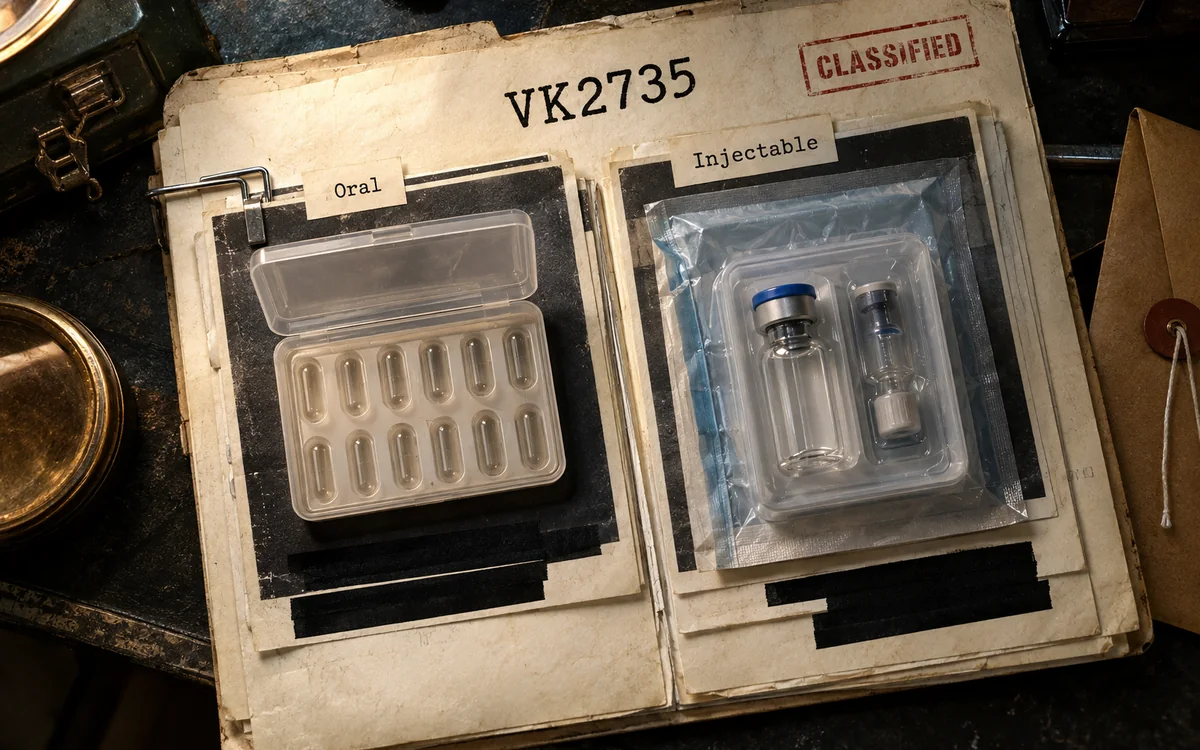
VK2735 has been studied as an injected and an oral GIP/GLP-1 receptor agonist, but the two research records should not be fused into one result. The published VENTURE trial assessed subcutaneous treatment for 13 weeks. The oral source cited here is a sponsor announcement describing another formulation. A useful reading separates the route, evidence source and observation period before interpreting the speed or magnitude of weight change.
The dual-receptor description is the starting point
The VENTURE publication describes VK2735 as a GIP/GLP-1 receptor dual agonist. That places it in a related target category to tirzepatide, but not in the same molecular identity or evidence record.
Receptor categories can organize a comparison while leaving sequence, exposure and outcome differences unresolved. Calling two candidates dual agonists does not establish that their clinical effects or tolerability are equal. The relevant trial must identify the actual intervention.
What VENTURE found over 13 weeks
The randomized, double-blind, placebo-controlled study enrolled adults with overweight or obesity and excluded diabetes. Reported mean weight reductions ranged from 9.1% to 14.7% across active groups, compared with 1.7% with placebo at week 13.
This is a short-horizon result. It should not be extrapolated as a linear weekly rate over a year, nor compared with a much longer trial as though both assessed the same stage of the trajectory. Early changes and longer-term maintenance are different questions.
A short experiment has useful but bounded information
Thirteen weeks can provide information about early response and observed tolerability. It is less informative about durability, later discontinuation and uncommon events. The publication describes gastrointestinal adverse events; their time course should not be converted into a guarantee that problems disappear with longer exposure.
Scroll horizontally to read all columns.
| Question | What the cited study supplies |
|---|---|
| Early weight response | A placebo comparison at 13 weeks |
| Long-term maintenance | Not established by extending the early rate |
| Oral formulation effect | Requires the oral study record |
| Comparative superiority | Requires an appropriate active comparison |
| Current authorization | Requires an official product record |
These boundaries are part of the result, not reasons to ignore it.
Why the oral source is labeled differently
The oral VENTURE source is a company announcement of top-line phase 2 findings. It identifies a development event and the sponsor's account. It should not be presented as though it were the same published paper as the subcutaneous VENTURE study.
A sponsor report can be useful while lacking the detail needed to evaluate every method or result independently. Preserve its date, formulation and source type. Later full publications can add information; expected publication is not a substitute for a record already available.
Oral does not necessarily mean nonpeptide
A molecule's chemical class and its delivery route are different descriptions. An oral peptide formulation remains a peptide intervention, while a small-molecule GLP-1 agonist can act at the same receptor without being a peptide. Our orforglipron guide explores that distinction.
The oral-delivery overview explains why absorption, formulation and exposure must be measured. An injection result cannot simply be assigned to a tablet based on the active candidate name alone.
Early loss projected into a year
Imagine a short trial reports a substantial early reduction, and a summary multiplies the average weekly change by 52. That assumes the curve remains linear, ignoring the possibility of a plateau, different adherence and longer-term events.
The scientifically appropriate summary reports the actual assessment week and identifies longer follow-up as a separate question. Our plateau guide shows why established obesity trials often need to be interpreted as trajectories rather than constant rates.
A short study can show speed without establishing durability
VENTURE's 13-week endpoint captures an early part of a weight trajectory. It is useful for evaluating whether assigned groups separated from placebo during that period. It does not reveal the eventual plateau, maintenance after a year or behavior after treatment withdrawal. Multiplying a 13-week percentage by four assumes a linear trajectory that the study did not test.
The published subcutaneous study also reported that 130 of 140 participants across active groups achieved at least 5% weight reduction, compared with four of 34 in the placebo group. This is a pooled responder figure across assigned active groups, whereas individual-group mean changes answer a different question. Mixing the pooled rate with the largest single-group mean can create an artificial description of a group that never existed.
The peer-reviewed publication and the separately identified oral sponsor report should consequently remain separate evidence records. The shared molecule name does not establish equivalent exposure, tolerability or long-term outcomes for the two formulations. A future oral publication can strengthen the evidence by providing the full analysis, missing-data rules and adverse-event detail. Until then, the transparent approach is to identify which formulation produced each finding and which parts are available only as sponsor-reported results.
How much can a 13-week study establish?
A short randomized trial can establish an early group difference under its assigned regimens. It can also reveal common adverse events during the period studied. It cannot show whether the same slope continues through a year, where the curve levels off or what happens after withdrawal. Multiplying the short-term percentage by the number of similar periods assumes a linear trajectory the experiment did not test.
The phase of exposure matters within those weeks. Early escalation and later exposure can have different adverse-event patterns. A report that gastrointestinal events became less frequent with continued exposure should be read alongside the number of participants still receiving treatment and the reasons for discontinuation. A falling rate among those remaining does not describe everyone who started.
A route change creates a formulation question
The amount administered by mouth is not automatically the amount reaching systemic circulation. An oral-development program has to characterize exposure, variability and the conditions of administration. Those measurements belong to the specific formulation. They cannot be borrowed from an injectable trial simply because the active molecular name is the same.
The oral versus injectable peptide guide explains why peptide chemistry and route are separate classifications. A tablet can contain a peptide. An injected product can have a delivery profile quite different from another product using the same receptor targets. Route labels alone do not establish equivalence.
How to read the oral announcement without treating it as a paper
A sponsor top-line report may disclose a prespecified endpoint, headline estimates and selected safety information. It may provide less detail about missing outcomes, analysis populations or subgroup results than a full publication. The appropriate response is to label the source and preserve those limits, not to discard the report or promote it to a peer-reviewed trial by implication.
Compare the stated endpoint with the result actually emphasized. Was the headline based on everyone assigned, those completing treatment or a hypothetical adherence scenario? If the announcement does not supply the information, mark the comparison unresolved. Do not fill the gap by assuming the analysis matched VENTURE.
A future full report can then be checked against the announcement: same enrolled population, same visit, same primary endpoint and same adverse-event accounting. That makes the development record auditable. It also keeps early evidence from turning into a product recommendation for any vial or tablet offered online under the VK2735 name.
How to compare the next VK2735 record
Match the route, formulation, trial identifier, diabetes status, time horizon and analysis. Then separate full publications from sponsor announcements. If a new report changes only one part of that record, do not overwrite unrelated findings or combine them into a fictional single experiment.
The useful conclusion is that VK2735 has a specific early clinical record and a distinct oral-development record. A broader claim about long-term benefit or superiority needs the corresponding study, not a larger receptor count or a projected weight curve.