Retail provider comparisons.
Compare US and Canadian peptide-provider records through dated status statements, COA access, lot traceability, blend documentation and testing methods. These source-linked educational reviews separate company claims from independently checked evidence; inclusion is not an endorsement or a quality ranking.
Guides in this topic
 Documentation & Traceability
BioTech Peptides Blends: What a COA Can Say About Each Component
A component-by-component worksheet for blend identity, quantitative content, sampled stages and the questions one headline result leaves open.
Updated 2026-11-09T09:06:28.317Z ↗ Documentation & Traceability
BioTech Peptides vs The Peptide Labs: Identity, Blends and Content Evidence
Compare single compounds, blends, content measurements and report access without turning an unseen certificate or a public page into a quality score.
Updated 2026-11-09T09:06:28.317Z ↗ Documentation & Traceability
Blue Sky Peptide COA Library: Reading Batch Histories Without Mixing Lots
Use a public certificate library without mixing lots: archive identifiers, distinguish report revisions and preserve the file behind a research decision.
Updated 2026-11-09T09:06:28.317Z ↗ Documentation & Traceability
Core Peptides COA: How to Match a Report to the Product and Lot
Match the product, supplier lot and laboratory sample, then read purity, identity, report amendments and the limits of a public testing statement.
Updated 2026-11-09T09:06:28.317Z ↗ Documentation & Traceability
Core Peptides vs Peptide Warehouse: Comparing US and Canadian Research Records
An evidence worksheet for US and Canadian provider records, separating molecular comparison, administrative screening and exact product records.
Updated 2026-11-09T09:06:28.317Z ↗ Documentation & Traceability
Limitless Biotech Testing: Product Formats, Method Scope and Lot Evidence
Read the stated testing categories by product format, with separate fields for purity, sterility, endotoxin, thresholds and sample-specific reports.
Updated 2026-11-09T09:06:28.317Z ↗ Documentation & Traceability
Peptide Sciences Alternatives: A Research Documentation Checklist
A detailed supplier-change checklist: preserve historical records, define comparable material and keep continuity claims separate from lot evidence.
Updated 2026-11-09T09:06:28.317Z ↗ Documentation & Traceability
Peptide Sciences vs Core Peptides: Historical Records and Current Documentation
Compare historical and current records fairly, with dated specifications, separate lot chains and a fictional supplier-transition example.
Updated 2026-11-09T09:06:28.317Z ↗ Documentation & Traceability
Peptide Warehouse Canada Review: Manufacturing Claims, Lot Tests and Product Records
A Canadian documentation review separating manufacturing stages, dispatch, lot-matched testing, analytical methods and product-authorization questions.
Updated 2026-11-09T09:06:28.317Z ↗ Documentation & Traceability
The Peptide Labs COA: Member Access, Purity, Content and Traceability
Examine member-access documentation through explicit evidence stages, keeping public claims, measured content and lot verification separate.
Updated 2026-11-09T09:06:28.317Z ↗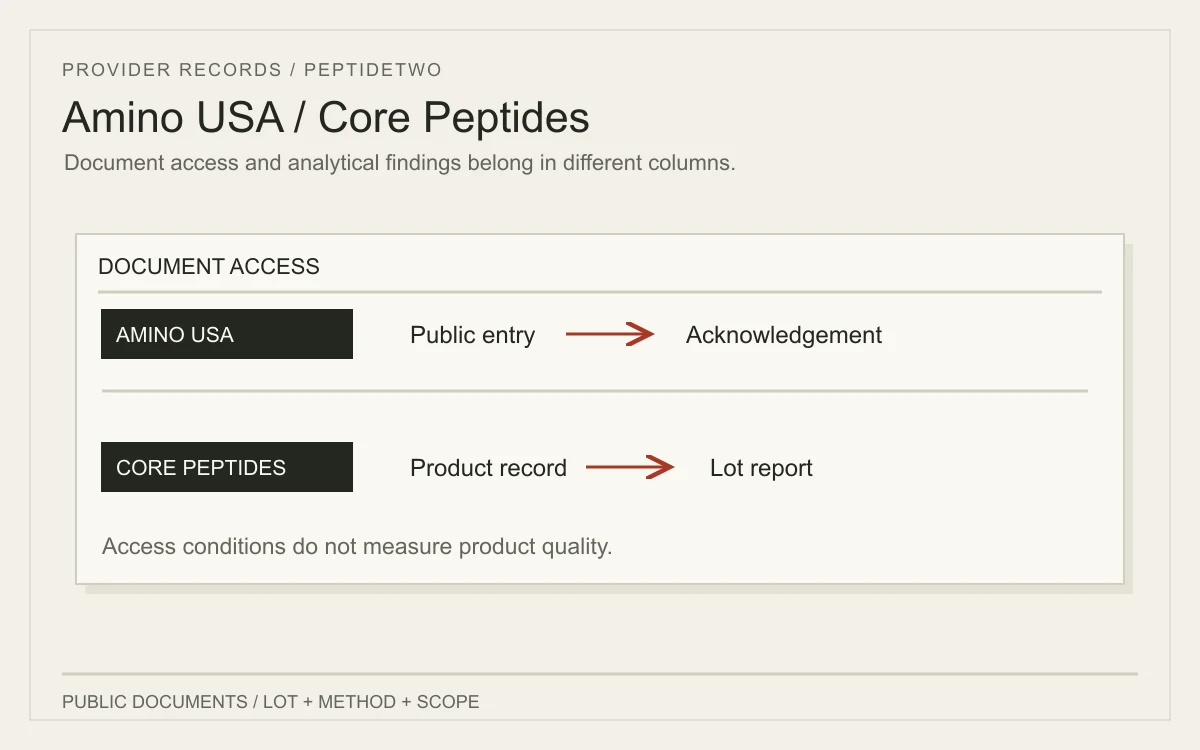 Research Practice
Amino USA vs Core Peptides: Public COA Access and Evidence Limits
A focused comparison of the document paths visible on the public websites, with unresolved access and batch questions kept explicit.
Updated 2026-11-06 ↗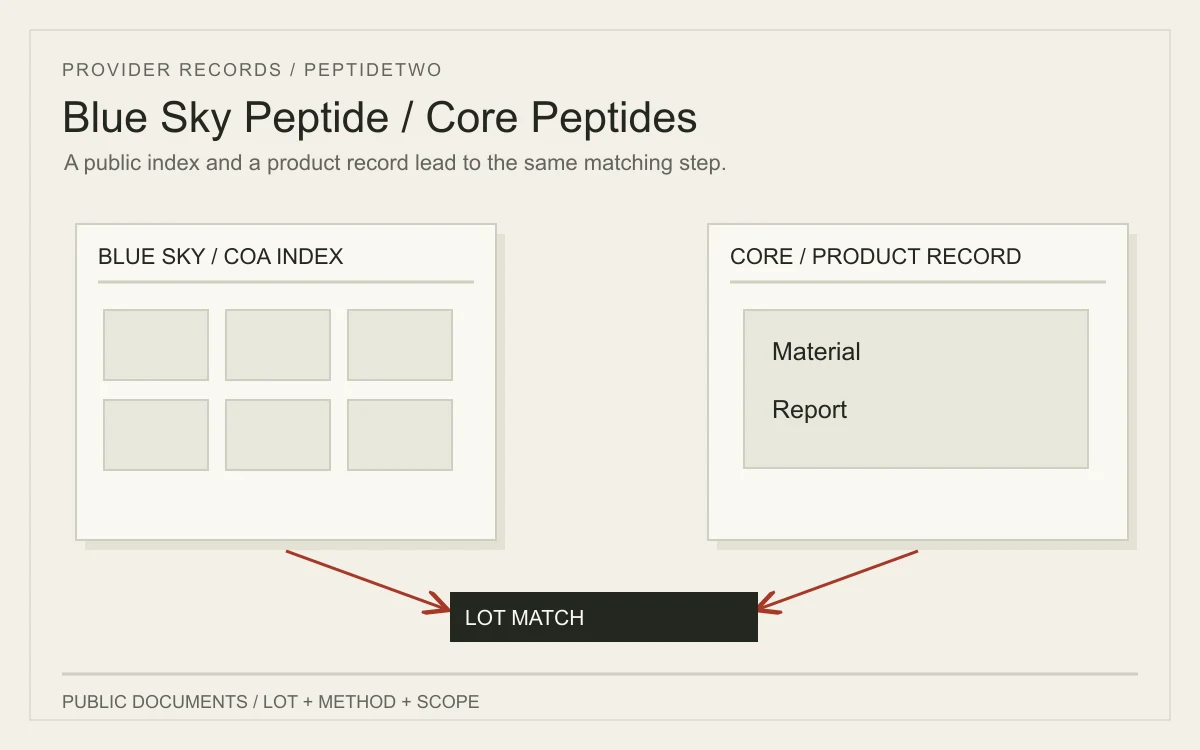 Research Practice
Blue Sky Peptide vs Core Peptides: COA Libraries and Product-Page Records
A comparison of two document-discovery models: Blue Sky Peptide’s public COA directory and Core’s published product-page approach.
Updated 2026-11-09T09:06:28.317Z ↗