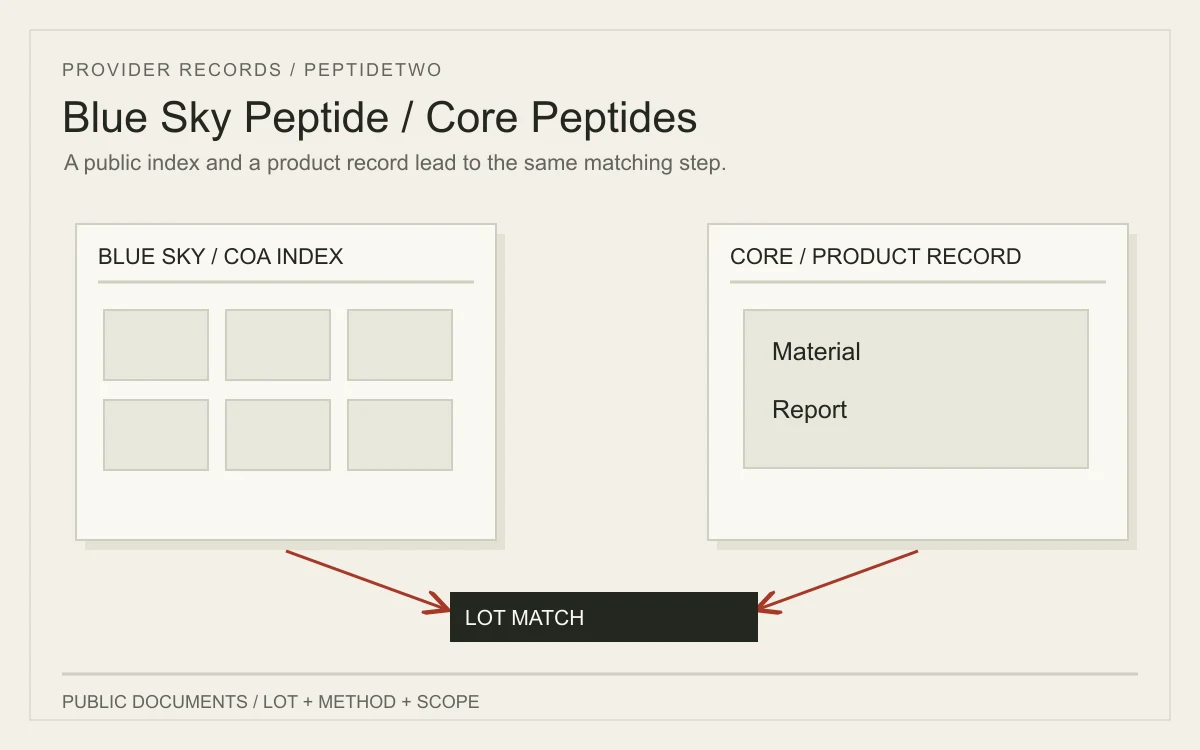
Blue Sky Peptide vs Core Peptides offers a useful comparison of how research documentation is organized. Blue Sky Peptide has a public COA directory with downloadable links. Core says that certificates for tested batches are published on product pages. Both approaches still require the same final step: connect the correct report to the material and lot being evaluated.
This article compares document discovery and published policies. It does not turn an organized library, a company history or a testing statement into an independent quality finding.
Review scope: Public website information checked on November 6, 2026. This is a documentation comparison, not an independent product test, transaction test or endorsement. No affiliate links or paid placements were used in this series.
Blue Sky Peptide vs Core Peptides: two routes to reports
Scroll horizontally to read all columns.
| Review step | Blue Sky Peptide | Core Peptides |
|---|---|---|
| Starting page | Public, paginated COA directory | Product-page certificate model described on company page |
| Finding an older batch | Directory invites requests for previous-batch COAs | Confirm the matching batch with the available product record |
| Analytical labels | Directory labels refer to HPLC/MS identity and purity | Read the actual report rather than assuming the scope from the company page |
| Destination information | Shipping policy says US domestic addresses only | Company information describes US-only researcher service |
| Independent lot verification | Not performed | Not performed |
What a central COA directory helps with
The Blue Sky Peptide directory provides a public index, pagination and document links. Its text invites readers to request previous-batch certificates if the relevant lot is not shown. This gives a researcher a clear discovery path and an explicit follow-up route.
It does not establish that every visible entry matches current inventory. Some document names identify an amount, blend or dated record; those details should be retained. The changing number of files is not used here as a quality metric because more files do not automatically mean better evidence for a particular lot.
What a product-page model helps with
Core’s company page says tested-batch certificates are published with product pages. That can connect a product description and a document in one place. The remaining question is which batch is represented and whether it is the batch relevant to the research record.
A document placed beside a product description can still concern an earlier batch or a different nominal amount. Read the identifiers in the report rather than relying only on the page where it appears. The provider COA guide describes that matching sequence.
Follow the document beyond the download button
Record the material name, lot, report identifier, date, laboratory and analytical method. If a document supplies a verification route, check that the details agree with the saved record. A logo, filename or screenshot alone should not be treated as an authenticated result.
Keep identity, area purity and content separate. HPLC/MS labels tell a reader which kinds of evidence to examine; they do not remove the need to inspect the method and reporting basis. The mass-spectrometry guide and HPLC purity versus peptide content guide explain the underlying questions.
Compare current policies on their own terms
The Blue Sky Peptide shipping policy states US domestic shipping only and distinguishes processing from carrier transit. Core’s policy describes its own shipping, cancellation and refund conditions. Use the current policy for the actual destination rather than assuming equivalent coverage from both companies’ US orientation.
Save the chosen service, processing conditions and quote date. A public estimate is not a measured delivery result. We did not test checkout, dispatch, refunds or customer support, so the article does not rank service performance.
Choose a review workflow, not a universal winner
A researcher who is checking several historical reports may value an index. Someone checking one precise material may begin with its product record. In either workflow, the evidence question ends at the relevant lot and method, not at the website layout.
For a different catalogue-and-policy comparison, read Core versus BioTech Peptides. The ten-website overview shows other document-access models and clearly labels status or access limits.
Use the library and product-page workflows
The Blue Sky Peptide COA library guide explains how to preserve batch histories and distinguish revised documents from new samples. The Core Peptides COA guide applies the same identifier discipline to product-page reports. The access route can differ while the need to match the relevant material stays the same.