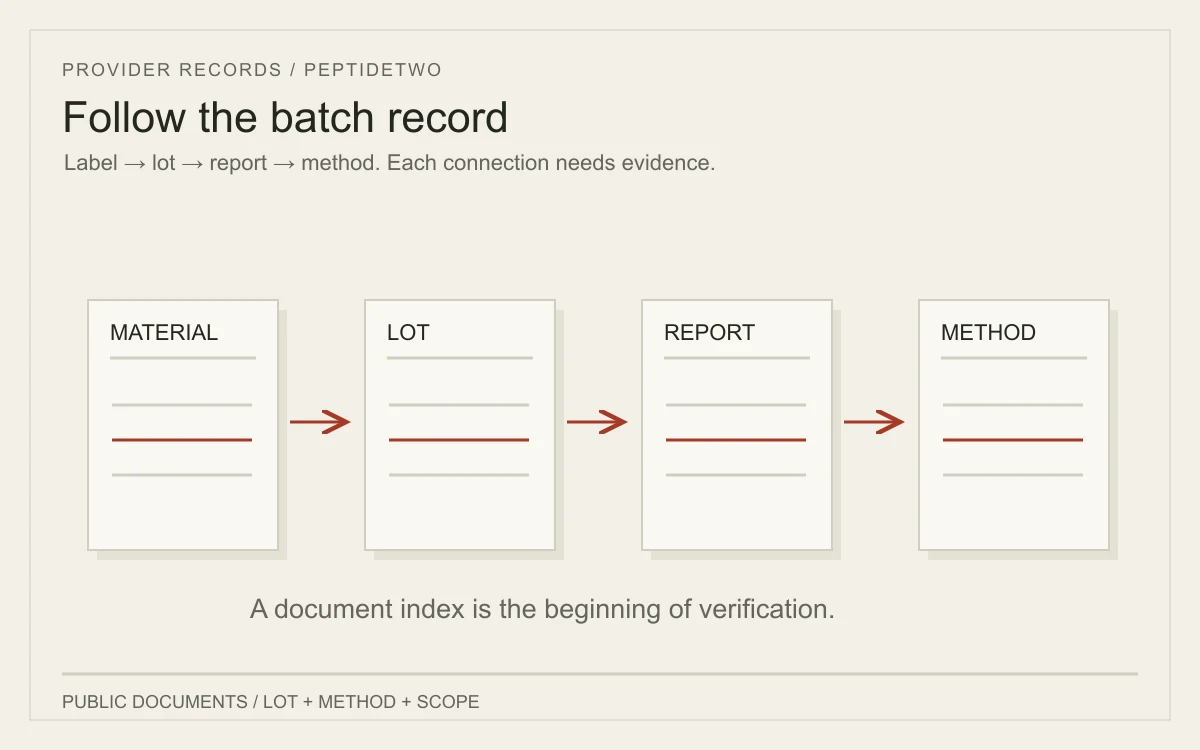
A peptide provider COA comparison should follow a material from its label to the correct analytical record. Counting PDFs, comparing the largest percentages or preferring a familiar laboratory logo skips that essential connection. Start with a lot-matching workflow, then examine the method and result.
This guide compares public documentation routes used by retail providers. It complements our guide to reading a peptide COA, which explains the contents of an individual certificate. Here, the emphasis is how a website-level claim becomes a defensible record for a particular material.
Review scope: Public website information checked on November 6, 2026. This is a documentation comparison, not an independent product test, transaction test or endorsement. No affiliate links or paid placements were used in this series.
Peptide provider COA comparison: public access models
Scroll horizontally to read all columns.
| Model | Observed provider example | What the model does not establish |
|---|---|---|
| Public document index | Blue Sky Peptide’s COA directory; Swiss Chems’ test-results directory | That every indexed document matches current inventory |
| Product-page certificates | Core’s company page describes tested-batch reports on product pages | That placement alone authenticates the relevant lot |
| Request for a specific lot | Swiss Chems’ quality policy describes lot-specific COAs on request | That a request has been fulfilled or a report independently validated |
| Member or access conditions | The Peptide Labs describes member certificates; Amino USA presented an acknowledgement | That unseen records are absent or analytically inferior |
Step 1: write the material identity in full
Use the actual product description, molecular form, declared amount and whether the material is a mixture. A shortened name can omit a fragment, counterion, modification or blend component. Keep the label text and the report description side by side before comparing results.
If those descriptions differ, retain the discrepancy and seek clarification through the provider’s normal documentation process. Do not silently rename one record to make it fit another. The identity framework gives examples of distinctions that affect a research claim.
Step 2: connect the lot, report and source
Record the lot identifier, report number, report date and laboratory identity. Keep the official page from which the document was obtained and the date it was retrieved. If a laboratory provides its own verification route, compare the returned record with the saved report.
A third-party-looking PDF can still be a seller-posted copy of a document. Without an independent source check, describe it that way. This guide did not authenticate the current lots of the companies listed, and document availability is not presented as proof of the contents of a shipment.
Step 3: identify the quantity actually measured
Scroll horizontally to read all columns.
| Report field | Interpretation question | Common comparison error |
|---|---|---|
| HPLC area percentage | Which peaks, detector conditions and integration basis were used? | Treating area percentage as target-peptide mass fraction |
| Identity assignment | What structural or mass evidence supports the assignment? | Treating a purity result as identity evidence |
| Content or assay | What amount, standard and material basis define the result? | Treating label quantity as a measured assay |
| Microbiological result | Which test and sample specification were assessed? | Treating chemical purity as sterility or endotoxin evidence |
The Bachem analytical FAQ distinguishes HPLC purity, net peptide content and gross weight. The purity versus concentration guide works through the numerical implications. A valid comparison preserves those definitions even when a website uses a single broad heading such as “quality.”
Step 4: separate public claims from verified findings
Blue Sky’s index and Swiss Chems’ directory are observable document-discovery resources. Core’s company page describes a testing and publication workflow. The Peptide Labs’ company page describes its own testing and access model. These are different evidence types and should be labeled accordingly.
A manufacturer’s GMP or compliance statement is another distinct claim. The FDA’s cGMP overview describes regulatory manufacturing requirements and oversight; it does not certify the particular retailer, lot or material being reviewed here. A research-use label or a COA should not be presented as an approval record.
Step 5: preserve unanswered questions
Use statuses such as “public page reviewed,” “matched report reviewed,” “not obtained” and “requires clarification.” Do not convert an inaccessible document into a zero score or a general purity guarantee into a full pass. Access conditions and analytical findings deserve different columns.
Save the resulting record with the traceability framework. For examples of how the access models differ, see Blue Sky versus Core and Amino USA versus Core. The goal is a comparison that another reader can check, not a fabricated universal provider ranking.
Apply the framework to particular documentation models
For mixtures, use the BioTech Peptides component-level worksheet. For format-dependent method statements, read the Limitless Biotech testing guide. The Blue Sky certificate-library workflow addresses historical lots, while the The Peptide Labs COA access guide keeps a public statement separate from a legitimately obtained member report.