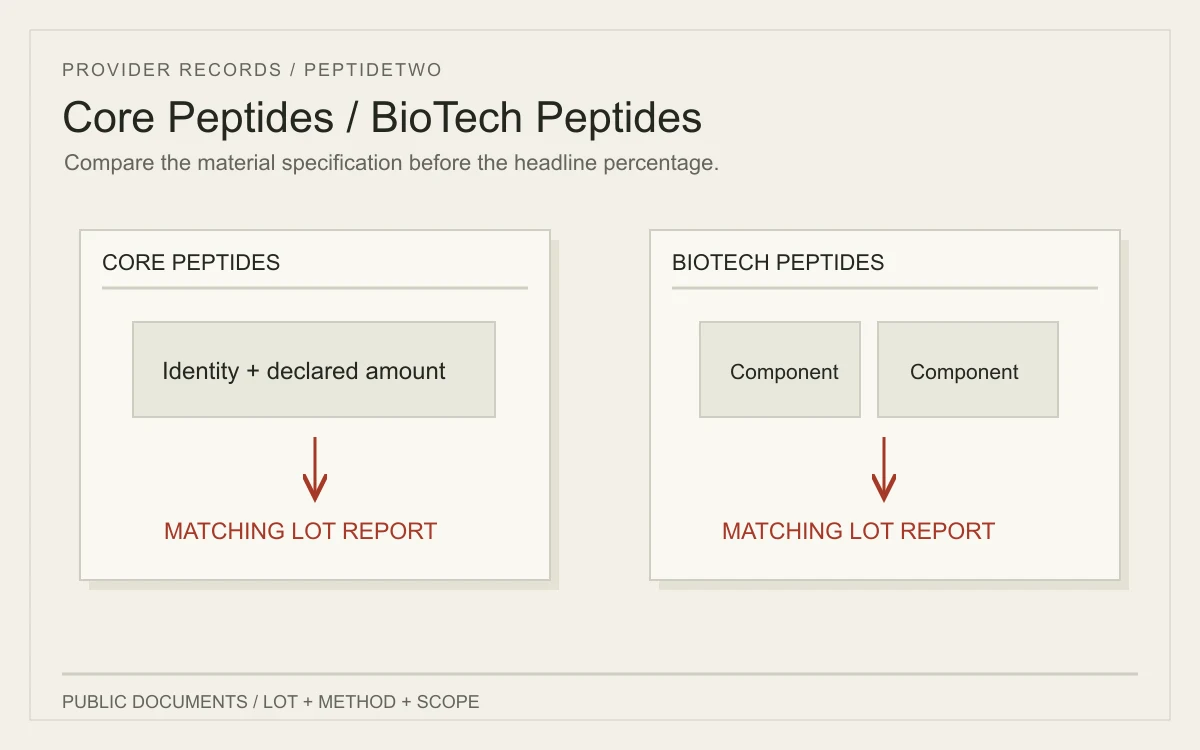
Core Peptides vs BioTech Peptides should begin with the material specification, not a purity slogan. Both websites describe research peptides and testing, while their catalogues include individual compounds and blends. A meaningful comparison needs the same molecular identity, component amounts and document scope on both sides.
This review separates what each company publishes from what would require a laboratory sample, an authenticated current-lot record or an actual transaction. It also keeps customer-service terms separate from chemical evidence.
Review scope: Public website information checked on November 6, 2026. This is a documentation comparison, not an independent product test, transaction test or endorsement. No affiliate links or paid placements were used in this series.
Core Peptides vs BioTech Peptides at a glance
Scroll horizontally to read all columns.
| Field | Core Peptides | BioTech Peptides |
|---|---|---|
| Catalogue context | Research peptides and peptide blends | Research catalogue includes individual compounds and blends |
| Published testing description | Company page describes independent batch testing and product-page COAs | Company page describes HPLC, MS and COA-based testing |
| Batch question | Which posted certificate matches the current lot? | Which available report matches the selected product and lot? |
| Policy starting point | Shipping, Returns & Refunds page | Shipping page with returns and damaged/missing-parcel sections |
| Independent findings in this article | No physical sample or transaction tested | No physical sample or transaction tested |
What the testing descriptions do and do not establish
Core’s company page says tested-batch certificates are published on product pages and describes independent laboratory testing. BioTech’s company page discusses HPLC, mass spectrometry and COA evaluation. Those pages are sources for the companies’ claims, not third-party verification performed by PeptideTwo.
Inspect the actual report for the chosen lot. Determine whether an HPLC result is a relative area percentage, whether an identity method is stated and whether a quantitative amount was measured. Do not infer a content assay from a high purity headline. The purity versus content explanation covers that distinction.
Single compounds and blends need different comparisons
For a single compound, preserve its full molecular name, fragment or analogue description and declared amount. For a blend, preserve the component list and the stated amount of each component. A shared total mass is not a matched specification when the constituents differ.
As a purely arithmetic example, a declared mixture of 4 mg of component A and 6 mg of component B totals 10 mg. Another 10 mg mixture with different constituent amounts is not the same record. These are invented amounts to illustrate a reading problem, not product claims or suggested research quantities.
A blend report should also make clear what the method can distinguish. A result for one component does not automatically quantify every constituent. Keep the identity framework and the mass-spectrometry guide alongside the catalogue comparison.
The published return policies differ
Core’s policy describes cancellation before shipment and a refund-request process. BioTech’s shipping page says it does not accept returns and separately describes how it addresses damaged or missing packages. These are different policy structures; neither establishes that a particular claim has been accepted or resolved.
Distinguish a cancellation, a return of material, a damaged-parcel replacement and an analytical-quality complaint. They may have different evidence requirements and conditions. Save the applicable policy version with the date of a quote or transaction record instead of relying on a general impression of customer service.
Compare complete order information without a checkout test
The amount shown on a catalogue card may refer to one size in a range. Confirm the selected quantity and pack count, then record the currency, mandatory charges and delivery destination. Shipping eligibility, processing and carrier transit belong in separate fields.
We did not verify stock at checkout, submit payment or test dispatch performance. Published cut-off times are therefore treated as policy statements, not measured service results. A discount or a delivery promise cannot substitute for a matching material record.
Use a two-column evidence record
Place the product specification first, the matched lot report second and the relevant policy third. Mark an unresolved field explicitly. This produces a defensible comparison even when the public information differs in detail, without collapsing every question into a single rating.
For a document-access comparison, see Blue Sky Peptide versus Core. For product-tier and processing differences, see Limitless Biotech versus Core. The COA comparison guide provides the common batch-record checklist.
Follow the component and lot questions in more detail
Use the Core Peptides COA checklist for product-page reports and the BioTech Peptides blend worksheet for component identity, quantity and sampled stage. These guides explain why the same report field should not be assumed to answer every question about a single compound or a mixture.
For adjacent comparisons, Peptide Sciences versus Core Peptides covers the historical-record problem, Core Peptides versus Peptide Warehouse separates US and Canadian record questions, and BioTech Peptides versus The Peptide Labs examines report access and content definitions.