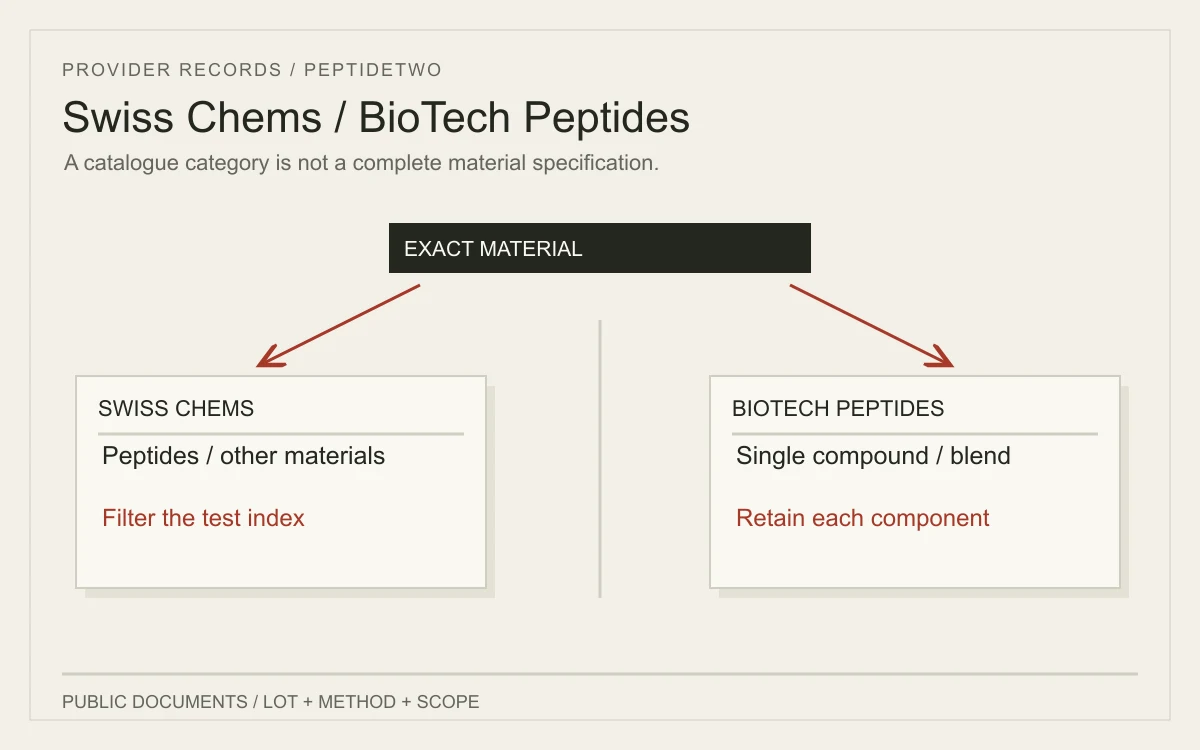
Swiss Chems vs BioTech Peptides is a comparison of specific product records, not two interchangeable catalogues. Swiss Chems presents peptides alongside other research-product categories and formats. BioTech Peptides presents individual research compounds and peptide blends. Start by deciding which exact material is being compared.
A compound name, capsule listing, blend label or vial presentation can change the documentation question. This review does not infer biological effects, interchangeable use or appropriate administration from any of those formats.
Review scope: Public website information checked on November 6, 2026. This is a documentation comparison, not an independent product test, transaction test or endorsement. No affiliate links or paid placements were used in this series.
Swiss Chems vs BioTech Peptides: the document map
Scroll horizontally to read all columns.
| Field | Swiss Chems | BioTech Peptides |
|---|---|---|
| Catalogue structure | Multiple research-product categories, including peptides and non-peptides | Research peptide catalogue with individual compounds and blends |
| Public testing information | Searchable test-results directory | Company page describes HPLC/MS and COA evaluation |
| Lot-specific follow-up | Quality policy says lot-specific COAs are available on request | Request the report matching the exact material and lot |
| Policy review | Separate quality-claim policy and requirements | Shipping page addresses returns and parcel issues |
Filter a broad catalogue before making a comparison
The Swiss Chems homepage includes categories beyond peptides. Its test-results directory also lists different kinds of research materials. The existence of a report elsewhere in that directory does not establish evidence for the peptide, salt or format under discussion.
BioTech’s catalogue includes both individual compounds and blends. Record each component of a blend rather than shortening it to the most recognizable name. A report must address the material actually described, not merely share a word with its label.
Preserve fragments and molecular forms as well. The TB-500 versus thymosin beta-4 identity guide illustrates why familiar naming can conceal a materially different molecular question. It is an identity example, not a recommendation for a product.
Read a test directory as an index
A public index makes it easier to discover a document. It does not, by itself, confirm the current supplied batch, who submitted the sample or whether the measurement answered the intended research question. Match the report identifier, material description, date and lot before using its result.
For BioTech, the company information page is a source for its analytical-testing claims. For Swiss Chems, the searchable directory is a document-discovery source. Comparing these presentation models is legitimate; treating either presentation as independent authentication of all products would go beyond this review.
A quality-claim policy has a defined scope
The Swiss Chems quality-assurance policy describes lot-specific COAs on request and a process for analytical-quality complaints. It also states conditions for the evidence submitted with a claim. Read the complete conditions rather than treating a headline purity guarantee as an unconditional outcome.
BioTech’s shipping page discusses returns and damaged or missing parcels. A parcel remedy is not the same as an analytical dispute procedure. Keep those categories separate when evaluating the information a laboratory might need to retain.
Purity, identity and content belong in separate rows
Different questions require different evidence. A peak-area percentage describes a chromatographic signal under a method. An identity assignment concerns the analyte. A quantitative content result concerns an amount on a stated basis. A marketing phrase such as “tested” does not supply all three automatically.
The COA comparison guide provides a report-matching workflow. The mass-spectrometry guide explains structural evidence, and the purity versus content guide covers quantitative interpretation. None establishes that a catalogue material is authorized or suitable for human or veterinary use.
A useful outcome is a complete material record
Choose a matched specification, identify the actual report, note the tests performed and save the applicable policy. If one field remains unresolved, retain the unanswered question. This is more informative than selecting a winner from unrelated catalogue entries or comparing the largest purity numbers without their methods.
For a comparison with a narrower shared catalogue context, see Core Peptides versus BioTech Peptides. The provider website overview describes other public document-access models.