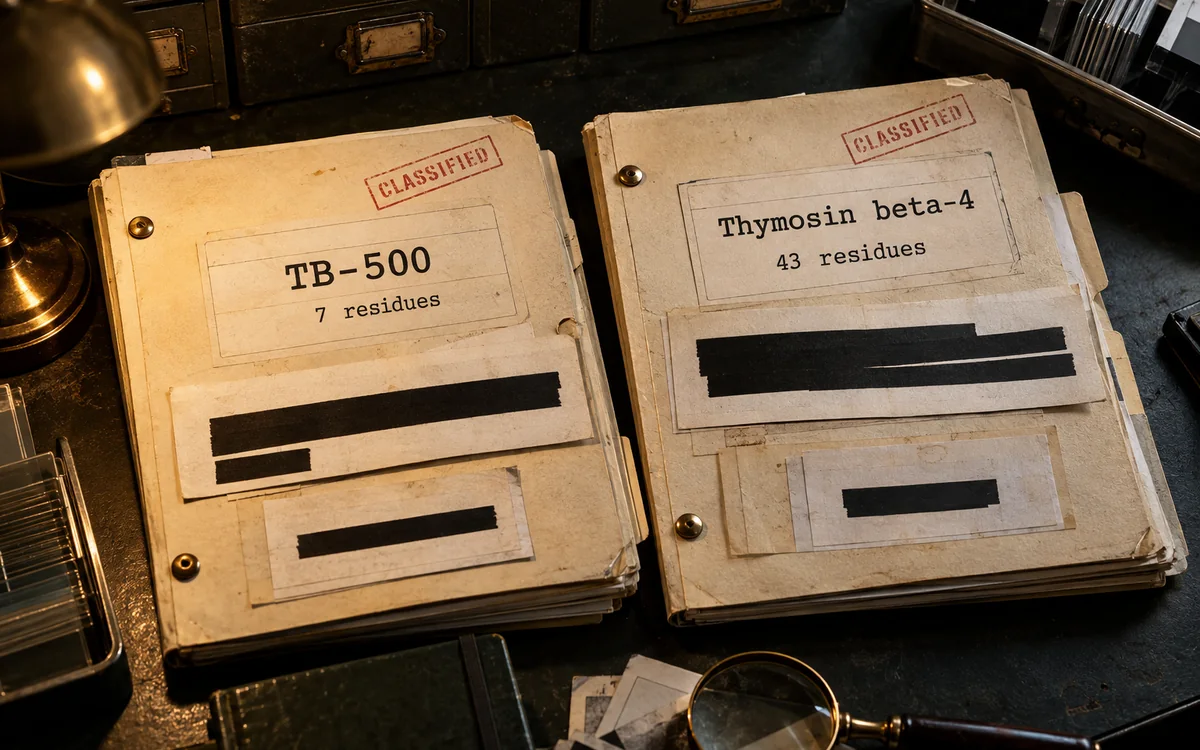
TB-500 and full-length thymosin beta-4 should not be treated as synonymous molecular identities. The FDA material used here distinguishes an acetylated short fragment from the 43-residue full-length peptide. That difference matters whenever a paper about one is cited to support a claim about the other. Start with the sequence and terminal chemistry, then follow the actual experimental material through the evidence.
The short answer
TB-500 and full-length thymosin beta-4 should not be treated as synonymous molecular names. The FDA record used in this archive identifies TB-500 as an N-terminally acetylated seven-residue fragment, while full-length thymosin beta-4 contains 43 amino acids. The distinction changes which studies can directly support a claim about the material.
What the names can hide
Commercial and informal terminology does not always follow a single molecular definition. A title may use a familiar abbreviation while the methods section specifies a different sequence or preparation. For a reader, the solution is to treat the name as a search aid and the documented molecular identity as the basis for comparison. If the identity cannot be resolved, the uncertainty should remain visible.
A comparison of the records
Scroll horizontally to read all columns.
| Feature | TB-500 definition used here | Thymosin beta-4 |
|---|---|---|
| Molecular scope | Acetylated fragment | Full-length peptide |
| Residue count | 7 | 43 |
| Identity question | Does documentation specify Ac-LKKTETQ? | Does the study specify full-length Tβ4? |
| Evidence transfer | Requires fragment-specific evidence | Does not automatically validate the fragment |
A shared region is not an equivalence study
A fragment can contain a region of biological interest without reproducing every property of its parent molecule. The surrounding structure, terminal chemistry and experimental context remain part of the question. To claim equivalent effects, evidence must address equivalence rather than merely demonstrate that two names are historically related. This is a reasoning requirement, not a judgment that the two must always behave differently.
Follow a claim through four checks
First, identify the exact substance in the original paper. Second, identify the model: purified system, cells, animals or people. Third, identify the endpoint and comparator. Fourth, compare that combination with the material and outcome named in the claim. A mismatch at any step does not necessarily make the paper wrong; it makes the claim less directly supported by that paper.
What an analytical certificate can add
A certificate of analysis can contribute evidence about the tested sample, but its scope matters. A percentage labeled purity is not a complete molecular identification. Read the method, the reference material, the sample or lot identifier and the reported limitations. Mass-spectrometry evidence and chromatographic evidence answer related but distinct questions.
What regulatory records mean
A substance database entry identifies an entity; an advisory-committee briefing discusses a regulatory question. These should not be presented as approval of a commercial product. A dated regulatory document also needs a date in the summary so that subsequent decisions are not silently ignored. The purpose of a source link is to let the reader inspect that scope rather than rely on an official-looking badge.
Reconstruct the molecule behind the abbreviation
The TB-500 definition discussed in the cited regulatory material concerns Ac-LKKTETQ, an N-terminally acetylated seven-residue fragment. Full-length thymosin beta-4 contains a longer surrounding sequence. The fragment’s new termini and the absence of the rest of the chain mean it is a different molecular object, not simply a shorter spelling of the same name.
Informal naming can be inconsistent. When a source says TB-500 without stating the structure, do not infer the identity from a different seller’s page. The uncertainty should stay in the record. A paper’s methods, a substance record and an analytical sample description can help resolve which material was intended and which was tested.
A shared sequence region may motivate a hypothesis about activity. It does not establish equivalent folding, interactions, exposure or clinical outcomes. Those are empirical questions. The useful first conclusion is an identity distinction, before any benefit comparison is attempted.
Trace one recovery claim all the way back
Suppose a secondary article claims that TB-500 improves a recovery outcome and cites a full-length thymosin beta-4 experiment. First identify the cited material. Then identify the model and measured endpoint. If the experiment used another molecule or measured a cellular process, both gaps belong in the summary. Neither is repaired by repeating that the fragment contains a biologically interesting region.
A chain of several citations can also end at the same original experiment. Count the underlying studies, not the number of pages repeating the claim. A review of full-length research does not create fragment-specific human evidence merely by using the names loosely.
What analytical evidence could resolve, and what it could not
A suitably designed identity assessment can contribute evidence that a sample matches a stated fragment or full-length structure. The sample identifier, spectrum, chromatogram and assignment matter more than a generic purity badge. A result for one submitted sample also needs a lot link before it is assigned to a material being discussed elsewhere.
The mass-spectrometry guide explains why intact mass and sequence-related evidence have different limits. The modification guide explains why termini belong in the proposed identity. Those methods address the molecule in the sample. They do not establish a recovery benefit or a safe human use.
This is relevant when comparing research peptides online: a correctly identified fragment can still have a limited biological evidence base. Chemical verification and clinical validation should be written as separate conclusions.
Read an official record according to its actual purpose
A substance identifier helps distinguish a chemical entity. An advisory-committee document evaluates a defined regulatory question at a particular date. Neither should be presented as approval of an online product. The 2026 FDA discussion also emphasizes problems caused by conflated common names and related but distinct substances.
The article’s central comparison therefore remains structural and evidential. If a claim concerns the fragment, require fragment-specific support. If it concerns full-length thymosin beta-4, preserve that identity. If the source does not resolve the name, say so rather than manufacturing certainty from a familiar acronym.
Questions worth asking before sharing a summary
Does the cited study use the same sequence? Is the reported effect a cellular observation or a clinical outcome? Is a result for the full-length molecule being assigned to the fragment without explanation? Can the reader trace the material to a primary source? A summary that answers these questions is more useful than one that repeats a long list of possible benefits without establishing which molecule was tested.
How to record an unresolved commercial name
If a source gives only the name TB-500, write the name exactly as presented and add that the complete structure was not supplied. Preserve the date and source. Then request the sequence, terminal chemistry and sample-specific analytical assignment relevant to the comparison. Do not silently replace the missing structure with Ac-LKKTETQ or with full-length thymosin beta-4.
The uncertainty may be resolved later by adequate documentation. Until then, the biological claim should remain conditional on the material identity. This prevents two errors at once: assuming that an ambiguous label confirms the fragment, and assuming it confirms the full-length peptide. Neither conclusion follows from the label alone.
A reviewer can then see precisely why a cited paper may not be applicable. The problem is the unverified link between the named material and the studied molecule, rather than an unexplained distrust of the source. That is a concrete issue another reader can investigate.