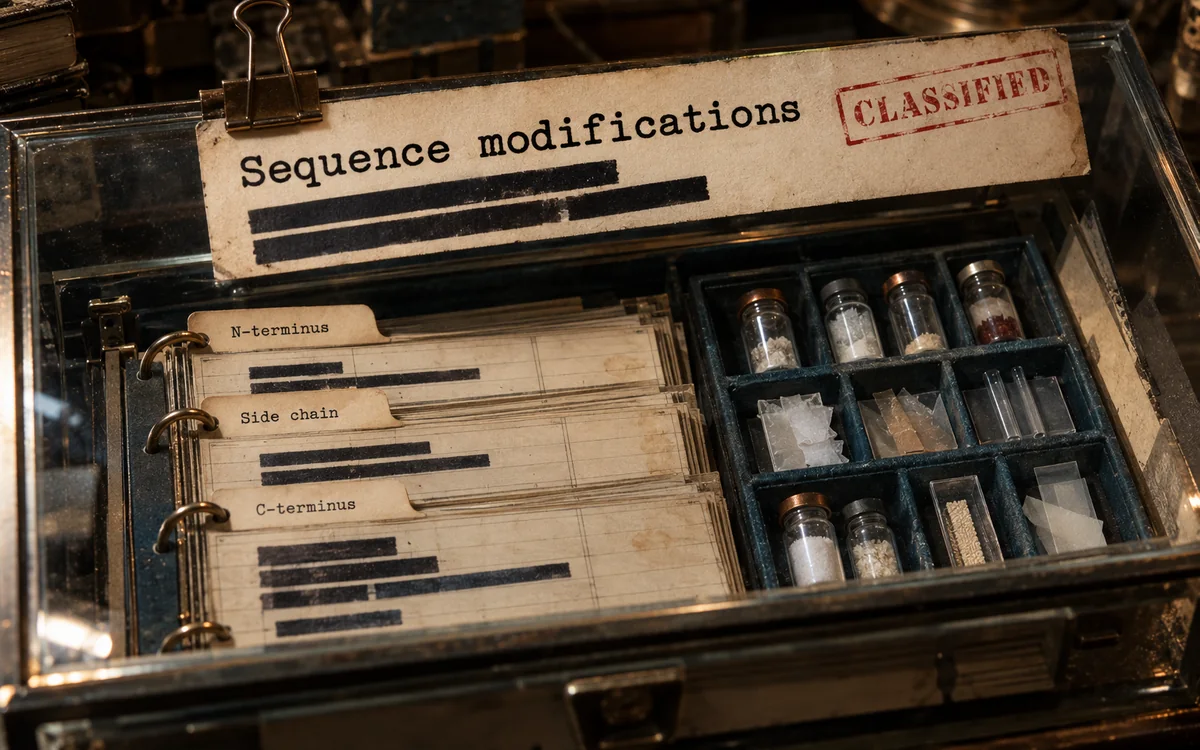
A peptide name is a useful index; a structure is a more precise identity record. Amino-acid order, terminal groups, stereochemistry and links or conjugates can change what molecule a source actually describes. Comparing studies therefore starts with the complete stated structure, not the shared nickname. An intended sequence also remains distinct from analytical evidence that a particular sample matches it.
Peptide sequence modifications: read the structure first
Most peptide sequences are written N to C. One-letter or three-letter residue abbreviations summarize the order, while naming conventions describe terminal groups and derivatives more precisely. IUPAC nomenclature recommendations define these terms. A reader should write down the exact sequence presented in the primary paper and check whether a commercial shorthand omits terminal changes. An inverted order or single-residue substitution is a distinct structure, even if the two names look related. Start with our peptide research primer if these conventions are new.
Check the N and C termini
Acetylation or another cap at one terminus, amidation at the other, or a free terminal group changes the molecular formula and often the behavior of a peptide. A study may specify these details in the methods or supplementary material rather than the title. Do not infer them from a nickname. Terminal modifications should be part of the mass calculation and identity interpretation. When an analytical report supplies only an expected mass, inspect which terminal structure was assumed; mass-spectrometry interpretation begins with that specification.
Look for links, cycles, and conjugates
A disulfide bridge, lactam cycle, lipid side chain, or other conjugate changes more than the number of residues. It may affect conformation, solubility, detection, or exposure in the model being studied. Even when two molecules share a core sequence, a finding for the modified form is not automatically evidence for the unmodified form. A striking example is the difference between full-length thymosin beta-4 and a fragment called TB-500. The appropriate comparison requires full structural and analytical detail.
Separate a proposed structure from an observed sample
A sequence listed in a paper states what investigators intended to study. Evidence about the supplied sample requires relevant analytical characterization. Mass spectrometry, chromatography, and other techniques answer different questions; none is a universal certificate of all attributes. The FDA analytical-method guidance is useful for distinguishing identity from purity, strength, and potency. The COA guide shows how to follow those tests to a specific lot.
Read terminal groups as part of identity
A free amino terminus and an N-terminal modification are different structural descriptions. So are a free carboxyl group and an amidated C terminus. A short sequence written without those details may be incomplete for comparing materials. The source should state the intended terminal chemistry rather than rely on a commercial naming convention.
This becomes important when comparing a peptide fragment with the corresponding region of a larger sequence. The fragment’s terminal groups can differ from the same residues embedded within the full chain. Shared residue order does not establish identical structure or reproduce the full-length molecule’s biological context.
Distinguish the chain from an attached component
Cyclization, disulfide connectivity, lipid attachment and other conjugation can add structural information beyond a linear amino-acid list. A sequence match may therefore be necessary for comparison while remaining insufficient. The identity record should show the modification and where it is attached when that is known.
Counterions and complexes raise another question. A salt description concerns associated chemical species and reporting basis; a metal complex may involve coordination chemistry that requires its own description. Neither should be treated as a decorative suffix. The acetate-versus-TFA article and the peptide dossiers provide examples of why the additional label matters.
A practical structure comparison without guessing the missing fields
Make two columns and copy only what each source actually states: sequence, termini, stereochemistry, connectivity and conjugate. Mark an unstated field as unstated. Do not complete a paper’s missing structure from an unrelated catalog that happens to use the same short name. That would create a composite identity no source supplied.
Then identify the analytical evidence for the sample. Intact mass may support some assignments while leaving same-mass alternatives open. Fragmentation can add information about sequence or modification placement under a suitable method. A claim about stereochemistry or connectivity may require additional evidence. The method should match the ambiguity.
For someone investigating a peptide online, this process is more useful than collecting synonyms. It reveals whether two records describe the same proposed molecule and whether the tested sample was characterized adequately for the comparison. Only after that should the biological result be compared. A common fragment or receptor target cannot fill a missing identity record.
Compare studies using a structure-first record
For each source, record the full sequence, modification sites, termini, stereochemistry when stated, salt or counterion, formulation, analytical evidence, and the experimental model. Mark unknowns explicitly. This avoids false equivalence between papers that share a familiar name but test different structures. A structure-first approach also sharpens SEO research queries: search for the exact compound and modification alongside the outcome, rather than treating a broad peptide family as one intervention.
A familiar name with a different structure
Suppose one paper studies a peptide with a free amino terminus and another studies an acetylated analogue with the same core residue order. A search result may abbreviate both with the same family name. For identity and evidence appraisal, write both full structures side by side, including terminal groups and any stereochemical changes. Then ask whether the analytical data and biological endpoints were collected under comparable conditions. Shared residue order does not make the materials identical. This structure-first comparison helps prevent a search-engine snippet from collapsing related but distinct molecules into one evidence base.
Check the complete molecular description
- Does the primary paper give the full sequence and terminal groups?
- Are the same stereochemistry and modifications present in both compared materials?
- What analytical evidence connects the proposed structure to the tested sample?
Questions about sequences and modifications
Why is the same peptide nickname insufficient for comparison?
A nickname may omit terminal groups, sequence substitutions, stereochemistry, linkages, or a conjugate. Those differences can change molecular identity and measured behavior. Use the complete structure from the primary methods and analytical record rather than relying on a search snippet or label.
Do fragments inherit evidence from a full-length peptide?
No automatic inheritance is justified. A fragment shares only part of the parent sequence and may have different structure, exposure, or behavior. Any claim about a fragment needs direct evidence for that specified fragment and endpoint. This is why TB-500 and full-length thymosin beta-4 require separate evidence records.
What should be included in a structure-first note?
Record residue order, N and C termini, stereochemical details when specified, cycles or disulfides, conjugates, salt or counterion, and the identity method. Add the paper’s experimental model and endpoint. Unknown features should remain marked unknown rather than inferred from a familiar name.