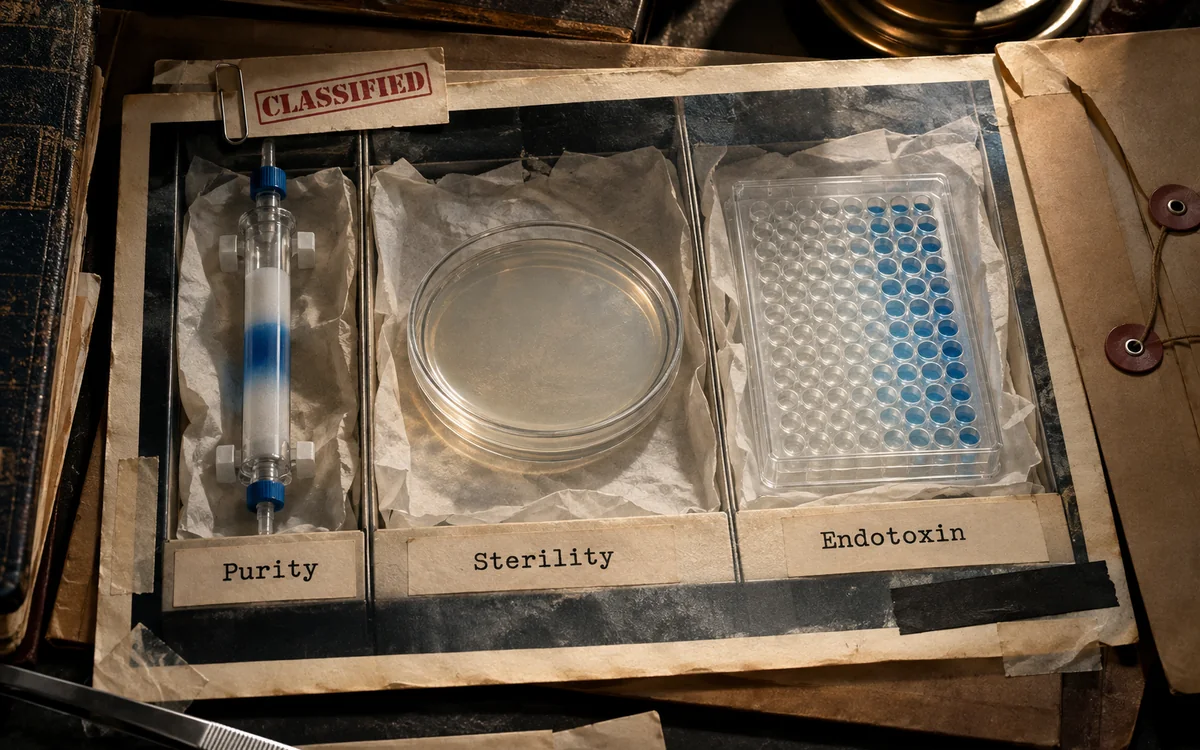
Chemical purity, sterility and bacterial endotoxin testing ask different questions. A chromatographic percentage cannot answer all three, and a clear-looking solution cannot replace any of them. Read the method and sample link behind each claim, then identify what was not tested. Even several satisfactory test results do not establish a preparation’s clinical suitability or substitute for the controls required for a regulated product.
Chromatographic purity is method-specific chemical information
A chromatographic result describes detected components under a specified separation and detection method. Its percentage may reflect relative integrated signal rather than absolute peptide content. Microbial contaminants and pyrogenic material are not established absent simply because the displayed trace looks clean.
Our HPLC purity versus content guide explains the chemical measurement. The FDA analytical-method guidance reinforces the need to match a method to its intended question. A method's technical sophistication does not make it a universal test.
Sterility addresses a different type of evidence
Sterility testing concerns viable microorganisms under the conditions and limits of the test. It forms part of a wider manufacturing and control framework; it is not a complete guarantee about every unit under every future handling condition.
The FDA production-controls discussion distinguishes sterility testing from broader process and microbial controls. That matters because a test result is evidence about the tested sample and validated procedure. It cannot repair an unknown manufacturing history or establish that unrelated handling preserved the same condition.
Endotoxin is not the same as a living bacterium
Endotoxin-related concerns can remain distinct from whether viable organisms are detected. A negative result on one question should not be used as the answer to another. Pyrogen is also a broader category than bacterial endotoxin, so the terms should not be used as perfect synonyms.
Scroll horizontally to read all columns.
| Quality question | Typical evidence context | What it does not settle alone |
|---|---|---|
| Chemical purity | Validated analytical separation | Microbial quality |
| Sterility | Appropriate microbiological testing and process controls | All pyrogen concerns |
| Bacterial endotoxin | Validated endotoxin assay | Every possible pyrogen |
| Identity | Structural or other specific evidence | Suitability for a clinical use |
Separating the categories is more useful than searching for one perfect certificate number.
Read a bacterial endotoxin result with its units and limits
The FDA's March 2026 pyrogen and endotoxin testing guidance discusses testing in a regulated-product context. A research certificate should not borrow its authority by displaying the name of a method without the sample and suitability evidence. Keep the reported units, method, dilution and result qualifier together.
For example, “below the reporting limit” has a different meaning from zero. It describes what the test could report under its conditions. If two certificates use different units or reporting limits, their negative-looking entries may not be directly comparable. Ask whether the sample matrix was evaluated for effects on the test before treating a result as dependable.
This guide does not supply an acceptable endotoxin threshold. The relevant limit and test strategy depend on the regulated product and its intended context; copying a number from an unrelated certificate would hide those assumptions.
Four statements that need different follow-up
Scroll horizontally to read all columns.
| Statement on a page | Useful follow-up | Conclusion to avoid |
|---|---|---|
| 99% purity | Obtain the chromatographic method and calculation basis | Therefore sterile |
| Sterility test passed | Check tested sample, method suitability and sampling/control context | Every container remains sterile after any handling |
| Endotoxin not detected | Check units, reporting limit and matrix suitability | No pyrogen of any kind is present |
| Identity confirmed | Inspect the structural assignment and sample trail | Clinically safe or effective |
When the report and the material have different histories
A lot may be tested before repackaging or other downstream work. If later material is discussed using the original report, document that relationship and identify the intervening events. Do not silently describe the earlier test as a measurement of the later container. This is a provenance question even when nobody disputes the laboratory's original result.
Use the sample traceability guide to connect the report to the physical record. A careful reading may end with different confidence for different attributes: a well-linked identity measurement, a clearly defined chemical-purity result, and an unresolved microbiological question. Keep all three visible.
Why multiple satisfactory tests still have a scope
Combining identity, chemical and microbiological results can provide a richer description of the tested sample. It does not establish the outcome of a clinical intervention or validate a preparation procedure. Stability over time, packaging and manufacturing controls are further questions. The tests should answer their own purposes before they are combined into a broader claim.
In a research note, give each attribute its own line: sample identifier, method, result with units, date and the conclusion supported. Mark an unreported attribute “not reported in the supplied record.” That wording avoids both assuming it passed and claiming it failed. The documentation template gives these observations a place beside their source files.
For the full certificate-reading sequence, start with how to read a peptide COA. For chemical quantities, continue with HPLC purity versus peptide content. These questions can share a document while requiring different evidence.