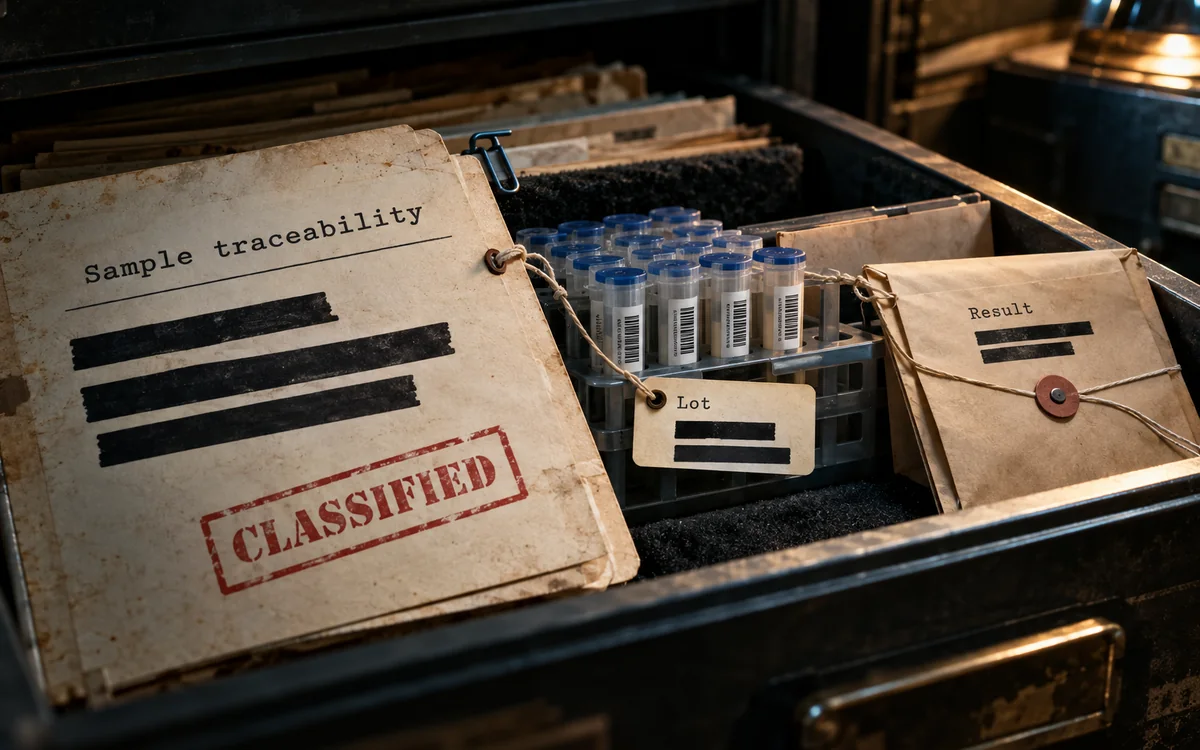
Sample traceability connects the material received with every derived sample, analytical file and final result. A batch number is one link, not the whole chain. The record needs to preserve what was received, how later identifiers relate to it and which measurement supports the quoted conclusion. That makes a discrepancy investigable even when filenames, staff or software have changed.
Research sample traceability: give every material an identifier
Record the source, received description, lot or batch identifier, date, container, and any relevant handling history. If the source uses a different identifier, maintain a cross-reference rather than replacing the original. An aliquot or derived sample should be linkable to its parent, with the reason and date of creation. This is a data-management principle, not a handling protocol. The COA guide explains how a certificate becomes meaningful only when it can be matched to the correct lot.
Connect each measurement to its method
A result should point to the instrument or source file, method name and version, reference information, sample preparation record, date, and analyst or responsible role where appropriate. Keep the unaltered original file and a separate processed version. If a chromatographic peak is reintegrated or a spectrum reassigned, document the reason, date, and before-and-after interpretations. The FDA analytical-method guidance shows why method detail is essential to interpreting a reported number.
Preserve provenance without forcing public access
The FAIR Guiding Principles describe findable, accessible, interoperable, and reusable research objects, including their metadata and provenance. FAIR does not mean that every underlying file must be openly released: privacy, intellectual-property, or other access limits can coexist with clear metadata and access rules. The NIH data-management and sharing policy illustrates planning for scientific-data stewardship in its funded-research scope. For an individual project, the immediate goal is that an authorized reviewer can reconstruct the evidence chain.
A worked lot-to-result chain
The following identifiers are invented examples of a record structure. They are not evidence of a received material or a laboratory result.
Scroll horizontally to read all columns.
| Record | Example ID | Link to preserve |
|---|---|---|
| Supplier lot | LOT-X | Supplier description and issued source document |
| Internal receipt | R-01 | LOT-X plus the particular received container |
| Derived sample | S-01A | Parent R-01 and the event creating the new sample |
| Measurement | RUN-01 | S-01A, acquisition file and method version |
| Processed result | AN-01 | RUN-01 and processing settings |
| Issued report | REP-01 | AN-01, conclusion and report revision |
The supplier lot and receipt ID serve different purposes. Several containers may carry the same supplier lot. A laboratory may receive them on different dates or assign separate internal records. Preserve that distinction if a question later concerns one container rather than the whole source batch.
A sample with more than one parent, such as a pool, needs all of its contributing IDs and the relevant event record. Forcing that relationship into a single parent field can hide part of the history. Choose a structure that can represent the work rather than quietly discarding the awkward relationship.
Chain of custody adds events to the identity map
Identity mapping says which records belong together. Custody information records events involving responsibility or location. Where relevant, log who or which role transferred or received the sample, when the event happened and the condition recorded at that point. This is a recordkeeping description, not a handling procedure.
Keep recorded facts separate from assumptions. If an intermediate location or date is unknown, say so. A continuous-looking spreadsheet made from inferred events is harder to investigate than a chain with a visible gap. The research documentation template provides the broader index for observations and corrections.
Investigate a certificate attached to the wrong sample
Suppose S-01A is linked to R-01, but its folder contains a certificate for LOT-Y while R-01 records LOT-X. Do not resolve the mismatch by renaming the PDF. Compare the original receipt record, laboratory-submitted sample ID and report ID. Preserve the discrepancy while the issuer or responsible team checks the source.
If a corrected mapping is confirmed, add the correction and its basis. If it remains unresolved, limit the conclusion: that certificate cannot presently be linked to this sample. That does not prove the laboratory's measurement was wrong; it means the connection to the material in question is missing.
The COA walkthrough helps check the certificate fields. For a revised structural assignment, retain the original acquisition and connect the new interpretation to it using the mass-spectrometry identity record.
Run a traceability check in both directions
Starting from a reported result, find the processed file, acquisition and sample. Then work forward from the received material and list the reports that depend on it. The backward check tests whether a claim has an evidence trail. The forward check helps identify which conclusions may need review after a corrected material description.
Record the result of that check, including missing files or access permissions that prevented review. A preserved link that nobody authorized can open is a different problem from an absent file, so describe it accurately. Keep any concentration calculation attached to its actual input record; the units guide explains which assumptions need to travel with that number.
Save the sample traceability checklist for a lot-to-result review. The calculation and records collection connects the supporting guides.
Apply traceability to supplier transitions and origin claims
The Peptide Sciences alternatives checklist and historical-versus-current record comparison explain how to preserve an older sample's evidence across a supplier change. The Peptide Warehouse Canada documentation review separates an origin statement from a lot chain, and the Core-versus-Warehouse worksheet keeps each candidate's material history independent.