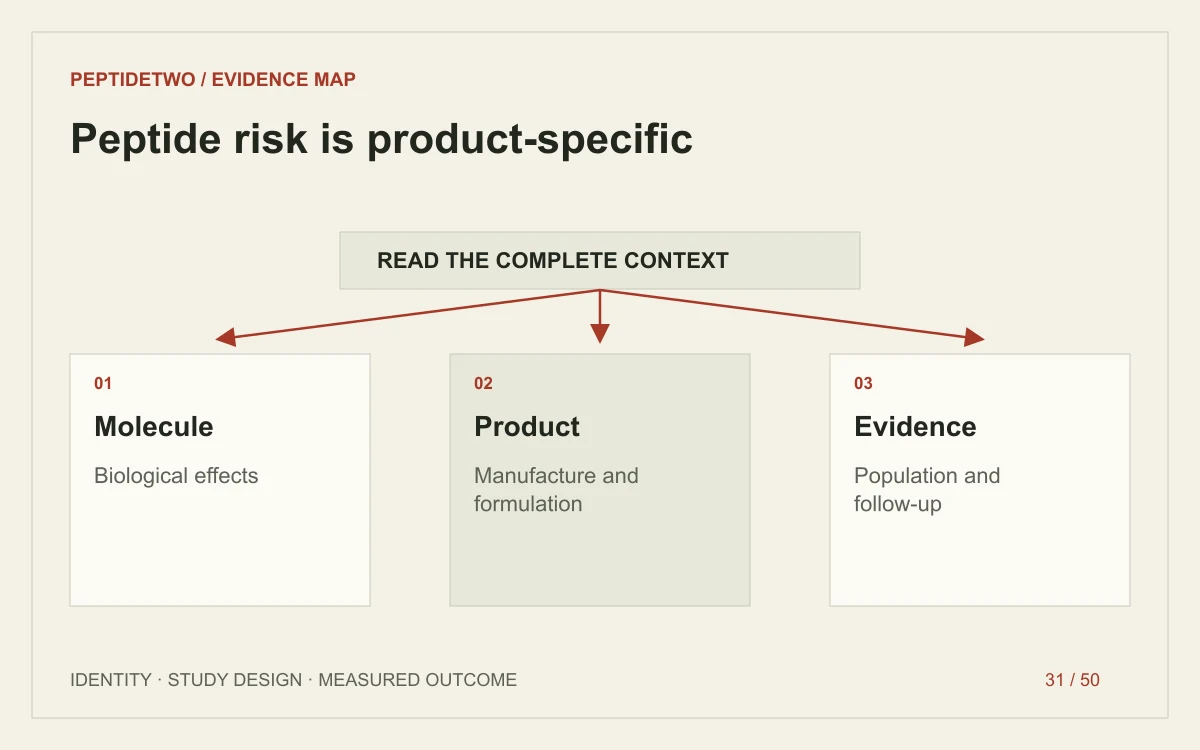
Peptide side effects depend on the exact molecule, finished product, route and person studied. The word peptide covers a broad chemical category. A safety result for an authorized medicine cannot be assigned to an unrelated research sequence, and a reaction to an unauthorized product may involve quality problems as well as the intended ingredient.
Begin with the exact intervention
Health Canada’s overview distinguishes established peptide medicines, cosmetic uses and unauthorized products. Those categories have different evidence and oversight. A general list of “peptide side effects” can conceal more than it explains if it mixes all of them together.
Record the molecule, formulation and route before interpreting an event. A topical cosmetic, an oral hydrolysate and an injectable medicine are not interchangeable exposures.
Separate pharmacological and product-quality questions
Canadian risk guidance describes concerns involving unauthorized products, including incorrect contents and lack of sterility in tested samples. Such concerns are different from adverse reactions characterized for a defined, authorized medicine.
Scroll horizontally to read all columns.
| Question | Relevant evidence |
|---|---|
| What adverse effects were observed? | Trial methods, event tables and follow-up |
| What warnings apply to this medicine? | Its current product monograph |
| Did the product contain the stated material? | Appropriate identity and content testing |
| Were manufacturing and supply controlled? | The applicable quality and authorization framework |
| How common is an event? | A suitable exposure denominator and study design |
A purity percentage does not answer every row. Our purity, sterility and endotoxin guide explains why those tests also address different properties.
Why an event rate needs a denominator
The Ozempic monograph contains safety information tied to its product and clinical programme. A trial percentage belongs to a defined population and observation period. A collection of online reports usually lacks that controlled denominator.
An adverse event is something observed during a study; it is not automatically proven to be caused by the intervention. Randomized comparisons, timing, assessment methods and alternative causes help interpret the relationship.
Short exploratory studies cannot establish long-term safety
The early CJC-1295 studies examined endocrine and pharmacokinetic responses over short periods in selected adults. Their reported tolerability does not supply a comprehensive long-term safety profile for every product sold under that name.
The same reasoning applies when an animal paper reports no visible toxicity. The experiment may not have measured the outcomes, durations or populations relevant to a human concern. An unmeasured outcome is a gap, not a reassuring result.
How to read a safety claim usefully
Look for the exact product, participant criteria, comparator, duration, adverse-event collection and withdrawals. Distinguish an absence of evidence from evidence of absence. Keep source dates visible because product warnings can change.
For a specific example, read Ozempic safety information in Canada; for unauthorized-product context, read research-use labels. This is an evidence-reading guide and does not diagnose a reaction or provide instructions for using research materials.