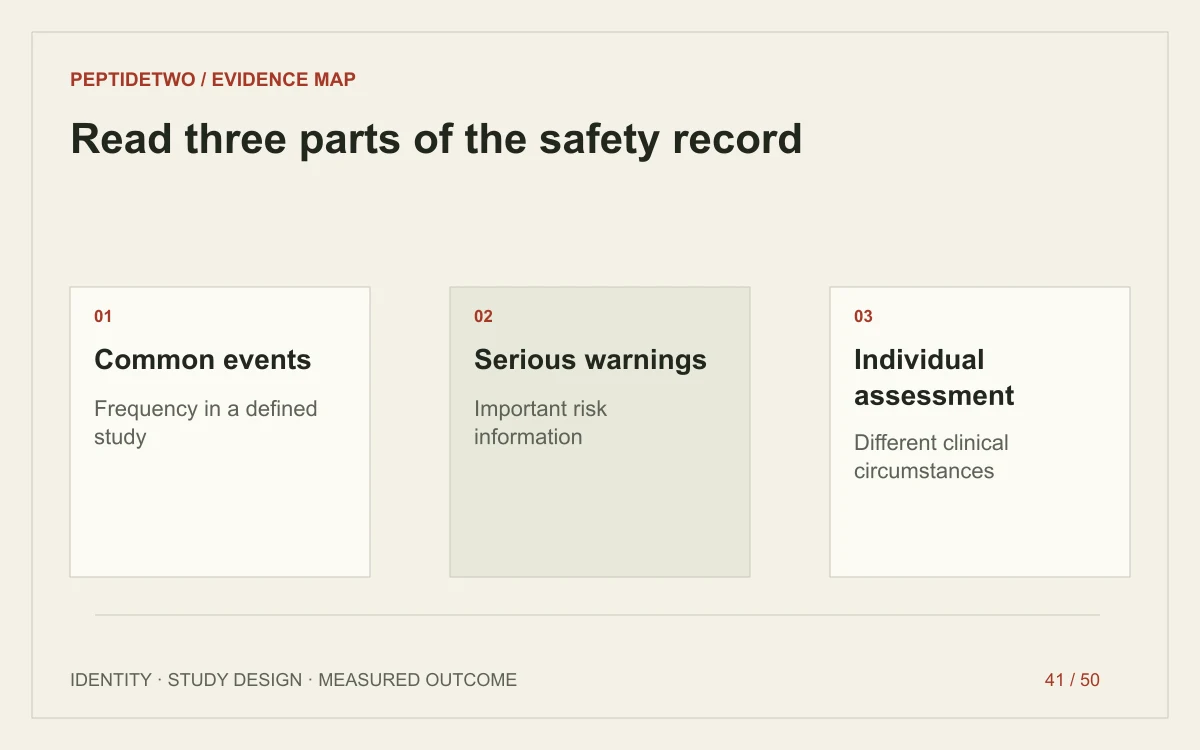
Ozempic side effects should be read from the current Canadian product monograph and the relevant trial, rather than a generic list for every GLP-1 product. Common gastrointestinal events, serious warnings and individual contraindications are different parts of the safety record. A trial percentage belongs to its population and observation period.
Use the current Canadian document
The Ozempic monograph checked for this article is dated July 2026 and includes recent safety-label changes. It lists gastrointestinal adverse reactions such as nausea, vomiting, diarrhea, constipation and abdominal pain, alongside other product-specific warnings and precautions. This article is an overview, not a replacement for the full patient information.
The Drug Product Database is the starting point for current Canadian product information. Search results from another country or an older version can omit updates or use different wording.
Common does not mean identical for everyone
Scroll horizontally to read all columns.
| Part of the record | How to interpret it |
|---|---|
| Adverse-reaction table | An observed frequency in a defined clinical setting |
| Warning or precaution | A risk needing attention even when uncommon |
| Contraindication | A product-specific condition in which the medicine should not be used |
| Postmarketing report | A reported event without a trial-style exposure denominator |
| Individual symptom | Needs clinical context rather than an online cause assignment |
An event occurring during treatment is not automatically proven to be caused by it. Randomized comparisons, timing, background illness and other medicines help interpret the relationship.
Do not borrow every semaglutide trial’s event rate
The STEP 1 study evaluated a particular semaglutide intervention in adults with overweight or obesity without diabetes. Its safety observations should retain that setting. They should not be copied as the exact rate for every Ozempic presentation or every population.
Likewise, duration matters. A short study cannot rule out all uncommon or delayed events. A spontaneous-report database can help identify signals but usually cannot produce the same kind of incidence estimate as a controlled trial.
Some concerns need their own explanation
The site has separate guides on pancreatitis evidence, thyroid-cancer research and hair-loss observations. Each distinguishes the actual study design and product context. A safety warning should not be erased because one study finds no clear increase; an association should not be inflated into proof of causation either.
For an actual new or concerning symptom, use the product’s patient information and appropriate clinical care. Severe or urgent symptoms require timely assessment. This article does not recommend changing a prescription or managing a reaction with an experimental product.
Authorized product and online ingredient are different
Health Canada’s peptide-risk guidance addresses separate quality concerns with unauthorized products. Safety evidence for Ozempic does not authenticate or validate an online research vial labelled semaglutide.
Read Ozempic versus Wegovy in Canada for product identity and generic semaglutide records for the authorized-generic distinction. Keep the exact product and current source date attached to a safety claim.