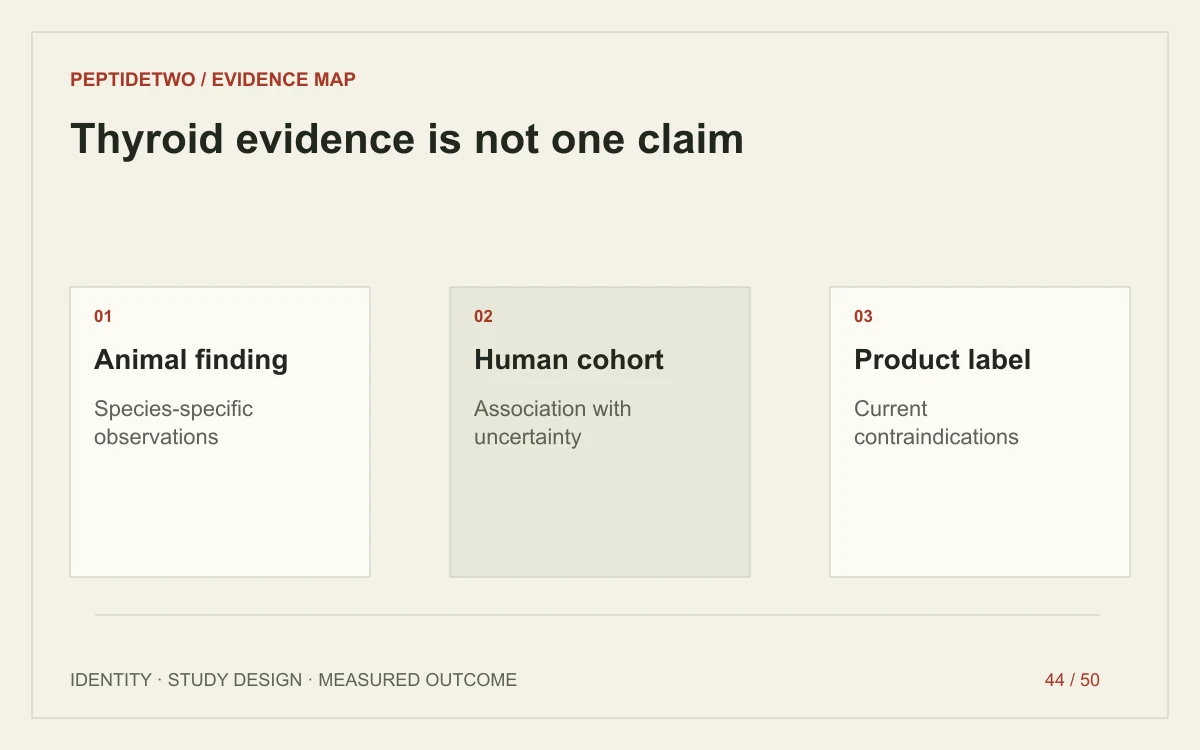
GLP-1 and thyroid cancer involves several different evidence questions. Rodent C-cell findings, human observational results and a medicine’s contraindications should not be collapsed into either “proven cancer cause” or “no risk.” The outcome type, population and follow-up determine what a study can say.
What the Canadian warning says
The current Canadian Ozempic monograph describes thyroid C-cell tumour findings in rodents, uncertainty about their relevance to humans, and contraindications involving personal or family history of medullary thyroid carcinoma or MEN 2. Those product instructions should be retained when interpreting observational research.
A study about overall thyroid-cancer diagnoses is not automatically an answer about every rare thyroid-cancer subtype or every high-risk individual.
The Scandinavian cohort gives a bounded human estimate
The 2024 Scandinavian cohort study compared new GLP-1 receptor agonist users with an active comparator in national data. It reported no substantially increased overall thyroid-cancer risk over a mean 3.9-year follow-up in the GLP-1 group. Its hazard-ratio confidence interval remained part of the result, rather than a guarantee of zero risk.
This was an observational study, not random assignment. The active-comparator design and adjustments help address some biases, but cannot make every unmeasured difference disappear.
Read four distinctions
Scroll horizontally to read all columns.
| Distinction | Why it matters |
|---|---|
| Overall thyroid cancer vs a subtype | Rare subtype estimates can be much less precise |
| Association vs causation | Observational comparisons can retain confounding |
| Mean follow-up vs lifetime exposure | Several years do not resolve every long-latency question |
| Population estimate vs individual decision | A cohort average does not replace product contraindications |
A point estimate below one should not be advertised as proof that the medicine prevents thyroid cancer. The uncertainty and design do not support that shortcut.
Why other cohorts still need careful comparison
A separate retrospective thyroid-tumour study used other data and comparator settings. Different diagnostic definitions, treatment patterns, follow-up and confounder control can affect the estimates. Agreement between studies can be informative without establishing universal certainty.
Surveillance also matters: people undergoing more clinical assessment may have more diagnoses detected. A careful paper explains how it attempts to address that issue rather than treating every recorded diagnosis as a simple causal signal.
How to state the conclusion accurately
The human studies discussed here can inform the population-level question over their observed periods. They do not cancel the current label, establish safety for a contraindicated person or predict decades of exposure. A clear safety summary preserves those limits alongside the reassuring observations.
Read the Canadian Ozempic safety overview and the pancreatitis evidence guide for other examples of warnings and empirical estimates serving different roles. This article does not assess an individual thyroid condition or recommend a prescription decision.