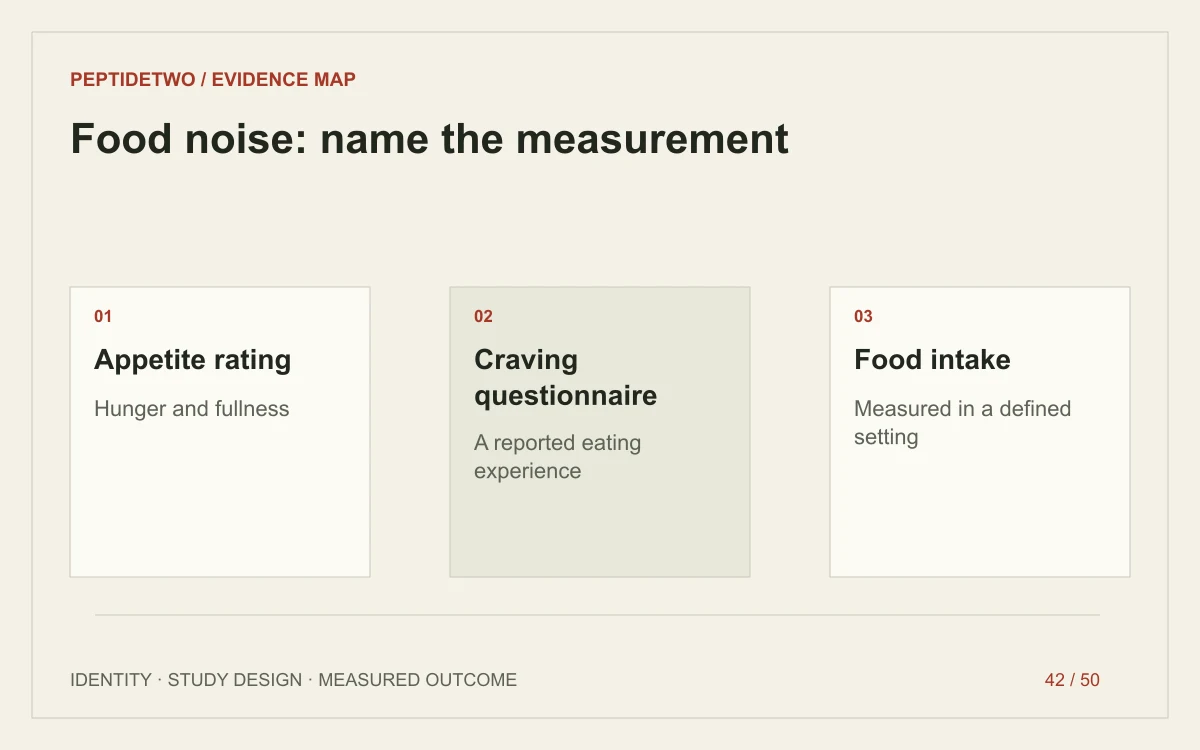
GLP-1 and food noise discussions often mix a familiar everyday phrase with several different research outcomes. A person may use food noise to describe persistent thoughts about food. A trial may instead measure hunger ratings, craving questionnaires, control of eating or intake at a laboratory meal. Those measures overlap without being identical.
What the small semaglutide study assessed
A 20-week randomized study in 72 adults with obesity compared semaglutide with placebo and assessed appetite, control of eating and food intake. It reported lower intake at an ad libitum lunch and favorable questionnaire findings for the tested intervention.
The controlled setting is valuable, but the result is not a prediction that every person will experience the same change in thoughts, appetite or intake in everyday life. A measured lunch and a broad psychological experience are different outcomes.
Use the study’s own endpoint names
Scroll horizontally to read all columns.
| Measure | What it records | Limit on interpretation |
|---|---|---|
| Hunger and fullness ratings | A reported sensation at specified times | Not a complete account of all food-related thoughts |
| Control of Eating Questionnaire | Responses to defined questions | Not a universal diagnostic test for food noise |
| Ad libitum meal intake | Food consumed in that study setting | Not every day’s intake |
| Longer-term weight change | A separate clinical outcome | Cannot isolate every appetite mechanism |
Calling all of these “food noise reduction” can make a headline easy to understand while losing the details needed to judge the evidence.
Appetite and gastric emptying are different mechanisms
The same study also assessed gastric emptying indirectly. Its reported result at the measured time point should not be replaced with the assumption that every appetite finding must be explained by persistent stomach-emptying delay. A symptom, an indirect test and a mechanism hypothesis are separate pieces of evidence.
Read gastric emptying and gastroparesis for the distinction between physiological delay and a clinical diagnosis.
Do not infer a complete weight-loss prediction
The larger STEP 1 trial evaluated a longer-term clinical intervention and body-weight outcome. It does not show that an individual’s self-described food noise can precisely predict their response. Behaviour, environment, tolerability and clinical circumstances can affect the observed course.
Similarly, the absence of a dramatic subjective change does not by itself identify a treatment failure or determine an appropriate adjustment. That would require individual clinical assessment, which this article does not provide.
How to discuss the term accurately
Keep the everyday description alongside the actual measurement. State whether a claim comes from a questionnaire, a meal experiment, a weight-management trial or an anecdote. The product safety information remains separate from a positive appetite result.
For another molecule’s research, read tirzepatide and hunger. For the outcome framework, use clinical-trial endpoints. This guide explains evidence; it does not diagnose an eating disorder, select a medicine or recommend a dose.