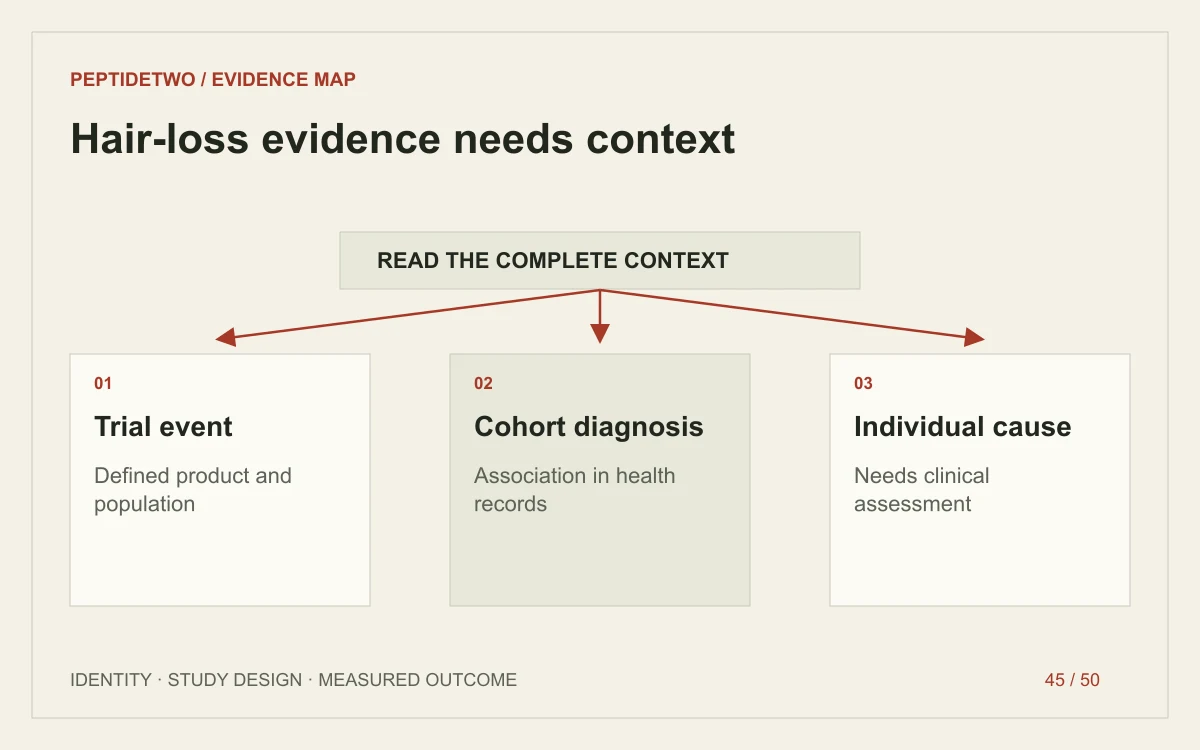
GLP-1 and hair loss is a legitimate research question, but reported events do not establish one cause for every person. Product trials, electronic-health-record cohorts and individual experiences provide different kinds of evidence. Hair-loss subtypes, weight change, underlying conditions and other exposures complicate interpretation.
What a product-event table tells you
The Canadian Zepbound monograph lists hair-loss events in its clinical safety data. Those observations belong to tirzepatide’s product and trial setting. They should not be copied as the exact rate for every semaglutide product or every user.
A trial event table describes what was observed and how groups compared. It may not provide a detailed dermatological diagnosis for every report or isolate the biological pathway responsible.
What the 2026 cohort adds
A 2026 propensity-score-matched cohort examined nonscarring alopecia outcomes among adults treated with GLP-1 medicines in electronic health records. It distinguished outcomes such as telogen effluvium and used comparison groups and follow-up windows.
This design can investigate associations in routine data. It cannot fully eliminate unmeasured confounding, inconsistent diagnostic coding or differences in who seeks care. A recorded diagnosis is not a standardized hair examination performed on every participant.
Keep the outcome types separate
Scroll horizontally to read all columns.
| Outcome | What it measures | Limit |
|---|---|---|
| Reported hair-loss event | An event recorded in a trial | May not establish subtype or mechanism |
| Coded alopecia diagnosis | A clinical record in a database | Depends on coding and healthcare contact |
| Hair diameter | Thickness of measured shafts | Not the same as hair count or shedding |
| Individual clinical assessment | A person’s pattern and context | Cannot be replaced by an average trial rate |
This distinction also explains why a cosmetic study reporting thicker shafts does not establish treatment of medicine-associated shedding.
Weight change is context, not an automatic diagnosis
A change in nutrition or body weight can be relevant to a hair-history assessment, but it should not be assumed to explain every event. Nor does the timing after starting a medicine prove a direct follicular drug effect. Several explanations can coexist and require appropriate evaluation.
The current Ozempic product information remains the relevant safety source for that medicine. This article does not recommend stopping or changing a prescription or treating hair loss with an experimental peptide.
How to read a proposed solution
Ask whether evidence concerns the same hair-loss subtype, population and outcome. A supplement’s general “hair support” claim cannot fill a diagnosis-specific evidence gap. Our collagen hair and nail review separates shaft-diameter studies from broader treatment claims.
For follicle-model research, read peptides and hair growth. For the broader safety context, use Ozempic side effects in Canada. Persistent or concerning hair loss deserves clinical assessment rather than a cause inferred from a search result.