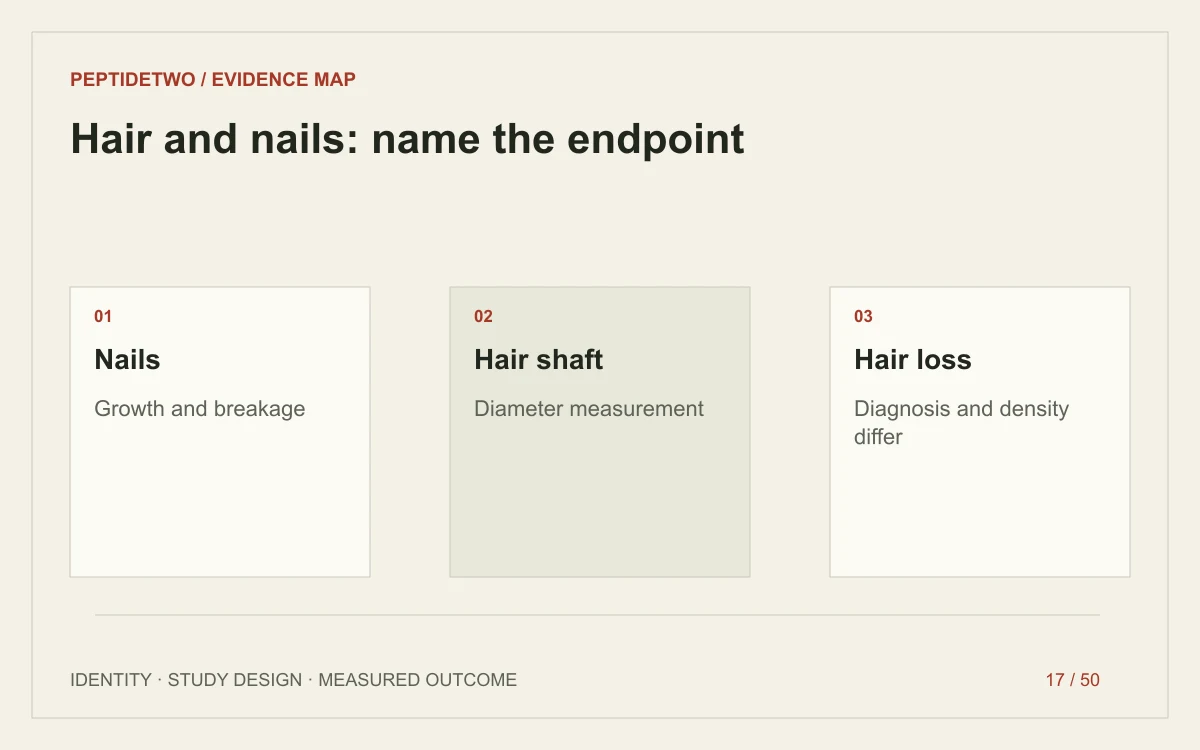
Collagen for hair and nails needs two separate evidence checks. Nail growth and breakage are different outcomes from hair-shaft thickness, hair count or treatment of a hair-loss condition. Human studies exist, but their design and endpoints do not support every claim made under the broad phrase “hair growth.”
The nail study was exploratory
A 2017 brittle-nail study followed 25 participants using a specific bioactive collagen preparation. It was open-label and single-centre, with treatment followed by an observation period. It assessed measures including nail growth and cracked or chipped nails.
Without a blinded placebo comparison, improvement cannot be attributed with the same confidence as in a well-controlled trial. Expectation, changes in nail care and natural variation remain possible explanations. The study is a signal for further research, rather than a guarantee for all collagen products.
Newer hair-diameter evidence asks a narrower question
A 2026 randomized study evaluated a particular low-molecular-weight preparation in 114 women with cellulite and self-reported hair thinning over 24 weeks. Hair diameter was among the reported outcomes, with improvement reported for the tested preparation. The source also describes product-specific pharmacokinetic work.
Hair-shaft diameter is not the same as the number of follicles, a confirmed diagnosis or prevention of every form of alopecia. A study in selected women does not establish identical effects in all ages, sexes or causes of hair loss.
Keep the outcomes separate
Scroll horizontally to read all columns.
| Outcome | What it can describe | What it cannot substitute for |
|---|---|---|
| Nail growth rate | Change in measured nail growth | Every cause of brittle nails |
| Nail breakage | Frequency of cracks or chips | A diagnosis of nutritional deficiency |
| Hair diameter | Thickness of measured shafts | Hair density or follicle count |
| Hair-loss treatment | A diagnosis-specific clinical result | A general cosmetic thickening claim |
A label that merges all four claims should provide evidence for all four. A favorable result in one column is not enough to fill the rest.
Why plausible biology is not the final answer
Collagen-derived peptides have been detected in human blood after selected hydrolysates. That exposure result is relevant to biological plausibility. It does not prove that a person’s hair or nail concern is caused by insufficient collagen, or that changing exposure corrects it.
Combination products create another attribution problem. If several ingredients change together, the study may evaluate the complete formula without isolating collagen’s contribution.
Read a before-and-after claim carefully
Hair length, styling, lighting and image selection can change perceived volume. A credible study should state how diameter or density was measured and whether assessors were blinded. For nails, ask how breakage and growth were recorded and whether the same methods were used throughout.
Read the wider hair-peptide guide for the difference between follicle models and clinical outcomes. The collagen safety guide addresses tolerability and source-related allergy. This evidence review does not diagnose hair loss or recommend delaying assessment of a new or persistent problem.