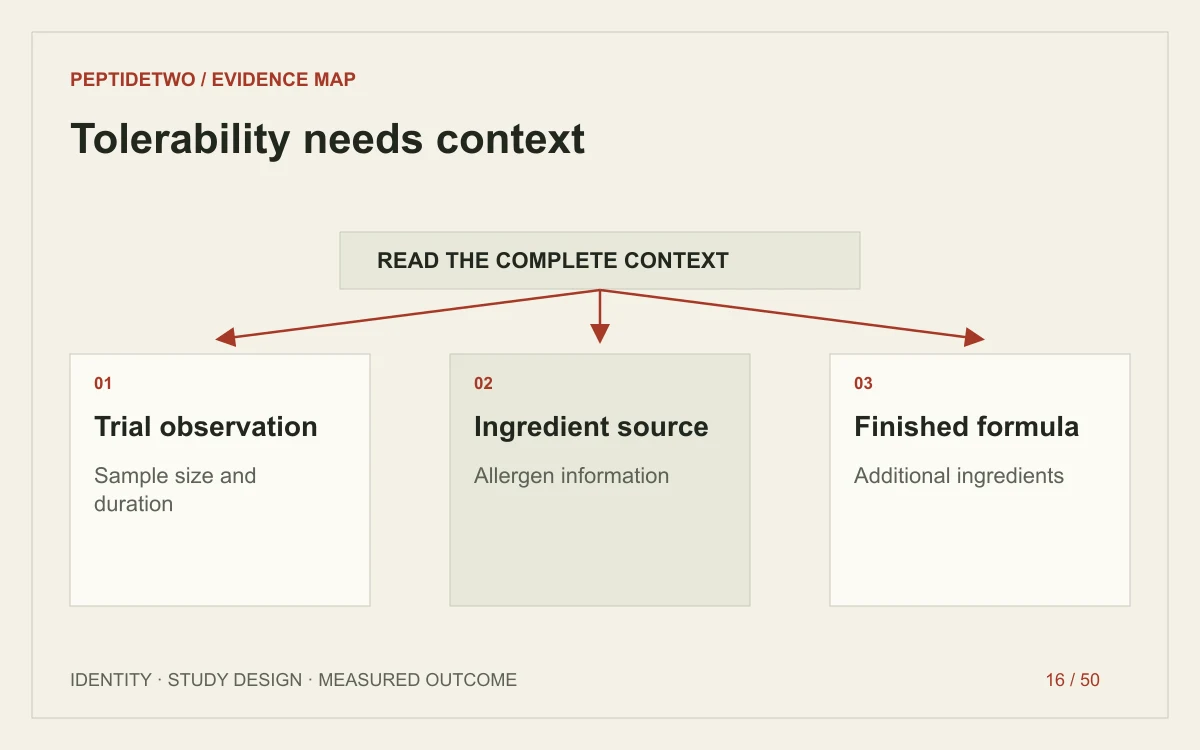
Collagen peptides side effects cannot be summarized with either “completely safe” or a list of unverified internet reports. Controlled trials, case reports and product labels provide different kinds of information. Source species, additional ingredients, participant selection and follow-up all affect what can be concluded.
What a small trial can say about tolerability
The 2014 skin trial reported no observed side effects during its study. The collagen-tripeptide skin study also reported good tolerability in its selected sample. These observations are useful, but small and relatively short trials are not designed to rule out every uncommon or delayed reaction.
“No events reported” should retain its sample and observation window. It is not equivalent to “no one can react.” Exclusion criteria can also remove people whose experience would be important in a broader safety assessment.
Why source-related allergy matters
A published case of anaphylaxis associated with fish collagen shows that hydrolysed or processed collagen should not automatically be treated as non-allergenic. A single case does not establish the frequency of that event in the general population, but it does disprove an absolute no-allergy claim.
The complete product’s ingredient and allergen information matters. A powder may include flavourings, sweeteners or other ingredients. A reaction to the finished product does not, without assessment, identify which ingredient caused it.
Different evidence sources answer different questions
Scroll horizontally to read all columns.
| Source | Useful information | Main limitation |
|---|---|---|
| Randomized trial | Observed events under a defined comparison | May miss rare or long-term harms |
| Case report | A possible reaction and its clinical circumstances | Does not provide a population event rate |
| Consumer review | An individual’s reported experience | No controlled denominator or confirmed cause |
| Product label | Declared ingredients and warnings | Does not replace individual assessment |
Comparing these sources requires care. Ten online reports are not ten events among a known number of exposed people, and a trial’s event percentage should not be attached to an unrelated formula.
What a Canadian product check adds
Where the product is licensed as a natural health product, the Canadian licence record identifies ingredients, recommended conditions and risk information. A food-format collagen product may be classified differently. Read the Canadian label guide before assuming that every product should have the same identifier.
An online “clean” or “natural” label is not a complete safety assessment. Nor does a purity certificate assess every possible allergen, ingredient interaction or manufacturing concern.
Keep an evidence-based safety summary specific
State which preparation was studied, who was included, how long follow-up lasted and how adverse events were collected. Separate an observed reaction from an established causal mechanism. Do not turn the absence of a signal into a guarantee.
People with a suspected reaction need appropriate clinical assessment rather than an online ingredient diagnosis; a severe allergic reaction requires urgent care. For scientific context, read source differences and the skin-trial review. This article does not select a product or a personal supplement regimen.