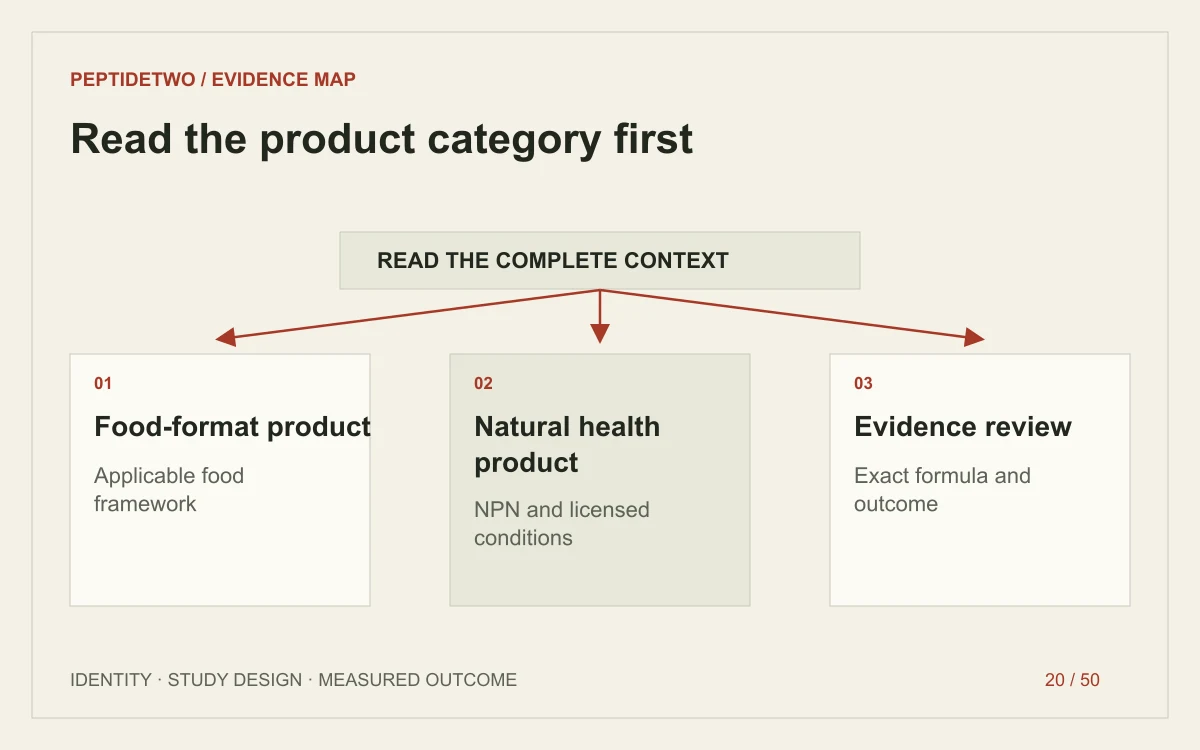
Collagen peptides in Canada can appear in products with different regulatory classifications. Before looking for an NPN, determine whether the item is marketed as a food or a natural health product. The words collagen powder do not, by themselves, decide the category or establish every advertised benefit.
Why product format does not settle classification alone
Health Canada’s food–natural health product guidance considers multiple product characteristics, including composition and representation. A powder format is not a complete classification decision. Claims and the context in which a product is represented also matter.
This prevents a common shortcut: assuming that an item without an NPN is necessarily an unauthorized drug, or assuming that every oral collagen product must have the same licence. Establish the category before applying the identifier rule.
How to match an NPN
For a licensed natural health product, the Licensed Natural Health Products Database provides a record for the eight-digit NPN. Compare the product name, licence holder, medicinal and non-medicinal ingredients, form, recommended use and risk information.
Scroll horizontally to read all columns.
| Label detail | Matching question |
|---|---|
| NPN | Does the complete number resolve to this product? |
| Product and licence holder | Are the names consistent? |
| Ingredients and source | Does the record describe the formula being offered? |
| Recommended use | Is the advertised claim within the recorded conditions? |
| Warnings | Are the relevant cautions presented with the product? |
A number belonging to a different formula is not a valid match simply because both products contain collagen. Keep the date of the lookup because records and formulations can change.
A licence and a research paper are different records
A paper can evaluate a particular hydrolysate and outcome, such as the specific preparation in the skin-elasticity trial. A product licence describes the conditions for that licensed product. Neither record should silently expand the other.
For example, a paper about a skin measurement cannot establish a claim about every hair-loss diagnosis. A product’s general collagen content also does not prove that its peptide distribution matches the material in the paper. Read hair and nail outcomes for that distinction.
Keep ingredient and allergen information visible
Source species and added ingredients belong in the comparison. A published fish-collagen allergy case shows why a source description can be relevant to safety; it does not provide a population risk rate. Flavoured blends also contain ingredients beyond the collagen itself.
The label may answer a composition question that the headline omits. Conversely, a promotional claim may go beyond the label and need additional evidence. Record those as separate observations rather than reducing the review to one approval badge.
A useful Canadian buying-information boundary
This guide explains how to read public product records. It does not rank brands, independently authenticate a package, certify a laboratory result or recommend a supplement regimen. A database match is evidence about a record, not a test of every container sold under that name.
For the evidence behind common claims, read skin outcomes and joint-pain outcomes. For medicine identifiers, the DIN guide explains why an NPN and a prescription-drug identifier belong to different pathways.