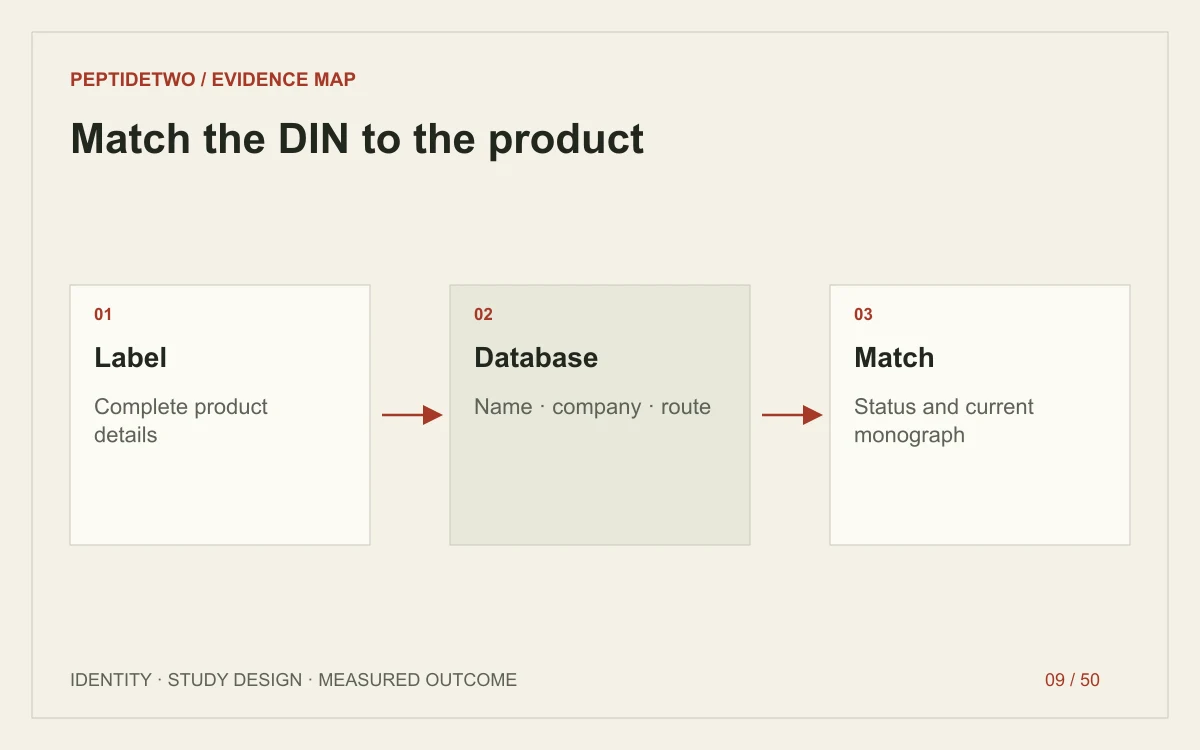
A peptide drug DIN check starts with an eight-digit Drug Identification Number and the exact product label. The number is a route into a Canadian product record. It is not useful evidence if it belongs to another brand, company, dosage form or route. A copied number can look convincing until those fields are compared.
What a DIN identifies
Health Canada’s DIN information explains that the identifier is assigned to a drug product. The Drug Product Database provides the corresponding product details and access to current product information. Searching by an ingredient alone can return multiple presentations and should not replace the final product match.
For peptide medicines, the distinction is especially useful because an ingredient such as semaglutide can appear in several products. A molecule name is not a unique finished-product identifier.
Use a field-by-field match
Scroll horizontally to read all columns.
| Field to compare | What to look for |
|---|---|
| DIN | All eight digits, entered accurately |
| Product name | Exact brand or generic product name |
| Company | The sponsor or company named in the record |
| Dosage form and route | The actual presentation and administration route |
| Status and monograph | Current record status and the applicable product document |
Open the record through the regulator’s own database rather than a screenshot embedded in a shop page. A screenshot can omit status, age or context. Keep a dated copy of the relevant record for your own documentation.
Worked example without a real-product endorsement
Imagine a website advertising a research-labelled injectable material but displaying a number that resolves to an oral tablet. The ingredient name may appear in both places, yet the route and product identity do not match. That is not evidence that the injectable listing has the tablet’s authorization.
The same reasoning applies if the company or product name differs. Do not repair a mismatch by assuming that two similar names must refer to the same thing. Resolve the discrepancy with an authoritative record.
DIN, NPN and laboratory report number are different
An NPN identifies a licensed natural health product under a different framework. Use the Licensed Natural Health Products Database for that number. A laboratory’s report identifier or a supplier’s lot code is neither a DIN nor an NPN.
This does not mean every cosmetic must have one of those identifiers. Product categories have different requirements. The classification guide explains why the product category should be established before deciding which identifier to expect.
What a successful match still cannot prove
A matching public record identifies an authorized product. It does not authenticate every physical package offered online, prove a seller’s supply chain, guarantee storage conditions or settle whether a product suits a particular person. Those are separate questions.
Health Canada’s injectable-peptide advisory cautions against unauthorized products and points readers to authorization checks. A database lookup is one useful step, not a substitute for the rest of the medicine-supply framework. For a different kind of record, see how to authenticate a peptide COA; for oral supplements, see collagen labels and NPNs.