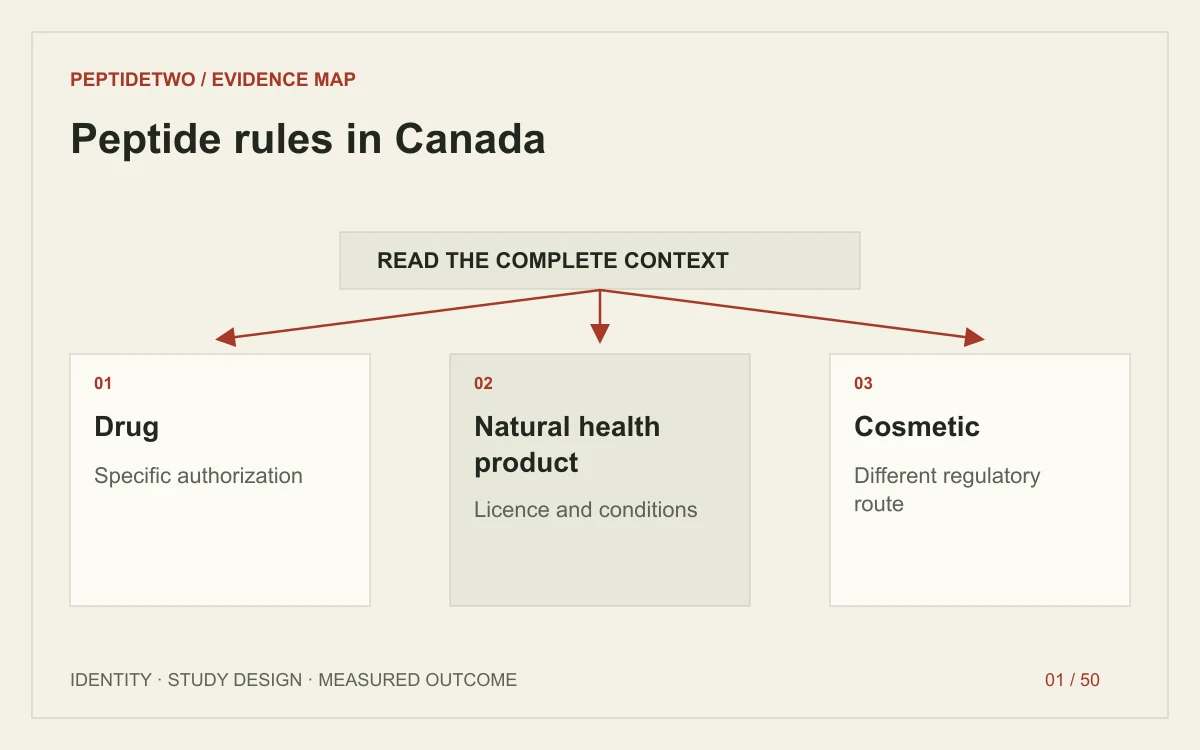
Are peptides legal in Canada? There is no useful yes-or-no answer for the entire chemical category. A prescription peptide medicine, an oral collagen supplement, a cosmetic serum and an online research vial can fall under different rules. The question that produces a verifiable answer is: what is this exact product, what is it claimed to do, and which Canadian regulatory pathway applies?
Start with the product rather than the molecule name
Health Canada’s October 2026 guidance explains that classification depends on composition, intended use and route of administration. Injectable peptides are classified as drugs. A label containing a familiar ingredient does not establish that a particular formulation has been authorized.
For example, semaglutide is an ingredient in authorized medicines. That fact does not authorize every vial advertised as semaglutide. Conversely, the presence of the word peptide on a cosmetic does not make it a prescription medicine. Keeping those distinctions prevents a search result about one category from being applied to another.
Which record answers which question?
Scroll horizontally to read all columns.
| Product being discussed | Useful starting record | What still needs checking |
|---|---|---|
| Manufactured prescription medicine | Drug Product Database | Exact brand, formulation, route, status and monograph |
| Licensed natural health product | Licensed Natural Health Products Database | NPN, ingredients and licensed conditions |
| Cosmetic serum | Cosmetic regulatory framework and product label | Claims, composition and applicable cosmetic requirements |
| Research-labelled material | Classification and research guidance | Actual intended use and applicable Canadian requirements |
The Drug Product Database and natural health product database answer different questions. Neither should be replaced by a seller’s badge or an overseas approval notice. Cosmetics have their own regulatory framework; an ingredient list is not evidence of drug authorization.
Why “available online” does not settle the issue
A Canadian domain, domestic dispatch address or Canadian-dollar checkout establishes something about a website’s presentation. It does not establish product authorization. An analytical certificate describes reported tests on a sample; it is also a different record from a marketing authorization.
Consider a listing that presents a chromatogram and a familiar peptide name. A reader can inspect whether the report matches the lot and method, but that exercise cannot answer whether the product may be supplied for a particular human use. Our DIN verification guide separates those checks.
Research and clinical access are separate pathways
Laboratory research and authorized human clinical trials are not interchangeable activities. A trial listing describes a study; it does not turn a retail product into that study’s investigational product. Likewise, a research-use label is not a general exemption from Canadian requirements. Read the research-use-only explanation before treating that phrase as a legal conclusion.
This page explains how to inspect public records, rather than deciding the legal status of an individual transaction. Product facts, the activity being performed and the relevant regulator determine what further advice is needed. Record the date of the check, because classification guidance and product status can change.
A practical record to keep
Write down the complete product name, manufacturer, dosage form or material specification, route, claimed purpose and any DIN or NPN. Keep the original label beside the database result. A mismatch is a reason to resolve the identity question, not to substitute a similarly named product. For the broader science, start with what research peptides are.