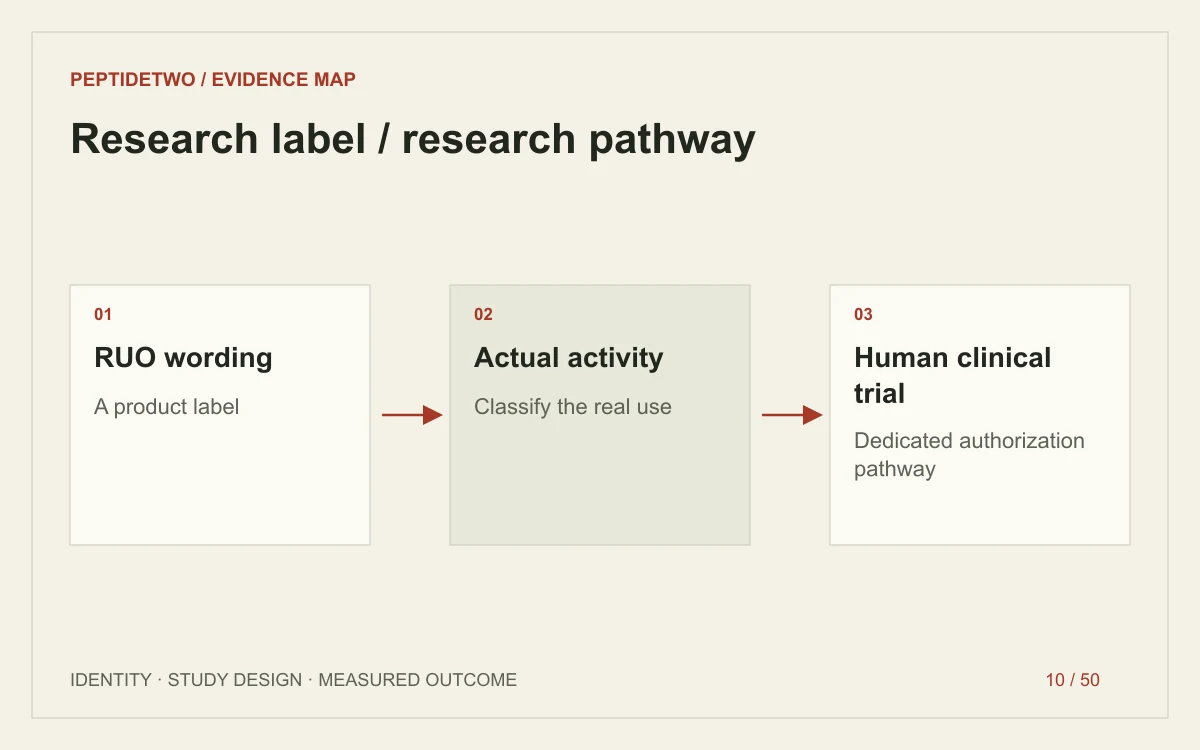
Research use only peptides do not gain Canadian authorization simply from the words on a label. Health Canada’s current research guidance explicitly says that a research-use label does not make a product legal to import or sell. The actual product and activity still matter. An authorized human trial is also a separate pathway from a retail research-material listing.
Read the regulator’s specific distinction
The October 2026 research and clinical-trial guidance discusses products labelled for research or investigational use that are not authorized for human use. It also describes the dedicated pathway for drugs used in authorized human clinical trials. Those two parts should be read together rather than treating the word investigational as approval.
A label can describe a stated intended use. It cannot, on its own, demonstrate that the real promotional claims, supply activity and product classification satisfy applicable requirements. The Canadian classification guide explains the wider framework.
Three kinds of evidence that should not be merged
Scroll horizontally to read all columns.
| Evidence | What it documents | What it cannot replace |
|---|---|---|
| Research-use wording | A stated label or claim | Applicable product and activity requirements |
| Analytical report | Specified tests on an identified sample | Clinical-trial authorization or safety evidence |
| Authorized trial documents | A specific study and investigational-drug context | Authorization of every retail product with the same name |
For example, a trial registry number can identify a study. It does not establish that a seller’s material is the investigational product supplied in that study, or that a customer is a participant. A laboratory report cannot establish those links either.
Keep laboratory research records precise
Scientific records should state the exact material identity, lot, formulation and experimental context. Those details support interpretation of an experiment. They do not convert a laboratory method into instructions for human use.
Likewise, a supplier’s general purity claim should not be copied into a research record as a lot-specific measurement. Read sample traceability and the research record template for the documentation distinctions. Traceability makes uncertainty visible rather than resolving every quality question.
Why clinical evidence cannot be borrowed from a name
A published trial evaluates an intervention with defined manufacturing, formulation, oversight and participant follow-up. Sharing a molecule name does not establish equivalence to that intervention. A small exploratory result also does not independently establish broad effectiveness or long-term safety.
Health Canada’s health-risk guidance distinguishes testing claims from safety and authorization. A research label and a certificate cannot collectively supply the missing clinical evidence simply because they appear on the same webpage.
How to read an ambiguous listing
Separate its material description, intended-use language, promotional claims and supporting documents. Record which points are verified and which are only assertions. Avoid interpreting a familiar disclaimer as a universal permission statement.
For manufactured medicines, inspect the Drug Product Database. For clinical research, inspect the actual trial pathway and study record. Classification and enforcement guidance provides the Canadian context. This educational explanation does not determine a particular shipment’s legal status or provide administration instructions.