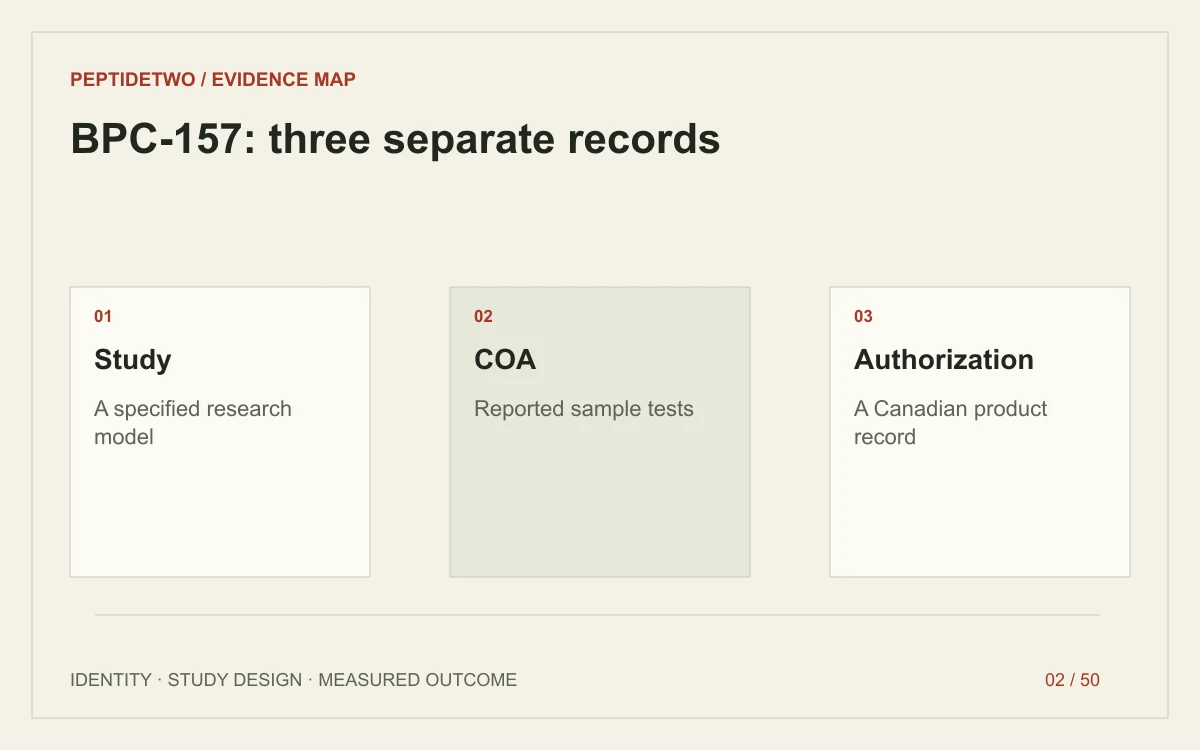
BPC-157 in Canada is a product-status question as well as a research question. Health Canada’s public material identifies BPC-157 among ingredients encountered in unauthorized peptide products. An online offer, a published experiment or an HPLC certificate cannot substitute for a Canadian authorization record for the product being offered.
Read the dated Canadian notices
The regulator’s 9 April 2026 injectable-peptide advisory includes BPC-157 among examples of unauthorized injectable products seized. The October 2026 peptide overview also names it in the context of unauthorized health products promoted for human use. These are Canadian product warnings; they should not be rewritten as a claim that every laboratory activity involving the sequence has the same legal classification.
The distinction matters when a search result simply says “BPC-157 is legal.” Ask what jurisdiction, product, activity and date the statement addresses. A statement about an overseas pharmacy policy does not answer the Canadian question.
What research can establish
An original tendon study examined tendon explants and fibroblasts, including cell migration and survival under experimental stress. That evidence supports a description of those experiments. It does not establish a validated treatment for a Canadian reader’s tendon injury, a human preparation protocol or the equivalence of a retail vial.
Scroll horizontally to read all columns.
| Claim or record | What it addresses | What it does not establish |
|---|---|---|
| Tendon-cell experiment | Effects in a defined model | Human recovery time or effectiveness |
| Lot-linked analytical report | The tests actually performed | Clinical benefit or marketing authorization |
| Canadian regulatory notice | The products and concerns described | A general research protocol |
| Product database entry | An exact authorized product | Approval of similarly named online material |
Why third-party testing is a different question
Health Canada’s risk guidance explicitly separates third-party testing from assurance of safety, effectiveness and authorization. A report may be useful for an analytical question while leaving manufacturing controls, sample custody, sterility or other questions unresolved. “Tested” is too broad unless the method and sample are identified.
For a claimed report, first determine which lot was tested and whether the laboratory can authenticate the document. Our COA authenticity guide explains that process. Authentic paperwork still cannot convert a research chemical into an authorized medicine.
Separate Canada from US headlines
Peptide discussions frequently combine US compounding developments, social-media anecdotes and Canadian supplier listings. Those sources concern different regulatory and evidentiary settings. A change discussed in one country is not proof of Canadian authorization, and an advisory committee discussion is not the same document as a finished-product approval.
The defensible approach is to retain the Canadian source, its date and the exact wording of the product claim. Do not infer an authorized indication from a sequence name or from another peptide’s clinical development.
Where to continue the evidence check
Use the Drug Product Database for exact Canadian product records. Read the BPC-157 dossier for the broader literature and the focused tendon-model guide for what the laboratory endpoints mean. This page does not provide sourcing, administration or treatment instructions.