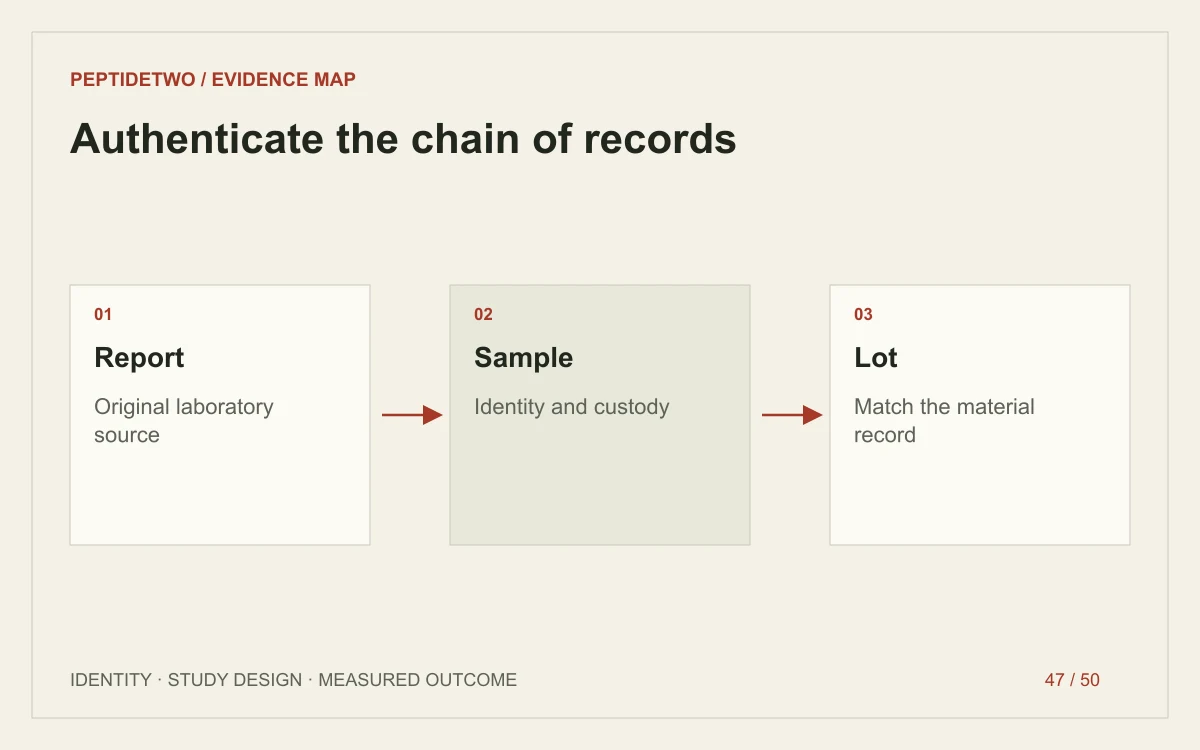
To verify a peptide COA, separate document authenticity from sample identity. An authentic laboratory report can still concern a sample that has not been independently connected to the material in a particular container. Conversely, a polished PDF or a functioning QR code does not establish that the laboratory issued the document.
Trace the report to its issuing source
Record the laboratory name, report number, issue date, version and sample identifier. Use the laboratory’s independently located official contact or verification system, rather than assuming that a link printed on a seller’s copy is authoritative. This is a verification workflow, not a claim that a particular report has been authenticated here.
Report amendments matter. A newer revision may correct a field or replace a result. Retain the version that was actually verified, without deleting the history that explains a discrepancy.
Match the material and the sample separately
Scroll horizontally to read all columns.
| Connection | Evidence to retain | Remaining gap |
|---|---|---|
| Laboratory → report | Authentic report identity and version | What material was submitted? |
| Report → sample | Sample identifier and description | Who selected and handled the sample? |
| Sample → lot | Documented lot match and custody | Does it represent other containers? |
| Method → result | Procedure and reporting basis | Does the method answer the claimed question? |
These links should not be collapsed into a single tested badge. A seller-submitted sample and an independently sampled container are different evidence situations.
Read what the method actually establishes
ICH Q2(R2) describes analytical validation concepts. A result is meaningful in relation to a procedure and its intended purpose. A chromatographic purity figure cannot, on its own, establish identity, amount, sterility and every contaminant question.
Our COA-reading guide addresses the content of the report. This article addresses the separate authenticity and custody questions. Both are needed before the document is used as evidence.
Accreditation is another record, not a universal badge
ISO/IEC 17025 concerns laboratory competence, impartiality and consistent operation. A laboratory claim should be checked against the relevant accreditation record and scope. That does not mean every result it issues automatically covers every sample type and method.
Read independent testing and accreditation for that distinction. Material and analytical terminology also helps separate a reported purity from net peptide content.
State the conclusion at the level actually verified
A useful review might say that a report number and version were confirmed, but sample custody was not independently established. That is more accurate than either declaring the entire lot certified or dismissing every unverified field as a failure.
Health Canada’s risk guidance explains why third-party testing alone does not establish safety, effectiveness or authorization. Document verification cannot turn a research material into an approved medicine. For supply-chain context, read sample traceability. No laboratory was contacted and no supplier report was authenticated as part of this explanatory article.