Peptide molarity counts amount of substance per volume, while mg/mL expresses mass per volume. To convert between them, you need the molecular mass of the exact entity being counted and a meaningful mass-concentration input. A familiar peptide name or an HPLC area percentage cannot supply those values by itself.
Start with the units
The BIPM SI brochure defines the mole and the relevant unit framework. For a specified entity, amount concentration in mol/L equals mass concentration in g/L divided by molar mass in g/mol. The units make the calculation auditable.
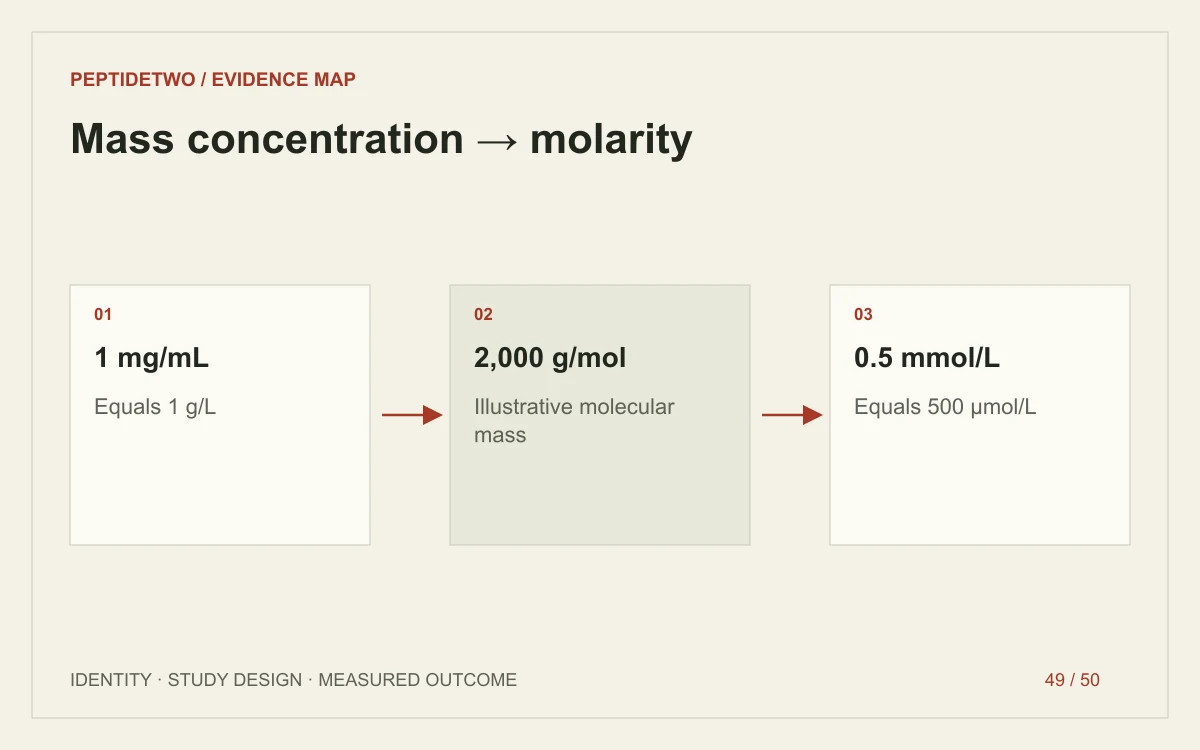
One mg/mL equals one g/L. Dividing g/L by g/mol leaves mol/L. Multiply mol/L by one million to express the value in µmol/L, commonly written µM. The conversion should retain all those steps rather than hide them in an unexplained factor.
Worked arithmetic examples
Scroll horizontally to read all columns.
| Mass concentration | Illustrative molar mass | Calculated amount concentration |
|---|---|---|
| 1 mg/mL = 1 g/L | 2,000 g/mol | 0.0005 mol/L = 0.5 mM = 500 µM |
| 1 mg/mL = 1 g/L | 5,000 g/mol | 0.0002 mol/L = 0.2 mM = 200 µM |
| 0.5 mg/mL = 0.5 g/L | 2,500 g/mol | 0.0002 mol/L = 0.2 mM = 200 µM |
These are arithmetic examples with explicitly chosen molecular masses, not measured peptide lots or preparation instructions. They show why the same mg/mL can represent different molarities for different molecules.
Which molecular mass belongs in the calculation?
Identify whether the value describes the free peptide, a salt, a conjugate, a copper complex or another defined entity. Counterions, water and the reporting basis can complicate a mass input. Peptide documentation FAQs explain distinctions between gross material weight and net peptide content.
The relevant question is what the measured or labelled mass represents. Using a free-peptide molecular mass with an unqualified gross-material concentration can create a mismatch. Do not silently treat every milligram of container contents as the same analyte mass.
Purity and measured content are different inputs
A chromatographic area percentage is not automatically a mass-fraction correction. It depends on the method and detector response and may not account for all non-peptide components. Read purity versus peptide content before using an area figure to adjust a concentration.
Analytical validation guidance also emphasizes fitness for intended use. The arithmetic cannot validate an input that has not been measured appropriately.
Keep the calculation with its assumptions
Record the entity, molecular mass, mass-concentration source, final volume and rounding. If the input is nominal, label the result nominal too. A calculated molarity does not establish solubility, stability or biological activity.
The site calculator handles mass/volume and dilution arithmetic; this guide supplies the separate molecular-mass step. Use the record template to retain the assumptions. No clinical dose or administration volume is selected by this conversion.