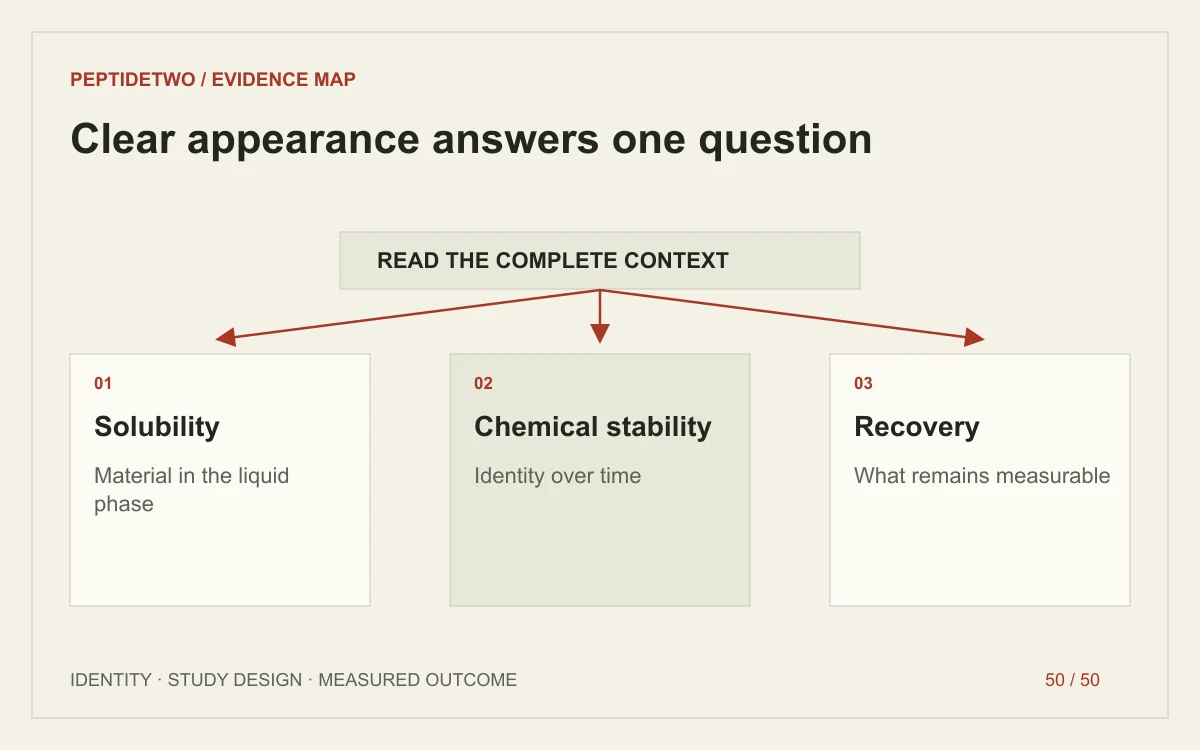
Peptide solubility vs stability separates whether material dissolves from whether the intended molecule remains unchanged and recoverable over time. A visually clear solution cannot establish chemical identity, content, absence of small aggregates or preservation under every storage condition. Appearance is an observation, not a complete validation.
Define the question before testing
Peptide handling and analytical FAQs discuss material-dependent handling and specification issues. Sequence, modifications and formulation can influence behaviour, so a generic storage rule for every peptide is not a defensible substitute for data on the actual material.
This article does not select a solvent, mixing method or storage period. It explains the measurements needed to interpret a claim, because an unvalidated preparation instruction would add uncertainty rather than resolve it.
Different processes can change the result
Scroll horizontally to read all columns.
| Process | What changes | Why appearance is insufficient |
|---|---|---|
| Dissolution | Distribution into the liquid phase | A clear sample may still have other unresolved properties |
| Chemical degradation | The molecule’s chemical identity | Products may remain dissolved |
| Aggregation | Association of molecules | Small species may not be visibly cloudy |
| Adsorption | Material associates with a surface | Loss can occur without an obvious visual change |
| Precipitation | Material leaves the apparent solution | Visible material does not identify every cause |
These processes need not be mutually exclusive. A sample can lose recoverable analyte while also developing chemical changes.
Recovery is not always the same as degradation
Recommendations for peptide standards in mass-spectrometry assays discuss the importance of defined materials and analytical handling. A lower measured signal can arise from several sources, including sample recovery or analytical conditions. It should not automatically be interpreted as molecular destruction.
Conversely, an unchanged total signal may not prove every molecular form remained the same if the procedure cannot separate relevant species. The method’s selectivity is part of the stability claim.
What a stability claim needs
Identify the material, formulation, container, conditions, time points and analytical endpoints. An appropriate procedure must be able to detect the changes relevant to the intended use. ICH Q2(R2) provides the validation framework for judging whether the procedure can answer that purpose.
A single time point or a general supplier statement does not establish a validated shelf life for every preparation. Changing the container, concentration or other conditions can change the question being asked.
Keep nominal calculations separate from measured reality
A concentration calculation assumes that the stated analyte mass is in the stated final volume. It cannot determine how much remains soluble, intact or recoverable. Our molarity guide makes the input assumptions explicit.
For broader context, read stability and degradation evidence and analytical method reading. A useful laboratory record states which property was tested and which remained unverified, instead of using the word stable as a universal assurance.