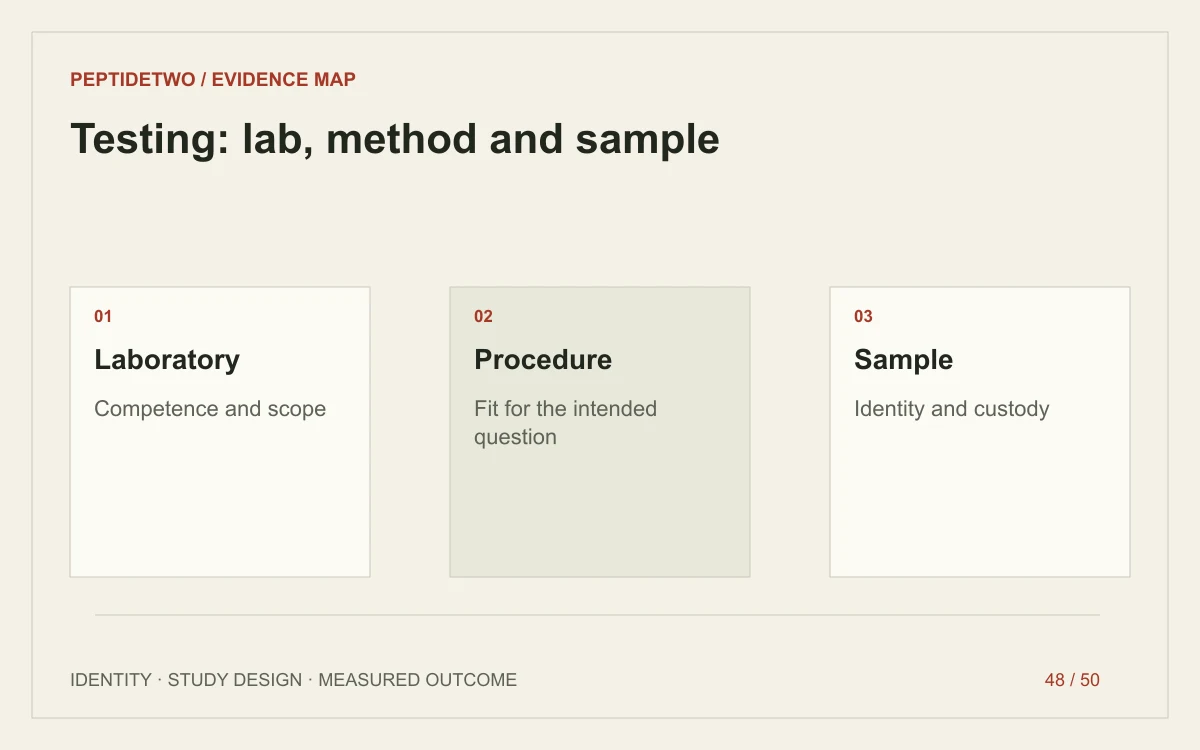
Third-party peptide testing is useful only when the laboratory, sample and method match the question being asked. Independence from a seller is one consideration. It does not make an unsuitable method valid, establish sample custody or turn a single purity result into a complete quality assessment.
What ISO/IEC 17025 addresses
The official ISO/IEC 17025 overview describes requirements for competence, impartiality and consistent operation of testing and calibration laboratories. Accreditation is therefore a relevant record to inspect, but the exact accredited scope still matters.
A general accreditation logo should not replace a scope check for the sample type and procedure. An educational comparison should state whether the current record was actually verified rather than inferring coverage from a website badge.
Independence has more than one dimension
Scroll horizontally to read all columns.
| Dimension | Question to ask |
|---|---|
| Organizational relationship | Who operates and pays for the test? |
| Sample selection | Who chose the material submitted? |
| Custody | Can the sample be traced to the stated lot or container? |
| Method suitability | Does the procedure address the intended property? |
| Reporting | Are limits, units and uncertainty described appropriately? |
A seller can legitimately commission an external laboratory while still controlling which sample was sent. That is not the same situation as an independent organization selecting an unopened sample from the supply chain.
Match the method to the property
ICH Q2(R2) frames validation around intended analytical use. Identity, chromatographic purity, content and microbiological questions require their own appropriate evidence. No generic tested label tells the reader which of those was assessed.
Peptide analytical terminology further distinguishes material properties that can be confused in a report. The purity-versus-content guide explains why an area percentage is not automatically the mass of peptide in a container.
What a useful commissioning brief contains
Define the question, material specification, expected reporting units, sample-handling requirements and decision criteria before interpreting a result. Ask the laboratory to identify method limitations and whether the reported work falls within its accredited scope. These are information requirements, not a recommendation of a particular laboratory.
If a method cannot distinguish relevant molecular forms or omits a property of interest, state the limitation. A report can be valid for its actual purpose while being insufficient for a broader claim.
Testing does not answer the clinical or authorization question
Health Canada’s guidance explicitly cautions that third-party testing alone cannot verify safety, effectiveness or authorization. A strong analytical result should not be repurposed as a treatment claim.
Use COA authentication for report provenance and purity, sterility and endotoxin for different test questions. No laboratory scope, sample or transaction was independently audited for this article, and no testing provider is endorsed.