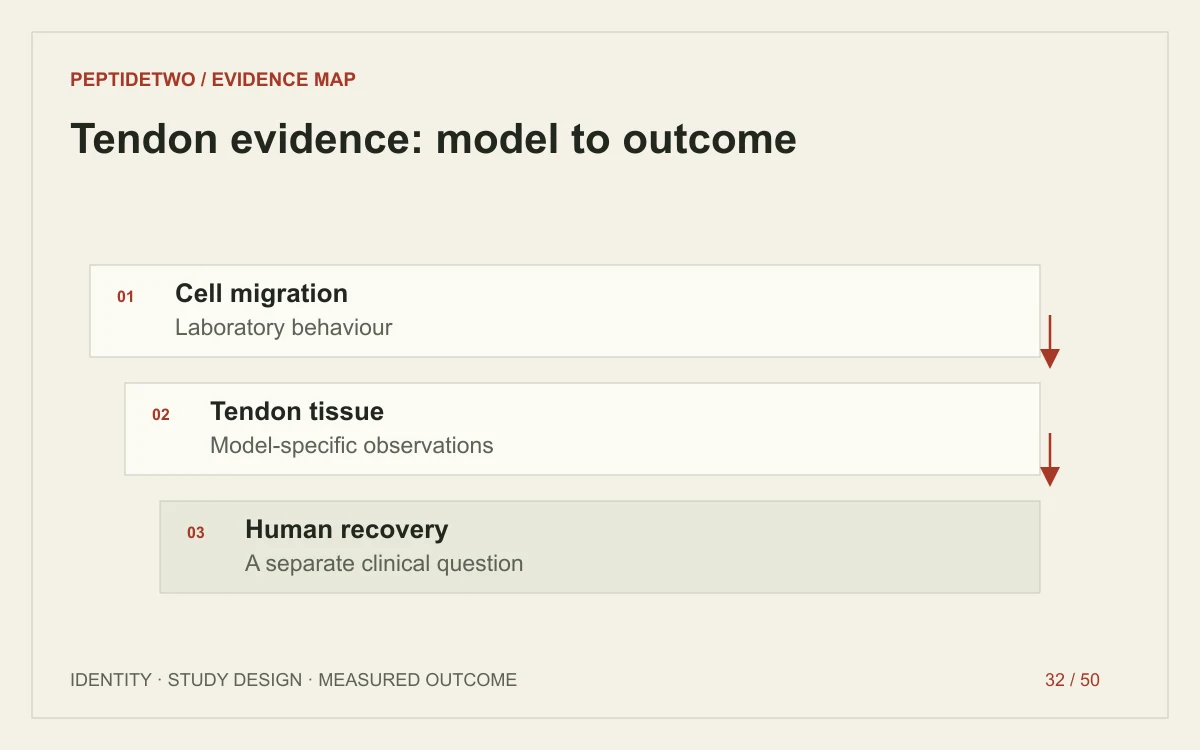
BPC-157 tendon research includes laboratory studies of tendon explants and fibroblasts. These experiments investigate biological mechanisms. They do not establish a predictable human recovery time, an effective treatment for every tendon injury or equivalence between the experimental material and an online product.
What the cell-migration study actually did
The 2011 tendon paper examined explant outgrowth, cell survival under oxidative stress and migration-related behaviour in tendon fibroblasts. It reported increased migration and changes in the FAK–paxillin signalling context. It did not show a direct increase in cell proliferation in the particular assay described.
This detail matters because “promotes healing” can conceal several different measurements. More movement in a cell assay is not the same measurement as restored tendon strength or a patient’s return to sport.
A second study addressed a receptor-related mechanism
The 2014 study used rat Achilles-tendon fibroblasts and examined growth-hormone-receptor expression and downstream responses. That is a mechanistic result in a defined cell setting. It does not establish a clinical combination regimen or prove a broad growth-hormone effect in people.
Scroll horizontally to read all columns.
| Measured feature | Scientific question | Clinical claim still requiring evidence |
|---|---|---|
| Explant outgrowth | How cells emerge from tissue in the model | Faster recovery of a human tendon injury |
| Migration | How cells move in an assay | Restored mechanical strength |
| Receptor expression | A possible signalling mechanism | Clinical benefit from a peptide combination |
| Patient function | A directly relevant outcome | Needs an appropriate human trial |
Why the knee-pain paper does not fill the tendon gap
A small retrospective knee-pain report involved different clinical circumstances and self-reported follow-up. It was not a randomized tendon-healing trial. Knee pain can arise from multiple causes, so it cannot be treated as a direct measurement of repaired tendon tissue.
Its reported symptom observations should also be kept separate from the authors’ proposed future structural claims. A suggestion that imaging should be studied is not an imaging result.
What a useful human tendon study would need
It would identify the injury and population, compare a defined intervention with appropriate care or placebo, and measure prespecified clinical outcomes. Function, imaging, tissue mechanics, adverse events and follow-up would each need an explicit role. No single cell assay can provide all of those answers.
Our preclinical-to-clinical guide explains the translation problem. The endpoint guide helps distinguish an intermediate marker from a result a patient can experience.
The Canadian product question remains separate
Health Canada’s injectable-peptide advisory includes BPC-157 among unauthorized products encountered. An experimental tendon result does not supply a Canadian product authorization. Read the Canada status guide for that record check. This article does not recommend using BPC-157 or provide preparation or administration instructions.