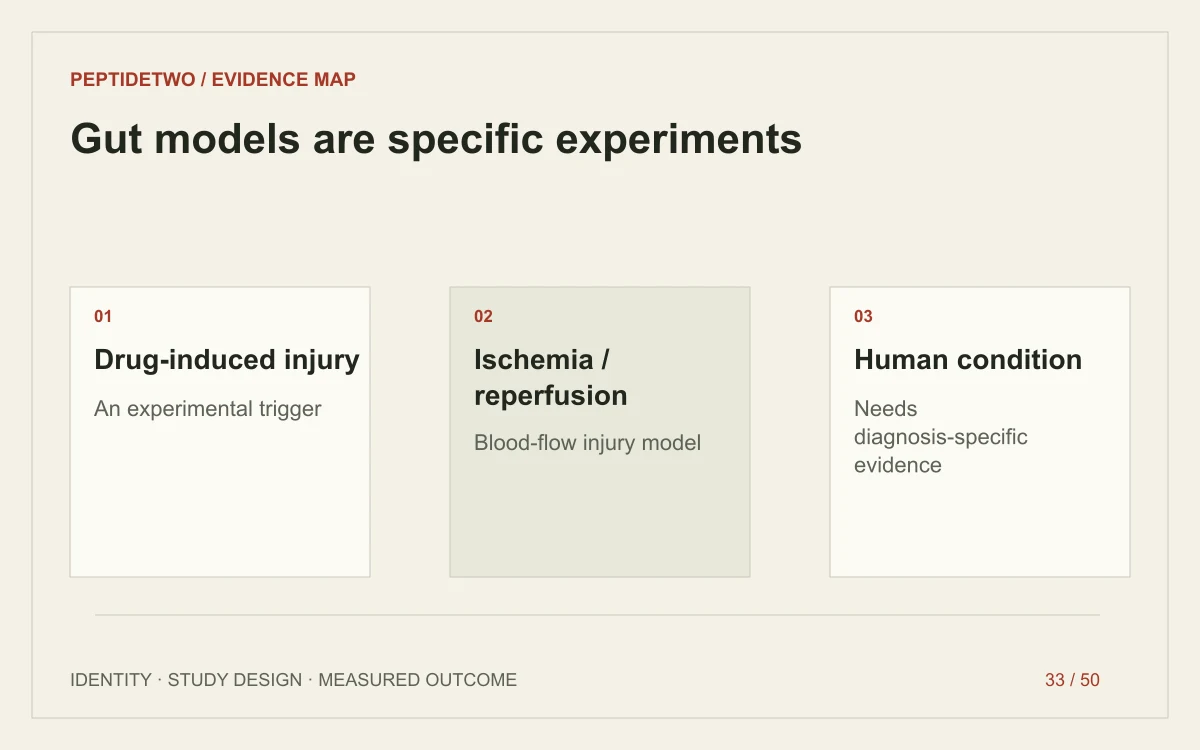
BPC-157 gut research spans several experimental injury models, especially in rats. A result in a chemically induced lesion or blood-flow injury model is not the same as evidence for treating a human digestive diagnosis. The exact model and endpoint should remain visible whenever a “gut healing” claim is discussed.
Different experiments create different injuries
A 1997 original study investigated gastrointestinal lesions associated with non-steroidal anti-inflammatory agents alongside an inflammatory model in rats. A later study examined colitis-related ischemia and reperfusion in rat colon tissue. These interventions and observations address particular experimental conditions.
Such models can help investigate mechanisms, but they do not reproduce every feature of chronic human inflammatory bowel disease, functional symptoms or an undiagnosed complaint. The broad word gut cannot make those settings equivalent.
Match the claim to the model
Scroll horizontally to read all columns.
| Evidence setting | What it can investigate | What it cannot directly establish |
|---|---|---|
| Drug-induced animal lesion | Response under a specified injury trigger | Treatment of every human digestive condition |
| Ischemia–reperfusion model | Tissue response to altered blood flow | A clinical remission rate in inflammatory bowel disease |
| Cell or tissue marker | A mechanistic pathway | Durable symptom or quality-of-life benefit |
| Human randomized trial | A defined clinical comparison | Requires its own actual results |
The word colitis itself needs context. An experimental model with a defined trigger is not interchangeable with every disease carrying that label in clinical practice.
Why a mechanism does not specify a treatment
A tissue observation cannot determine a human route, formulation, preparation or regimen. Changing the experimental exposure introduces another uncertainty rather than creating a valid conversion. This article therefore does not translate animal methods into instructions.
Likewise, a report about a research sequence does not authenticate a retail product. Material identity, manufacturing and product oversight are separate from the biological hypothesis.
What would strengthen the human evidence?
A relevant trial would specify the diagnosis, inclusion criteria, comparator and meaningful outcomes. For a chronic disease, sustained response, adverse events, withdrawals and the effect of background therapy would matter. Biomarkers and symptoms should be distinguished rather than selected according to which looks most favorable.
Health Canada’s research guidance explains why promising early findings do not establish human effectiveness or safety. A trial registry entry also needs to be distinguished from published results; a study planned is not a clinical outcome measured.
Keep the Canadian status check separate
The Canadian injectable-peptide advisory includes BPC-157 among unauthorized products encountered. Neither a rat experiment nor the phrase research use supplies a finished-product authorization. The BPC-157 Canada guide addresses that issue directly.
For another model-specific review, read tendon research. For the general framework, use preclinical versus clinical evidence. This article does not diagnose digestive symptoms or recommend replacing clinical evaluation with an experimental peptide.