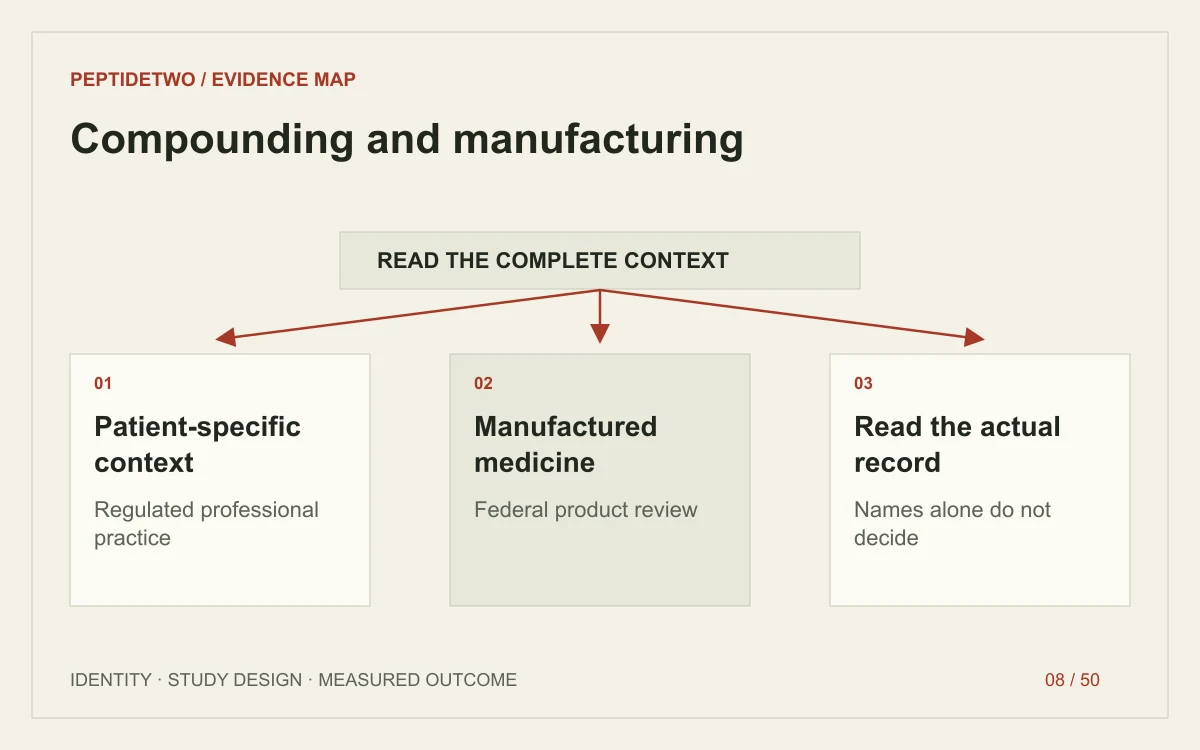
Compounded semaglutide in Canada should not be described as an authorized generic simply because it contains the same named ingredient. Compounding and commercial manufacturing have different regulatory contexts. A useful explanation starts with who prepares the product, for whom, under which professional framework and with what documentation.
What Health Canada means by compounding
The October 2026 peptide guidance describes compounding as preparation for a patient’s specific medical needs by pharmacists or other licensed healthcare practitioners. It also explains that some activities presented as compounding can be considered manufacturing. The activity and its context matter more than the label used in an advertisement.
This prevents two opposite errors: treating every compounded preparation as identical to a commercially authorized drug, or treating all legitimate professional compounding as an online research-vial business. Neither conclusion follows from the word compounded.
The framework considers several factors together
Policy POL-0051 provides a framework for distinguishing manufacturing from compounding. Relevant facts include the patient–professional relationship, commercial availability and the nature of preparation and supply. A single fact, such as a pharmacy name or an ingredient source, is not a complete regulatory assessment.
Scroll horizontally to read all columns.
| Issue | Why the distinction matters |
|---|---|
| Patient-specific medical need | Identifies the professional-practice context |
| Finished-product authorization | An authorized generic has its own reviewed product record |
| Preparation and supply activity | Can determine whether manufacturing requirements apply |
| Ingredient identity and quality | Necessary facts that do not alone establish authorization |
| Advertising language | A public claim may omit the facts needed to classify the activity |
Why the generic approvals do not answer every compounding question
Health Canada’s 2026 generic announcement concerns reviewed finished products. It is not a blanket authorization for every preparation containing semaglutide. Likewise, the fact that a generic is now authorized does not let an educational article resolve every individual compounding scenario without the underlying facts.
For a manufactured product, use the Drug Product Database. For a compounding question, the relevant professional regulator and the full practice context matter. These sources serve different purposes and should remain separate in a comparison.
A COA cannot fill the whole evidence gap
A chemical certificate may identify tests and reported results for a sample. It does not itself establish a patient-specific need, a practitioner relationship, finished-product stability or equivalence to a reviewed medicine. A purity figure is especially easy to overread when its analytical basis is not stated.
Our purity versus content guide explains why a percentage is not automatically a quantity of active ingredient in a container. The document-authentication guide addresses the separate question of whether a claimed report is genuine.
How to read a Canadian comparison responsibly
Identify the exact product description and the record supporting each claim. Mark unresolved fields as unresolved. Do not import an American shortage policy or US pharmacy rule into a Canadian explanation without checking the Canadian framework.
This article does not supply an individual legal determination, a pharmacy recommendation or a preparation method. Read generic semaglutide in Canada for the authorized-product pathway and the peptide classification guide for the broader context. A clear comparison tells the reader which question each source can actually answer.