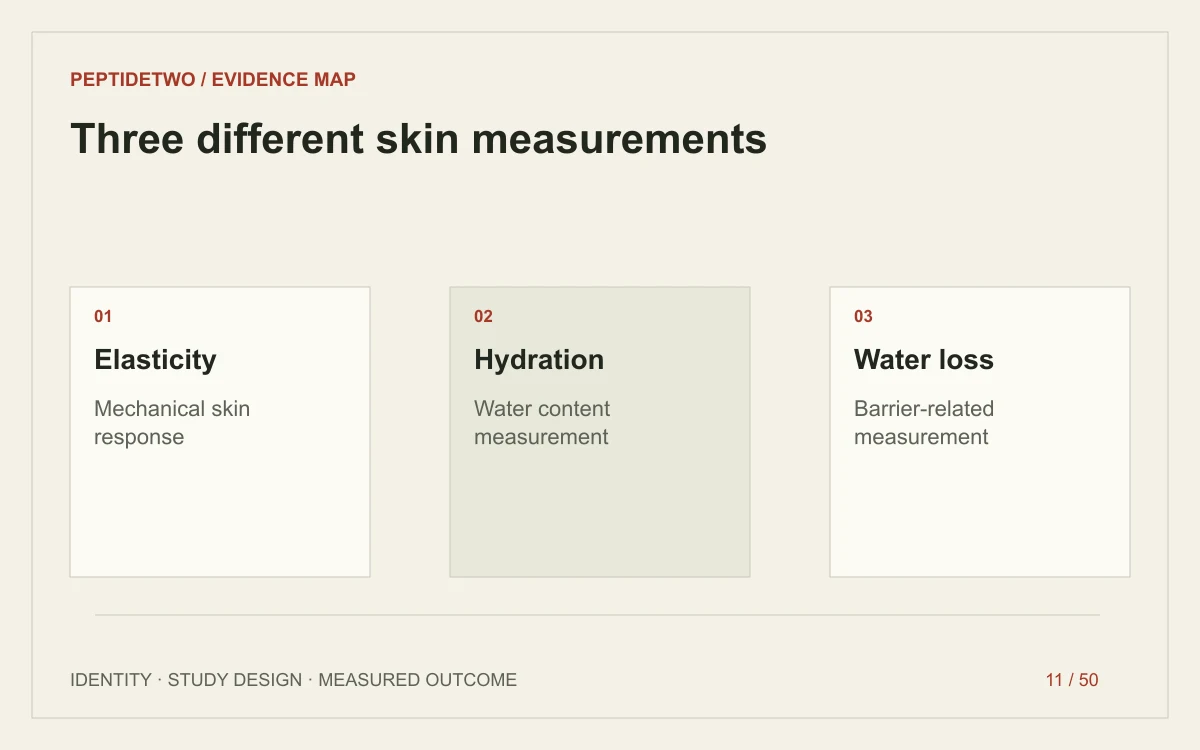
Collagen peptides for skin have human trial evidence, but elasticity, hydration and water loss are different outcomes. A positive result for one measurement should not be rewritten as proof that a powder improves every sign of skin aging. The most useful reading identifies the tested hydrolysate, participants, comparator and measurement before considering the headline.
Elasticity is not the same outcome as hydration
A 2014 randomized trial enrolled 69 women and tested a specific collagen hydrolysate over eight weeks. Elasticity improved relative to placebo. The abstract did not show statistically significant moisture or evaporation findings, despite a positive direction in a subgroup analysis. That distinction is lost when the study is summarized simply as “better skin.”
A separate randomized collagen-tripeptide study assessed hydration and transepidermal water loss, including adjustment for weather conditions. It illustrates why measurement conditions and the exact outcome deserve attention. It is not evidence that every collagen product has the same effect.
Read each endpoint literally
Scroll horizontally to read all columns.
| Outcome | What it measures | What it does not directly establish |
|---|---|---|
| Elasticity | A mechanical response of skin | Reduction in every wrinkle or skin condition |
| Hydration | Water-related properties of the measured surface | A universal anti-aging effect |
| Transepidermal water loss | Water moving across the skin barrier | The same thing as subjective softness |
| Participant rating | How a person perceives a change | A blinded instrument measurement |
An improvement can be statistically detectable without establishing how noticeable it would be to every user. Ask whether the paper reports between-group differences, their size and uncertainty, rather than only a change from baseline in the active group.
Absorption is a separate piece of evidence
Human blood measurements after gelatin-hydrolysate ingestion identified collagen-derived peptides in circulation. That finding addresses exposure. It does not, by itself, prove that those peptides rebuild facial collagen or explain a clinical improvement. Absorption and a meaningful skin outcome require different experiments.
Hydrolysates also differ in source and peptide distribution. A finished formulation may contain other ingredients, so an effect from a combination cannot automatically be attributed to collagen alone.
Which details make a trial useful?
Look for a credible placebo, blinded assessment, a prespecified main endpoint and transparent handling of missing participants. Check the age and skin characteristics of the sample. Record the product’s source, specification and study duration, and read the funding and conflict-of-interest disclosures in the full paper.
Results from selected volunteers should not be extended to eczema treatment, wound care or rapid correction of loose skin without direct evidence. Our trial-endpoint guide explains the difference between a measured surrogate and the broader outcome a reader hopes to achieve.
How this relates to Canadian labels
A Canadian product label and its regulatory category are separate from a literature summary. Read collagen labels and NPNs for record matching. For a different peptide category, collagen versus signaling peptides explains why an oral hydrolysate and a cosmetic copper peptide cannot share evidence merely because both are called peptides.