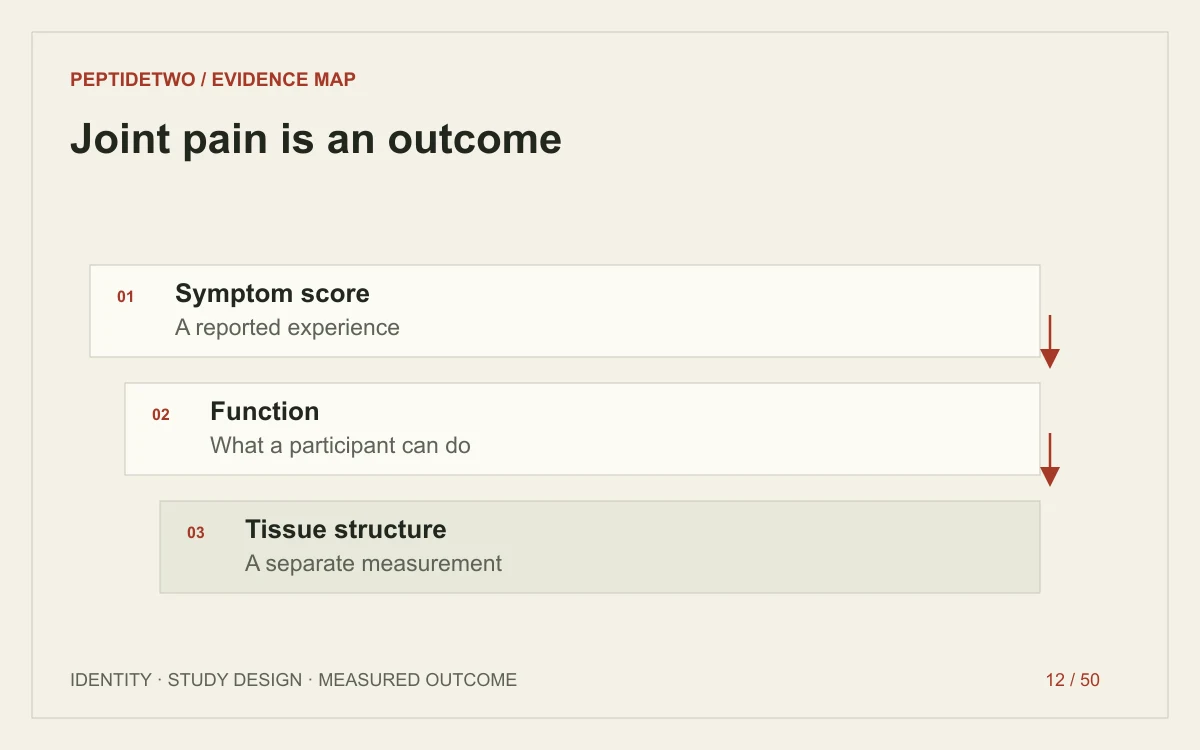
Collagen peptides for joint pain should be evaluated by the symptoms and populations actually studied. A trial reporting a change in pain does not automatically demonstrate regenerated cartilage, repaired tendons or prevention of arthritis. Those are different claims and require different outcomes.
What the activity-related joint-pain study tested
The 2008 Clark trial recruited 147 physically active athletes without evidence of joint disease and compared a specific collagen-hydrolysate formulation with placebo for 24 weeks. The abstract reports statistically evaluable data from 97 participants. Several pain measures favored the hydrolysate.
The population and the participant losses matter. A result among athletes with activity-related symptoms cannot simply be applied to every person with osteoarthritis, inflammatory disease or an acute injury. The difference between people recruited and people included in an analysis also needs explanation in the full report.
Separate a symptom from a structural result
Scroll horizontally to read all columns.
| Outcome | Useful interpretation | Unsupported shortcut |
|---|---|---|
| Pain rating | A reported change in a defined symptom | Cartilage has regrown |
| Movement or function | Performance on a specified task | Every joint has recovered |
| Imaging or tissue measurement | A defined structural observation | Pain must improve by the same amount |
| Subgroup finding | A result in a smaller selected group | The subgroup proves a universal treatment effect |
Symptom improvement is worth measuring, but it should be described accurately. Calling a pain score “joint repair” changes the claim without adding evidence.
Why a highlighted subgroup needs caution
The study also reported a knee-arthralgia subgroup. Subgroups can help identify a research question, but they contain fewer people and may involve additional comparisons. Ask whether the subgroup was prespecified and whether an independent study reproduces the result.
A small p-value does not resolve every design issue. The magnitude of the difference, uncertainty, missing data and choice of comparator remain part of the interpretation. Our research-paper guide offers a framework for those checks.
Do not borrow tendon or bone findings
The gelatin-and-exercise experiment examined collagen-related biomarkers in a small study; it was not a trial showing healed joint disease. A bone-density collagen trial addressed yet another tissue and outcome. These studies cannot be combined as though they all measured joint-pain relief.
This matters when a product page assembles several citations beneath one broad “connective tissue” heading. Each citation may be real while the combined commercial claim remains broader than any study.
What a useful comparison would retain
Record the exact hydrolysate, study population, comparator, duration, main endpoint and participant accounting. Compare that specification with the product being discussed. Note whether a claim concerns symptoms, performance or tissue structure before comparing results.
For the material distinction, read collagen peptides versus gelatin. For formulation and Canadian record questions, see collagen labels in Canada. This article evaluates evidence and does not diagnose the cause of joint pain or replace clinical care.