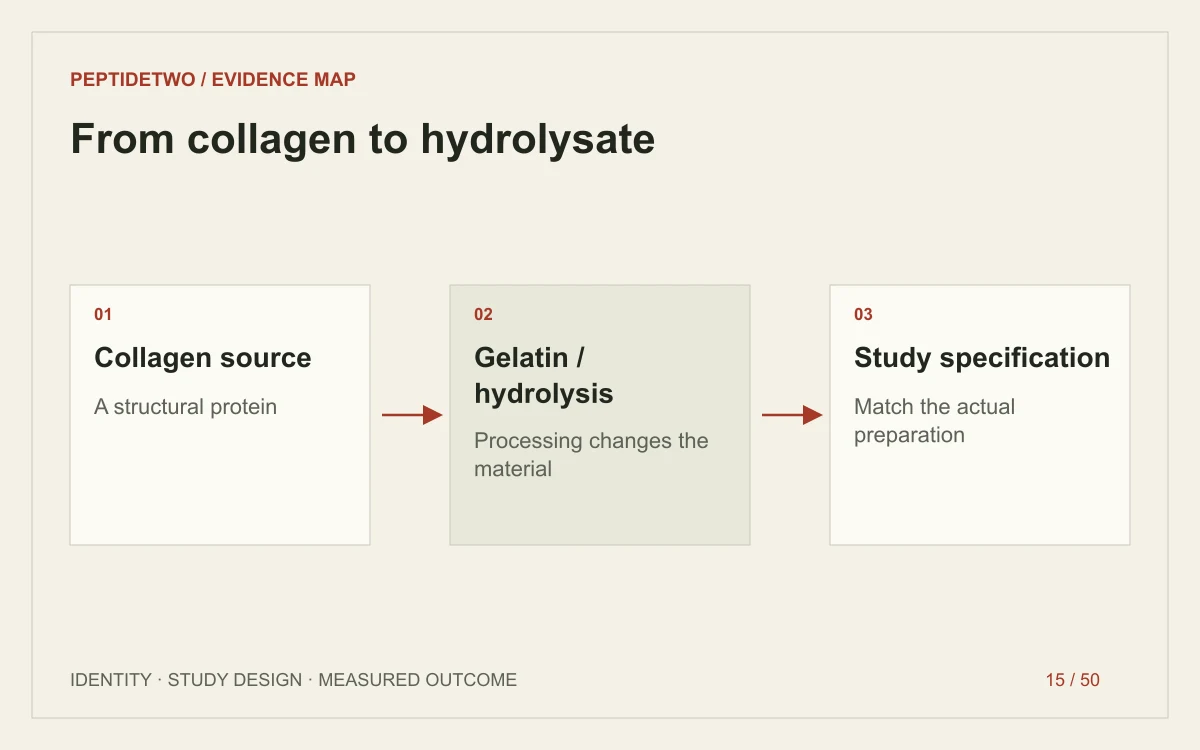
Collagen peptides vs gelatin is mainly a question of processing and material specification. Both terms relate to collagen-derived material, but they do not identify identical preparations. Hydrolysis changes the distribution of peptide fragments and the product’s physical behaviour. A study’s exact material matters more than treating the names as interchangeable.
Why the processing words matter
Gelatin is derived from collagen, and collagen hydrolysates undergo further breakdown into smaller fragments. The term collagen peptides is commonly used for hydrolysed preparations. It is not a universal specification for fragment size, source, purity or clinical effect.
For a research comparison, retain the name used in the original methods and the available characterization. If a paper tests a particular gelatin hydrolysate, its findings should not be silently reassigned to every product labelled gelatin or collagen powder.
Exposure and clinical outcomes are separate
A human gelatin-hydrolysate study identified peptide forms containing hydroxyproline in blood after ingestion. This demonstrates that selected collagen-derived peptides can be measured systemically under the studied conditions. It does not establish where every fragment acts or prove a cosmetic or joint benefit.
Scroll horizontally to read all columns.
| Observation | Supported interpretation | Further question |
|---|---|---|
| Peptides detected in blood | Exposure to identified fragments | Does a meaningful outcome change? |
| A synthesis biomarker changes | A biological process is affected | Does tissue structure or function improve? |
| A skin endpoint changes | A particular cosmetic measurement improved | Does the result transfer to another product? |
Read the gelatin-and-exercise experiment carefully
The 2017 gelatin experiment combined a defined preparation with intermittent activity and examined collagen-related synthesis measures. It was a small mechanistic study, not a randomized trial demonstrating that a tendon injury healed faster or that a specific rehabilitation outcome improved.
That distinction is important because “supports collagen synthesis” can become “repairs tendons” as the claim moves between websites. The second statement adds a clinical outcome the biomarker study did not directly measure.
What a product substitution would need
To compare two materials scientifically, consider their source, hydrolysis profile, added ingredients and intended endpoint. Matching the total powder mass does not guarantee an identical mixture of peptides. Nor does a texture difference by itself prove a health advantage.
Some cosmetic trials evaluate specific hydrolysates, such as the 2014 skin-elasticity study. Those findings concern that preparation and study setting. They are not evidence that all collagen-derived kitchen or supplement products produce the same result.
A useful way to summarize the distinction
Describe the preparation first, then the experiment, then the measured result. Keep physical properties separate from clinical claims. If the material cannot be matched to the one in a trial, state that uncertainty rather than borrowing the result by name.
For an outcome-specific review, read joint-pain evidence or skin-elasticity and hydration evidence. For the broader category distinction, collagen versus signaling peptides explains why these food-derived mixtures differ from defined research sequences.