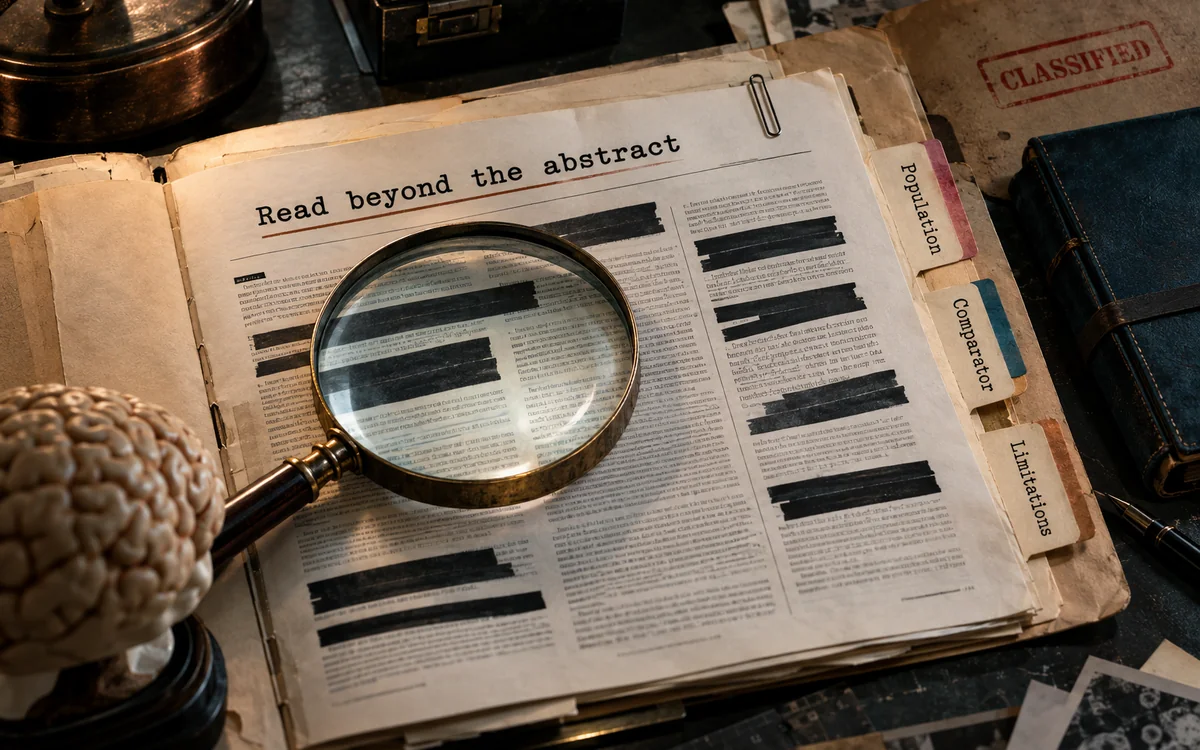
Start a peptide paper with a concrete question: what was tested, against what comparison, and what was measured? The answer is usually more useful than the abstract’s broadest claim. Then identify the molecular material, study design and analysis before deciding whether the conclusion follows. This reading method works for research peptides discussed online because it exposes the source trail behind a confident summary without requiring every reader to become a specialist in every technique.
How to read a peptide research paper: define the question
Write a one-sentence version of the study question that names the molecule, experimental model or population, comparator, endpoint, and observation period. If any of those pieces is absent, record the gap. Check whether the paper studied the same sequence, modification, and formulation named elsewhere. Our sequence guide and COA guide help keep molecular identity distinct from claims about activity. A similar name is not evidence that two materials were identical.
Classify the design before weighing the conclusion
Cell experiments, animal models, case series, observational human studies, and randomized trials have different strengths and failure modes. Look for allocation, blinding, controls, sample size rationale, prespecified analysis, missing data, and replication. The evidence-level guide explains what each design can support. For randomized trials, CONSORT 2025 gives reporting items to check. A study can be interesting while still being too narrow to support a commercial or clinical conclusion.
Read methods and results together
Verify how the outcome was measured, whether the method was suited to that question, which data were excluded, and how uncertainty was reported. In analytical work, the method’s selectivity and calibration matter; in a trial, the endpoint definition and analysis population matter. Figures can hide denominators or different axes, so read the captions and supplementary material. A p-value alone is not an effect size or a measure of practical importance. Look at the magnitude, confidence interval, consistency, and potential sources of bias.
Assess reviews without outsourcing judgment
A systematic review can synthesize multiple studies, but its conclusion depends on search coverage, eligibility rules, risk-of-bias assessment, and the comparability of included studies. The PRISMA 2020 statement provides a reporting framework for reviews. Check whether a review pools cell, animal, and human evidence as though they answered the same question. A narrative review is useful orientation, but it should not replace inspection of the original study behind a strong claim.
Use the abstract as a map, then check the route
The abstract helps identify the design and headline result. It may omit details that change interpretation: a run-in population, an exploratory endpoint, a treatment-policy analysis or a missing-data assumption. Find those details in the methods and results before repeating the most favorable sentence. If the full report is inaccessible, say that the assessment is limited to the accessible record.
Tables and figures deserve the same scrutiny as prose. Check units, denominators and the number observed at each visit. A smooth curve can conceal changing sample sizes. A bar labeled percent can describe a relative change, a proportion of participants or a percentage-point difference. The caption and methods should settle which.
Check whether two publications describe one dataset
A main trial report, a subgroup analysis and a mechanistic secondary analysis can all come from one randomized experiment. They add information, but they are not three independent replications. Use the registration identifier and participant description to connect them. Counting publications instead of independent datasets can make a small evidence base look much larger.
The reverse problem also occurs when unrelated experiments share a peptide name. A cell study, an uncontrolled clinical series and a randomized trial may have different materials and aims. Their conclusions should be compared only after those identities and designs are clear.
Inspect the claim that matters most to the article
Choose the central assertion rather than fact-checking only easy background facts. If the assertion concerns recovery, locate the recovery endpoint. If it concerns purity, locate the analytical method. If it concerns a mechanism, ask whether the study measured that mechanism or inferred it from a related response. A paper can be valid while a secondary article assigns it the wrong claim.
Funding and conflicts of interest are relevant context, not automatic proof that a result is false. Read them alongside design, reporting and independent replication. Likewise, publication in a familiar journal does not remove the need to check the methods. The useful question remains whether the evidence supports this particular sentence.
An evidence note should end with an open question that the source genuinely leaves unresolved, such as persistence after withdrawal or identity of an unassigned peak. Avoid filling that space with speculation. The research-record guide explains how to preserve the source, version and calculation so another reader can audit the note later.
Make an evidence note that can be checked later
Capture the full citation or DOI, publication date, study design, molecule specification, main result, uncertainty, funding or conflicts when reported, and one or two major limitations. Keep direct observations separate from your interpretation. Link the note to original figures and supplementary data rather than a screenshot of a promotional summary. The traceability guide applies the same principle to laboratory records. A short, accurate evidence note is more useful for later writing than a collection of impressive claims.
Translating an abstract into an evidence note
An abstract might say that a peptide “improved a biological response.” Rewrite it as a structured note: exact material, model or population, number of experimental units, comparator, measured response, time point, effect estimate, and uncertainty. Next, read the methods to find how allocation and measurement were performed. Finally, inspect the discussion for statements that go beyond the measured response. This process does not require dismissing the study; it identifies the useful finding and the inference boundary. Keep the source DOI and any supplementary material with the note so a later writer can verify it.
A comparison of two primary-report designs
The BPC-157 knee-pain report is retrospective and discusses observations without a randomized control arm. The MMPOWER-3 elamipretide paper reports a randomized controlled trial with prespecified clinical outcomes. The point is not that one molecule should be compared with the other. The point is that the design controls which causal question can be answered and how a finding should be worded. Read both reports through their methods before their conclusions.
Check the paper’s central claim
- Is the conclusion broader than the actual model, population, or measured endpoint?
- Can the molecule and material be identified from the methods?
- Are uncertainty, missing data, and alternative explanations visible?
Questions about reading original studies
Should I trust an abstract alone?
An abstract is an index to the study, not the complete evidence. It may omit details about methods, exclusions, missing data, adverse events, or limitations. Use it to locate the relevant paper, then inspect the methods, results, figures, supplementary material, and registration where applicable.
What is a strong sign of overinterpretation?
Watch for a conclusion about human outcomes when the study measured only a cell or animal endpoint, or a claim about a commercial material when the tested preparation was different. Also compare the headline with the prespecified primary outcome and uncertainty. A plausible mechanism is not a substitute for measured benefit.
How can a non-specialist keep useful notes?
Write down the exact molecule, study design, comparator, sample size or experimental units, endpoint, principal result, uncertainty, and one limitation. Save the DOI or stable source URL. This compact format helps prevent a strong-sounding quote from losing the conditions that made it true.