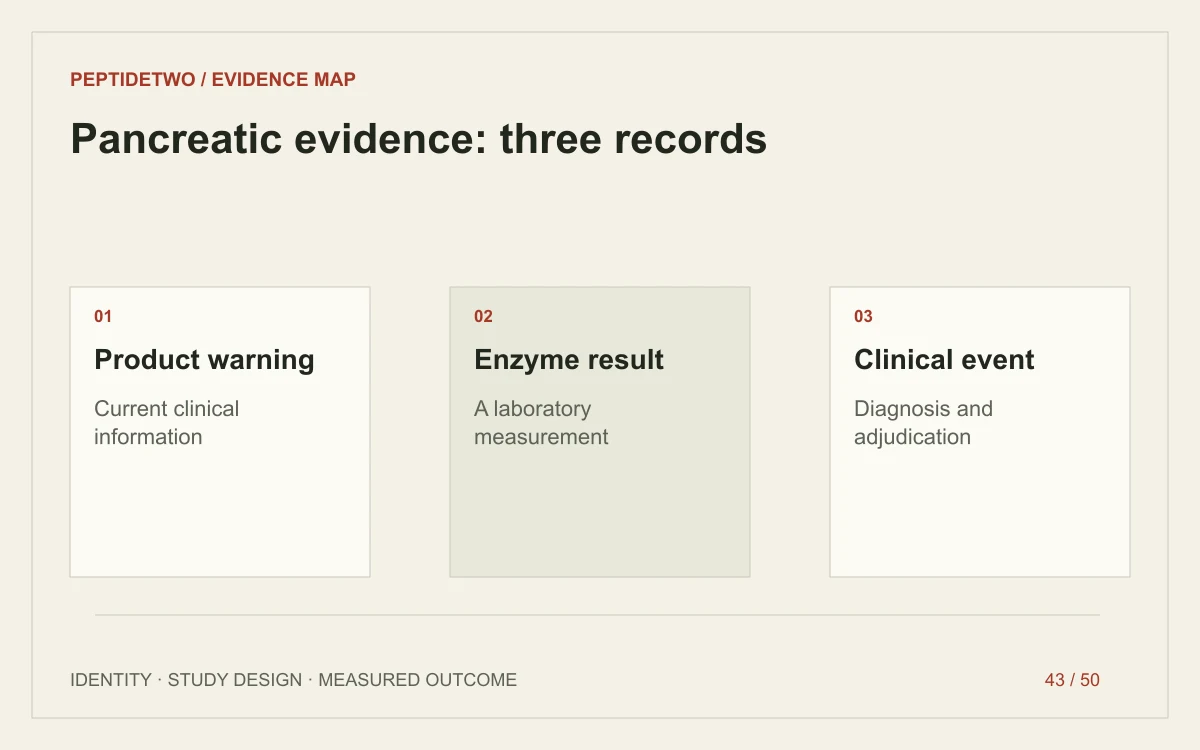
GLP-1 and pancreatitis discussions need to separate product warnings from laboratory enzyme changes and confirmed clinical events. These records address different questions. A study that does not show a clear increase in one setting cannot erase a medicine’s warning, and an elevated enzyme alone is not the same measurement as an adjudicated pancreatitis event.
Begin with the current product information
The Canadian Ozempic monograph includes pancreatitis-related safety information. It is the relevant source for that product’s current warning and patient instructions. A general article about the drug class cannot replace the actual label.
This page explains the evidence rather than diagnosing abdominal symptoms or recommending prescription changes. Severe or persistent concerning symptoms require appropriate clinical assessment, guided by the product information and the person’s circumstances.
What the liraglutide LEADER analysis found
The LEADER pancreatic-safety analysis included 9,340 people with type 2 diabetes and high cardiovascular risk. It assessed liraglutide versus placebo, monitored enzymes and used blinded adjudication of acute pancreatitis. The abstract reports 18 adjudicated events in the liraglutide group and 23 in the placebo group over the study’s observation period.
Those counts are meaningful only with the trial’s population, group sizes, follow-up and analysis. They are not a universal risk estimate for semaglutide, every GLP-1 medicine or every individual.
Why enzyme changes are a separate endpoint
Scroll horizontally to read all columns.
| Observation | What it represents | What it does not establish alone |
|---|---|---|
| Lipase or amylase elevation | A laboratory measurement | A confirmed acute-pancreatitis diagnosis |
| Adjudicated event | A clinical event assessed against study criteria | A precise risk estimate for all products |
| Postmarketing report | An event reported after use | A trial-style causal incidence rate |
| Product warning | Current risk-management information | That every user will experience the event |
The LEADER baseline enzyme report also shows why background measurements matter before interpreting treatment changes. An abnormal laboratory value and a clinical syndrome should not be used as synonyms.
What a negative or unclear comparison means
Rare events can leave wide uncertainty even in large trials. A result without a clear between-group increase is different from proof that the risk is zero. Conversely, a warning or case report does not demonstrate that every symptom in every user is caused by the medicine.
Study design, exposure duration, event definitions and participant selection all affect interpretation. The endpoint guide explains why the event definition is part of the finding.
Keep neighbouring safety questions separate
Gallbladder and biliary events and gastric-emptying effects are different topics, even when symptoms can overlap. A search page cannot diagnose the cause of an individual symptom by choosing one of those categories.
For the broader Canadian product record, read Ozempic side effects in Canada. For molecular context, see the liraglutide dossier. Keep the exact medicine and study context attached to every safety statement.