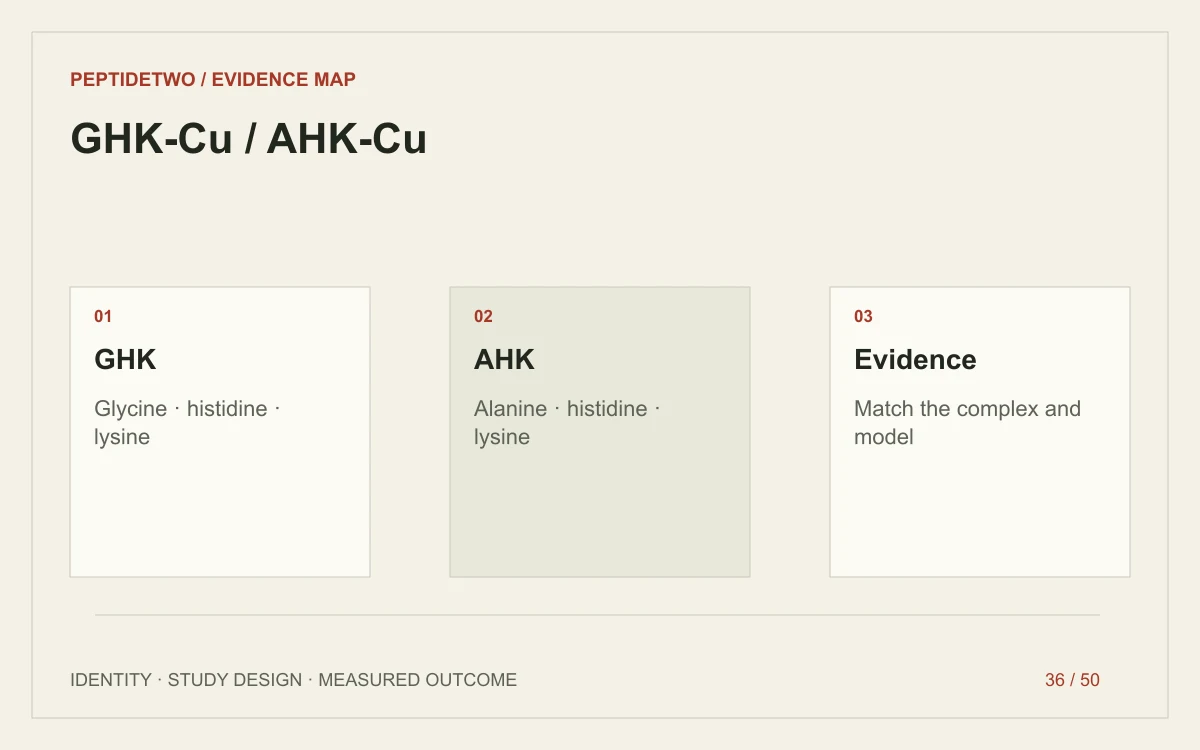
GHK-Cu vs AHK-Cu starts with a sequence difference: glycine in GHK and alanine in AHK. Both names describe copper-associated tripeptides, but a shared metal and similar letters do not make their experimental evidence interchangeable. The exact complex and the model used in a paper should stay attached to its result.
What the GHK-Cu fibroblast paper addresses
The Maquart fibroblast-culture study investigated collagen-synthesis responses associated with glycyl–histidyl–lysine copper complex. It is mechanistic laboratory evidence. It does not directly measure hair density or prove that a finished cosmetic delivers the same exposure to human tissue.
A formula’s ingredient name and its full composition also matter. Copper complexation and material specification should not be inferred only from the colour or nickname of a product.
The AHK-Cu hair work used a specific model
The 2007 hair study examined AHK-Cu in human hair follicles ex vivo and cultured dermal papilla cells. Human-derived tissue is biologically relevant, but it is not the same as a controlled clinical trial in people using a scalp product.
Scroll horizontally to read all columns.
| Evidence | What it can describe | What remains unmeasured |
|---|---|---|
| GHK-Cu fibroblast culture | A collagen-related cell response | A universal finished-serum effect |
| AHK-Cu follicle model | Follicle elongation in the model | Diagnosis-specific regrowth in people |
| Cultured papilla cells | Proliferation or signalling observations | Long-term hair density and tolerability |
| Topical clinical study | A particular formulation and setting | Every copper complex or route |
Why “human hair” can be an ambiguous headline
A paper can use human hair follicles outside the body. A headline shortening that to “tested in humans” changes the study type. The key distinction is whether people were assigned to an intervention with clinical follow-up, rather than whether the laboratory material originally came from a human donor.
Our hair-peptide evidence guide explains why follicle elongation, shaft thickness and visible scalp coverage answer different questions.
Do not transfer GHK-Cu clinical findings to AHK-Cu
The GHK-Cu post-laser study evaluated another formulation and context, with mixed objective and subjective findings. It cannot validate an AHK-Cu hair product or a different route of exposure. A one-letter sequence difference is not a licence to pool all outcomes under “copper peptides.”
A directly relevant comparison would need clearly identified materials, equivalent study conditions and the same outcome methods. The cited studies do not provide that head-to-head clinical comparison.
What to record in a research summary
Retain the full name, sequence, copper-complex description, formulation, model and endpoint. Mark whether the evidence is cellular, ex vivo, animal or clinical. Canadian product guidance also distinguishes cosmetic uses from unauthorized products promoted for human use.
For route-specific context, read topical GHK-Cu versus injectable claims. For the individual materials, use the GHK-Cu and AHK-Cu dossiers. This comparison does not establish a hair-loss treatment or rank products.