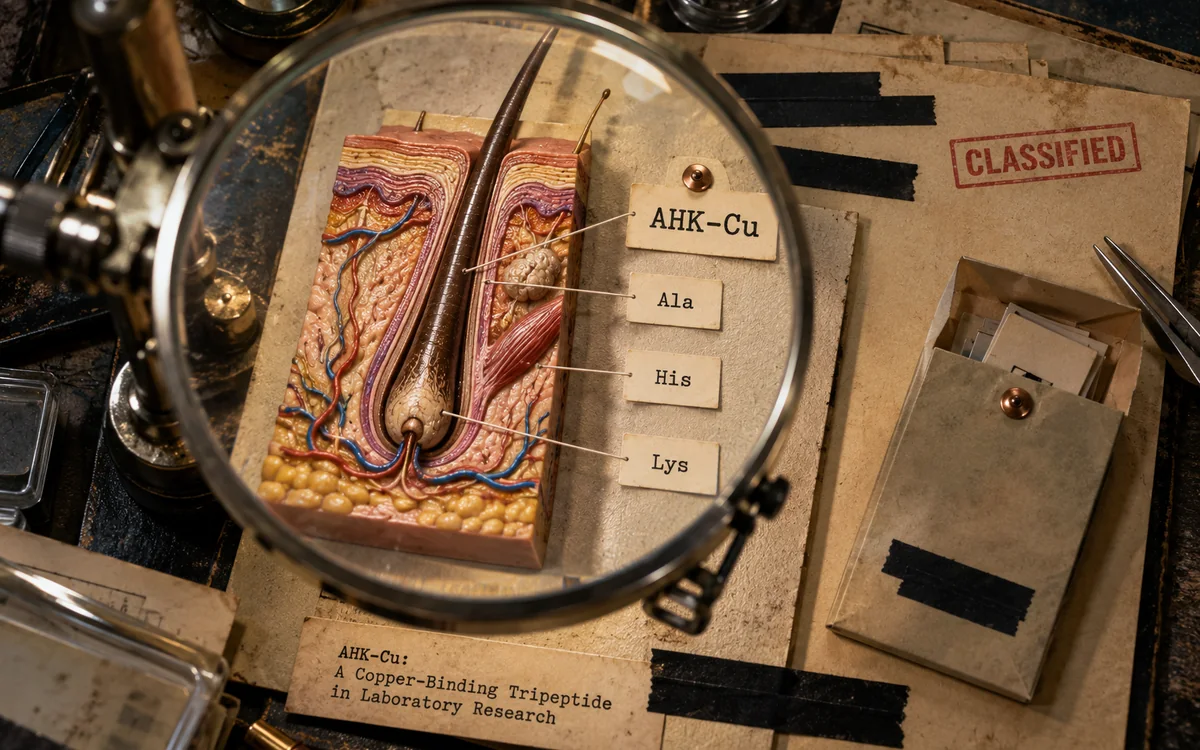
AHK-Cu is a copper-binding tripeptide discussed in laboratory research on skin and hair-related biology. Its short name can be confused with other copper peptides, including GHK-Cu. The molecules differ in their amino-acid sequence, so findings should be linked to the exact compound and model studied rather than generalized across the category.
AHK-Cu identity and copper binding
AHK refers to the amino-acid sequence alanine–histidine–lysine. The suffix Cu indicates association with copper in the studied complex. Composition alone does not establish the state of a supplied sample: the complex, concentration, purity, stability, and impurities need appropriate analytical support. Similar names are not evidence that AHK-Cu and GHK-Cu have identical properties.
What the hair research measured
A primary study investigated a tripeptide–copper complex in human hair-follicle and dermal papilla cell systems. In vitro experiments can probe cell responses under controlled conditions and suggest candidate biological pathways. The human hair-growth in vitro study does not establish an effect in people: cultured cells do not reproduce the full follicle environment, exposure, or outcome measurement in a clinical study.
Translation requires separate evidence
To support a claim about a real-world cosmetic outcome, research must test a defined formulation and appropriate comparator in human participants using prespecified measures and sufficient follow-up. Results also depend on the specific peptide complex, vehicle, stability, and exposure. A cellular marker or growth signal is not the same endpoint as a demonstrated change in hair density or appearance.
How to read a copper-peptide claim
- Verify the three-residue sequence and which copper complex was studied.
- Identify whether evidence came from cells, animals, or people.
- Check the measured endpoint and whether it is clinically meaningful.
- Look for formulation details, controls, replication, and adverse-event reporting.
How to interpret the next research step
For cell research, note whether the experimental cells came from donors, how they were cultured, and whether the observed response was replicated across independent samples. Laboratory conditions can alter cell behavior, so a response in a controlled dish is a starting point for mechanism work. Human cosmetic outcomes require a different design and direct measurement.
Compare with the GHK-Cu research overview and the guide to analytical identity claims. Mechanistic plausibility is a reason to study a molecule, not proof of a consumer result.
AHK-Cu research: what the primary evidence measures
The cited tripeptide-copper experiment used an in-vitro hair-follicle model. Measurements from isolated human tissue are informative about that model, but they are not a controlled clinical test of a finished product. Distinguish the peptide sequence AHK from GHK, and distinguish the copper complex studied from any other preparation bearing a similar label. Review the primary source rather than relying on a claim detached from its methods.
Evidence gaps and the next useful question
Translation would require analytical confirmation of the complex, formulation characterization, exposure assessment, relevant control groups, and outcomes measured in people. A visually persuasive image or a single tissue experiment cannot establish a reproducible clinical effect. The CONSORT reporting framework helps readers identify the design and outcome details needed for a clinical comparison.
How to compare research materials
Results can be compared only after the materials and questions are aligned. Record the exact name and sequence, modifications, analytical identity, sample matrix, comparator, endpoint, and observation window. The FDA analytical-method guidance separates identity, strength, purity, and potency as different characteristics; a single label or peak does not answer them all. When a paper omits these details, mark the comparison as uncertain rather than filling the gap with an assumption.
- What molecule and preparation did the investigators actually study?
- Was the endpoint a laboratory signal, a biomarker, or a patient outcome?
- What comparator and follow-up support the interpretation?
- Which details are missing or need independent replication?
Related research reading
Continue with ghk cu, peptide identity mass spectrometry, preclinical vs clinical peptide evidence. These guides help separate evidence quality, molecular identity, and outcome claims without treating them as the same question.