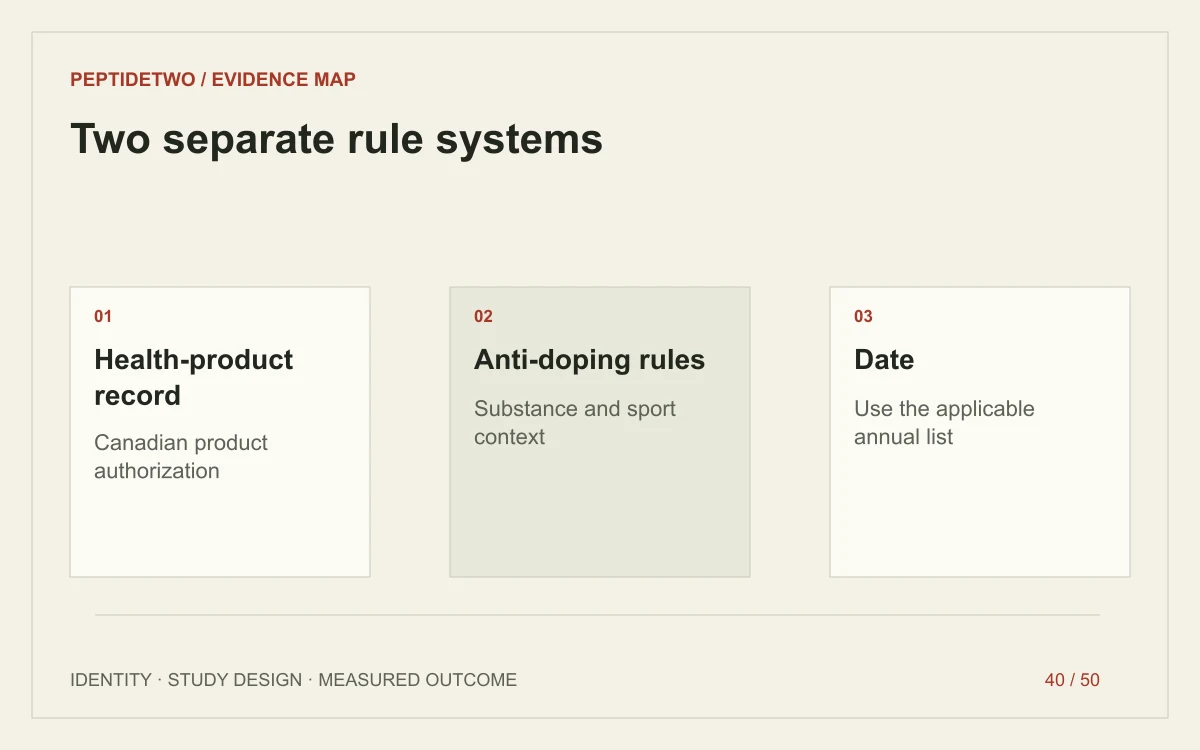
Peptides and WADA require a separate check from Canadian medicine authorization. A product can have a medical use while still being subject to sport restrictions, and a research-use label does not provide anti-doping permission. The exact substance, applicable list year and athlete’s rule context matter.
What the Canadian 2026 reminder says
Sport Integrity Canada’s 27 April 2026 reminder identifies BPC-157 and other non-approved peptides as prohibited under the 2026 framework and discusses the S0 category. It also explains that several kinds of conduct, not only a positive test, can be relevant under the Canadian Anti-Doping Program.
This is a sport-specific source. It should not be confused with Health Canada’s classification of a product for sale or used as a universal statement about every peptide in every context.
Use the applicable year
The 2026 Prohibited List took effect on 1 January 2026. The WADA list resource also provides the subsequent annual documents. The published 2027 list takes effect on 1 January 2027; publication in 2026 does not mean it replaced the current list immediately.
Scroll horizontally to read all columns.
| Question | Record to inspect |
|---|---|
| Is this product authorized in Canada? | The relevant Health Canada product record |
| Is this substance prohibited in sport? | The applicable annual WADA list and sport guidance |
| Does a medical exemption apply? | The relevant exemption process and exact circumstances |
| Does a product label settle the issue? | No; labels do not replace the substance and rule check |
Absence of a name is not a reliable permission signal
The lists contain categories as well as examples. A substance may need assessment within a class even when a particular retail alias is not visible in a short search result. Brand names and supplier nicknames can also obscure the underlying substance.
The Canadian reminder directs athletes and support personnel to authoritative substance-inquiry and medication-check resources. A seller’s assurance or a generic search snippet is not a substitute for that process.
Approved medicine and permitted use are different
Health Canada’s peptide overview includes established peptide medicines alongside discussion of unauthorized products. That product-level framework is different from anti-doping rules. Neither should be used as shorthand for the other.
This article does not decide an individual athlete’s eligibility, exemption or case. Those depend on the actual rules and circumstances. It also does not provide strategies to avoid detection or time use around competition.
What to keep in the record
Retain the full substance name, ingredient details, product record, applicable year and the authoritative response to any inquiry. Record the date of the check. If the product’s actual contents are uncertain, a label alone cannot establish what exposure occurred.
For molecular aliases, read CJC-1295 identity distinctions and TB-500 versus thymosin beta-4. For the broader product question, see Canadian peptide classification. A clear record separates scientific identity, health-product regulation and sport rules.