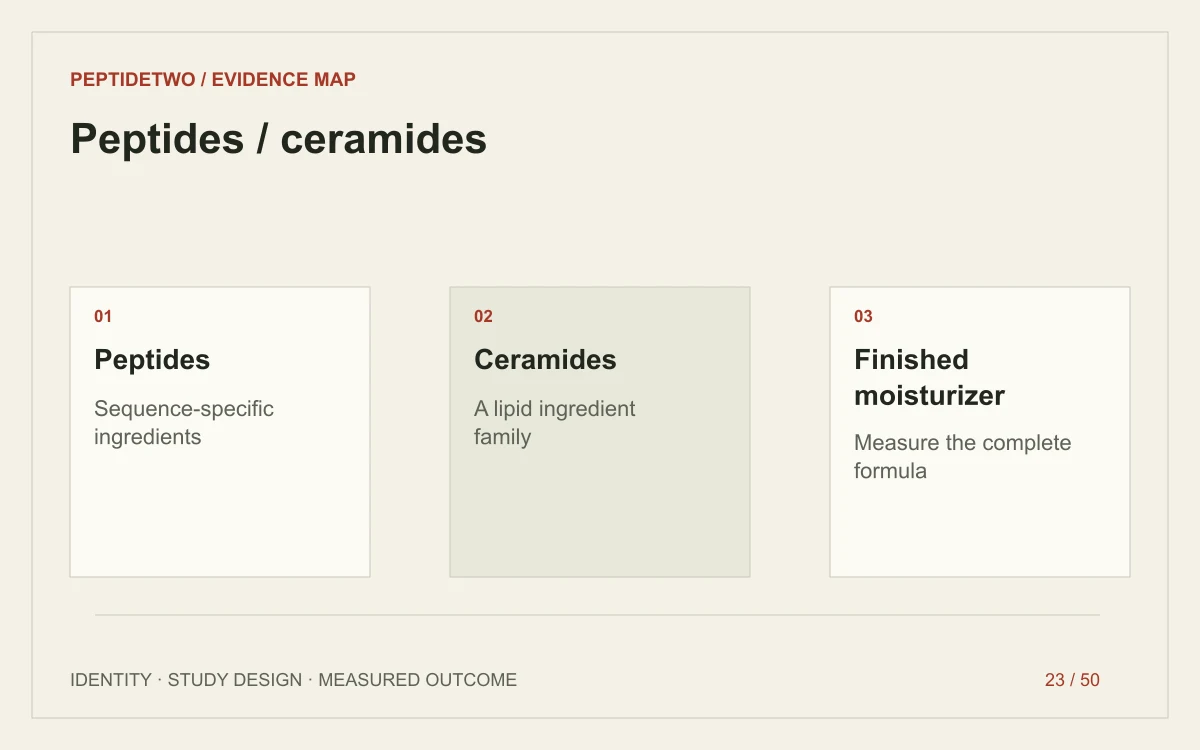
Peptides vs ceramides compares different ingredient families, not two names for the same skin-care function. Peptides are amino-acid sequences; ceramides are lipids. A moisturizer can contain both, but that does not show that their individual contributions have been isolated or that one ingredient family is best for every concern.
Start with the actual ingredient
“Peptides” can refer to many different sequences and modifications. A result for one palmitoylated sequence does not establish an effect for every multi-peptide serum. Ceramide-containing formulas also differ in lipid composition and other ingredients.
The ingredient record of a multi-peptide serum illustrates this complexity: peptides appear alongside glycerin, hyaluronate and other components. A hydration result for the finished formula cannot automatically be assigned to its peptides alone.
Barrier and wrinkle outcomes are not interchangeable
Scroll horizontally to read all columns.
| Endpoint | What it addresses | Question that remains |
|---|---|---|
| Transepidermal water loss | A barrier-related measurement | Was the difference between groups clear? |
| Surface hydration | A water-related skin property | How much is due to the vehicle? |
| Wrinkle assessment | A defined appearance outcome | Which sequence and formula were tested? |
| Symptoms in dermatitis | A clinical condition-specific result | Does it transfer to unaffected skin? |
These distinctions keep a reasonable ingredient explanation from becoming an unsupported medical or cosmetic promise.
A recent ceramide study shows why comparators matter
A 2026 randomized ceramide-NP moisturizer trial enrolled adults with atopic dermatitis who received standard therapy with the test emollient or placebo. The abstract describes favorable trends but reports that between-group changes in the barrier measures were not statistically significant.
Improvement from baseline in both groups is not proof that the added ingredient caused a superior result. Background treatment and the moisturizer vehicle matter. This is a useful example of reading the comparison rather than only the conclusion’s positive wording.
The peptide trial asks a different question
The pal-KTTKS split-face trial compared a moisturizer with the same moisturizer containing a specified peptide. It assessed photoaged facial skin and wrinkle-related outcomes. That design is relevant to the added peptide in that formula; it does not compare peptides with ceramides or establish treatment for eczema.
A fair side-by-side article should keep those populations and endpoints visible. Adding the results together does not create a new combination trial.
How to read a peptide-and-ceramide product
Identify the complete formula, the claim and the outcome tested. Ask whether the study compared the finished product with a credible vehicle and whether it isolated either ingredient’s contribution. If not, describe a result for the formula rather than attributing it to one component.
Cosmetic regulatory information is also distinct from medicine authorization. Read the palmitoyl-pentapeptide study guide for sequence-specific evidence and multi-peptide serum claims for formulation attribution. This comparison does not diagnose a skin condition or prescribe a routine.