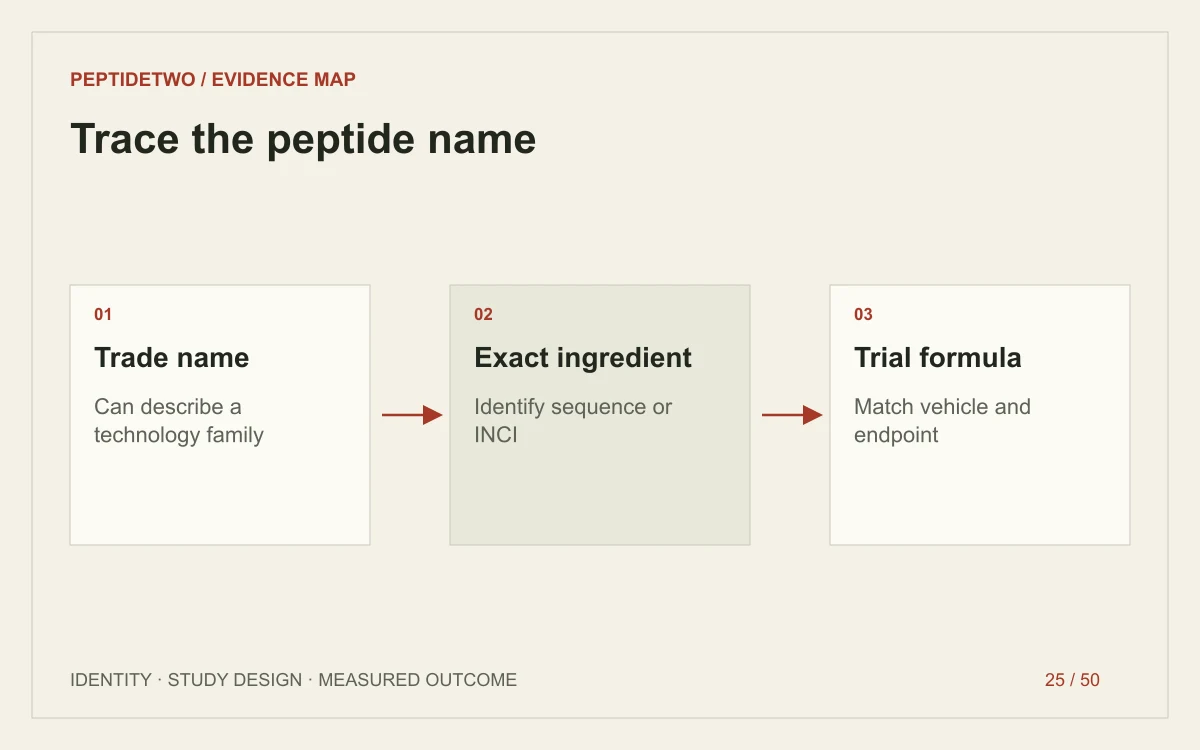
Palmitoyl pentapeptide evidence should be tied to the exact sequence and formulation. Matrixyl is a commercial name encountered across cosmetic peptide technologies, so the word alone is not a complete molecular specification. A trial of pal-KTTKS should not be assigned automatically to every later blend carrying a related trade name.
What the pal-KTTKS trial tested
The 2005 randomized split-face study compared a moisturizer with the same moisturizer containing palmitoyl-KTTKS. It included 93 women aged 35–55 and ran for 12 weeks. Technical image analysis, expert grading and self-assessment addressed wrinkle and fine-line outcomes.
The study reported favorable findings for the peptide-containing preparation relative to the control. Its design is useful because the vehicle comparison helps assess the added ingredient. The result remains specific to that preparation and population.
Why names can become misleading
Peptide ingredient nomenclature and trade names are different systems. A label may describe a technology blend rather than a single sequence. The manufacturer’s current multi-peptide product record names several distinct technologies and ingredients; that list should not be flattened into one generic “Matrixyl molecule.”
Scroll horizontally to read all columns.
| Identifier | What to establish |
|---|---|
| Trade or technology name | Which commercial ingredient or blend does it describe? |
| INCI ingredient name | Which named cosmetic ingredient is on this label? |
| Sequence or chemical description | What molecule did the paper actually study? |
| Finished formulation | Is the vehicle and ingredient combination comparable? |
| Clinical outcome | Which result was assessed, for how long and in whom? |
A split-face study has strengths and limits
Using each person as their own comparison can reduce some between-person variability. It does not eliminate every issue, such as measurement methods, product use, selection criteria or generalization to other populations. A 12-week result is not a complete long-term outcome record.
Check whether the assessment was blinded, how missing data were handled and what the primary outcome was. A statistically significant result should still be accompanied by its size and practical meaning.
Do not borrow another peptide’s mechanism
Argireline research involves a different sequence and design concept. Its findings do not fill an evidence gap for pal-KTTKS, and the reverse is also true. “Peptide” describes a broad chemical category rather than one uniform cosmetic effect.
This is why the Argireline guide and this article have separate questions. One is not a near-identical substitute for the other, and neither creates evidence for a complete commercial routine.
How to summarize a product claim fairly
State the exact peptide, the tested formula and the measured endpoint. If the material cannot be matched, call the connection uncertain. Do not interpret cosmetic appearance evidence as treatment for a medical skin condition; Canadian cosmetic requirements belong to a different framework from medicine authorization.
Read multi-peptide serum attribution for how combinations complicate the claim and peptides versus ceramides for why different ingredient families require different measurements.