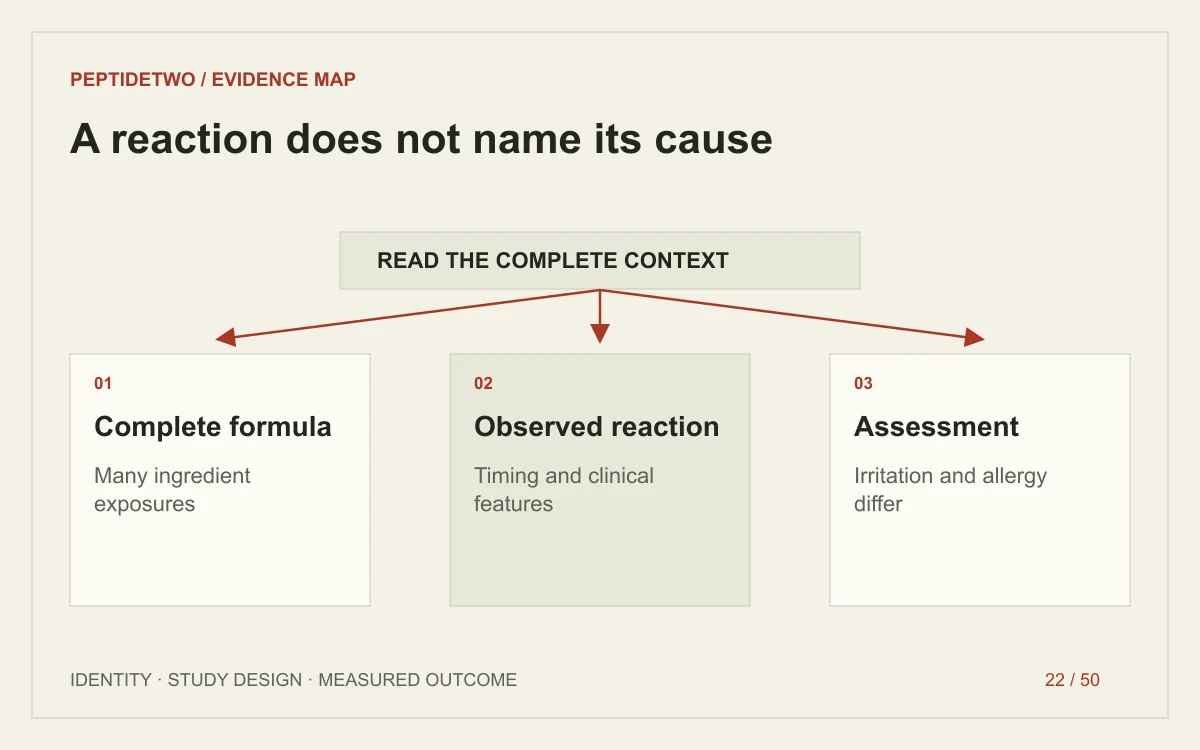
Copper peptide serum irritation describes an experience, not a confirmed ingredient diagnosis. A serum contains a complete formulation, and a reaction can occur in the context of other products, skin conditions or recent procedures. The phrase “copper peptides ruined my skin” in a review cannot establish which ingredient caused the change.
Look at the full formula
The current product record for one copper-peptide serum includes humectants, several peptides, preservatives and other components. Its ingredient list demonstrates why the finished serum is not a single-ingredient experiment. A temporal association with that product cannot, on its own, isolate copper tripeptide as the cause.
That does not mean a reported reaction should be dismissed. It means the description should remain accurate: a person reacted while using a product, with the cause not yet established. Repeating an ingredient diagnosis online can obscure information needed for an appropriate assessment.
Irritation and contact allergy are different questions
A clinical study of cosmetic dermatitis used history, examination and patch testing to investigate possible allergens in affected patients. This is a different process from an informal home test or a collection of product reviews. A study in selected dermatitis patients also cannot supply the incidence of reactions among all serum users.
Scroll horizontally to read all columns.
| Observation | What it can tell you | What it cannot establish alone |
|---|---|---|
| Symptoms follow product use | A possible temporal relationship | Which ingredient caused them |
| Symptoms improve after withdrawal | A useful clinical clue | A complete diagnosis |
| A clinical patch-test result | Evidence about a tested allergen | Every possible irritant reaction |
| Online before-and-after image | A reported visible change | A controlled causal comparison |
Small tolerability studies have limits
The small GHK-Cu post-laser trial evaluated a specific regimen and setting. A tolerability observation in selected participants does not guarantee the same result for every commercial formula or every person. Conversely, one negative review cannot establish that an entire ingredient class causes permanent damage.
Read adverse-event collection methods, exclusions and follow-up duration. An ingredient can have mechanistic research without a comprehensive estimate of every reaction to every finished cosmetic.
Why adding more products makes attribution harder
If a routine changes several ingredients at once, the observation cannot isolate one change. A new acid, retinoid, fragrance or procedure can alter the context. These are examples of confounding, not a diagnosis of what happened to a particular reader.
This article does not recommend challenging an irritated area with repeated exposure to identify the cause. Persistent, severe or otherwise concerning reactions warrant appropriate clinical assessment. Keep the product packaging and a clear history available for that discussion.
How to read safety claims more carefully
Use the complete ingredient list and instructions, rather than a “clean” or “gentle” headline alone. Canadian cosmetic regulation is a different framework from drug authorization; a cosmetic claim is not evidence of medical treatment benefit.
For study comparisons, read copper peptides versus retinol. For layering claims, see copper peptides and vitamin C. The aim is a precise account of the evidence, without minimizing a reaction or inventing its cause.