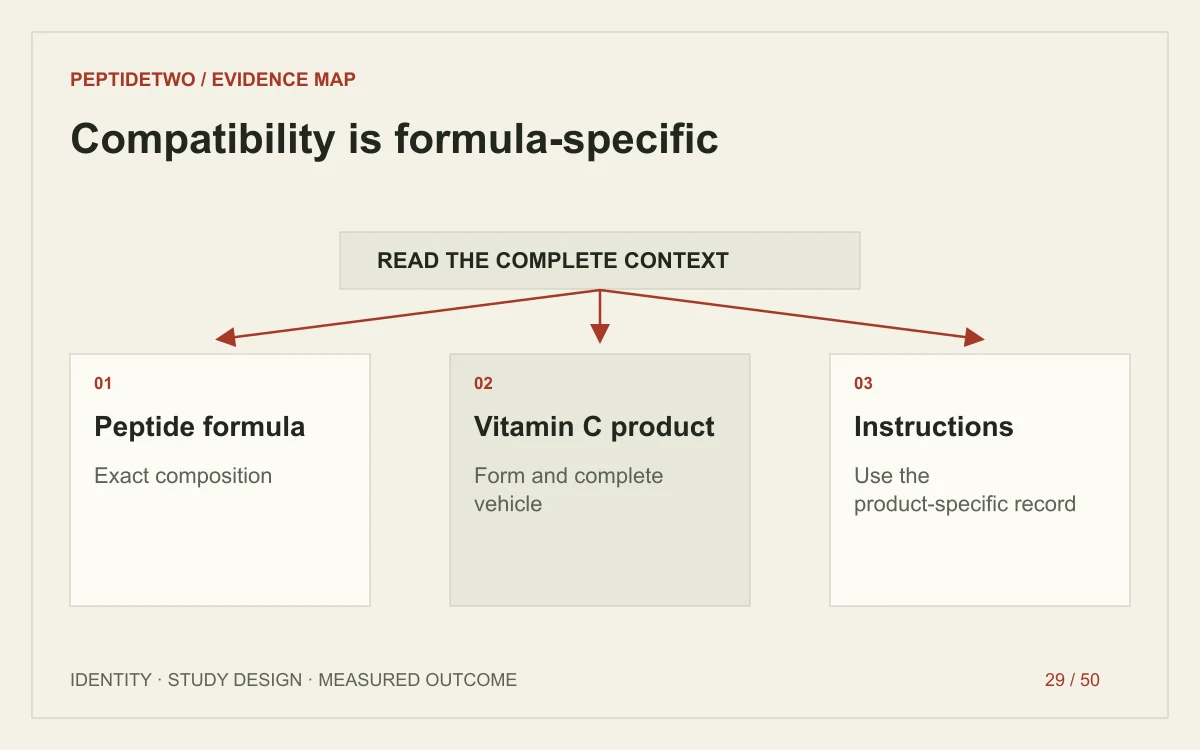
Copper peptides and vitamin C cannot be assessed from two ingredient-family names alone. A useful answer separates the instructions for a specific finished product from a universal chemical claim. Vitamin C products and peptide serums differ in form, concentration, pH and other ingredients.
What one manufacturer actually says
The current Canadian copper-peptide product record advises avoiding combinations with direct acids, retinoids and strong antioxidants such as vitamin C. That is a product-specific instruction. It should be retained when discussing that formula, rather than rewritten as proof that every peptide is destroyed by every vitamin C derivative.
A manufacturer’s compatibility instruction also does not identify a personal reaction’s cause. If someone reports irritation after combining products, the complete exposures still need consideration.
Why the full formulation matters
Scroll horizontally to read all columns.
| Detail | Why it changes the question |
|---|---|
| Exact peptide or copper complex | Different sequences and complexes are not identical materials |
| Vitamin C form | A broad family name can conceal different ingredients |
| Vehicle and pH | Affects the environment in which ingredients are formulated |
| Other components | Can influence stability and tolerability |
| Product instructions | Specify the intended use of the finished formula |
Without those details, a confident statement about chemical compatibility may be an extrapolation from a different system.
Do not turn a mechanism paper into a mixing test
GHK-Cu fibroblast research investigates a biological experiment. It does not test the stability of every commercial vitamin C and copper-peptide combination. A mixing claim would need an appropriately designed chemical or formulation study with the actual materials.
Likewise, a visual colour change in a mixture is not a complete analytical result. It cannot, by itself, identify the chemical species, quantify active content or establish skin safety. The solubility and stability guide explains why appearance is an incomplete measurement.
Separate stability from tolerability
A formula can remain chemically measurable while still being poorly tolerated by an individual. Conversely, a product that feels comfortable has not thereby been proven stable under every storage or combination condition. These questions need different evidence.
The separate multi-peptide formula record is another reminder that commercial products are mixtures. Recommendations should follow the exact product record rather than be transferred simply because both labels contain the word peptide.
A practical evidence-reading approach
Identify both complete formulas and read their own current instructions. If a claimed compatibility test is cited, ask what was mixed, under which conditions, for how long and with which analytical endpoint. Mark any extrapolation clearly.
This article does not provide a layering schedule or recommend experimenting on irritated skin. Canadian cosmetic requirements do not replace individual clinical assessment of a reaction. Read serum irritation for causal interpretation and topical versus injectable evidence for a larger example of why formulation context matters.