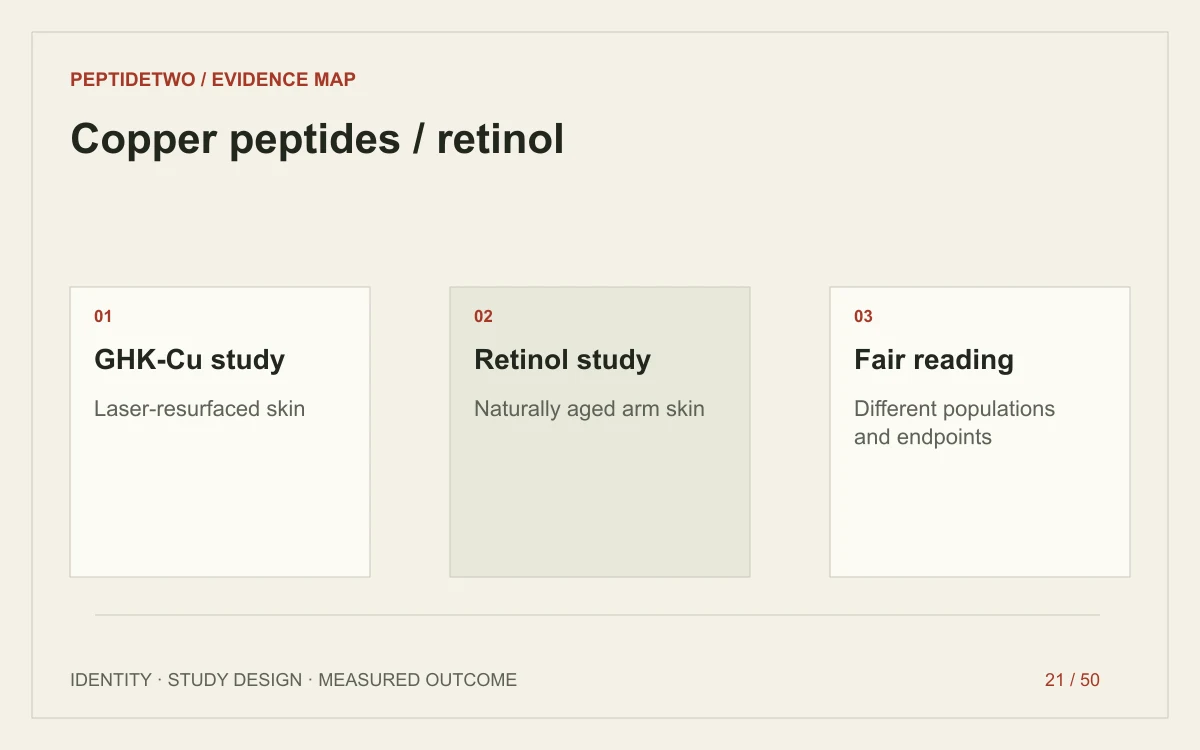
Copper peptides vs retinol is often presented as a choice between two equivalent anti-aging ingredients. The studies usually cited do not form a direct head-to-head comparison. Different populations, skin sites, formulations and endpoints make a simple “which is better?” ranking unreliable.
What a human GHK-Cu study measured
A randomized post-laser study compared skin-care regimens with and without GHK-Cu after carbon-dioxide laser resurfacing. Thirteen participants completed it. Objective assessments did not show significant between-group improvement in erythema resolution, wrinkles or overall skin quality, although patient-reported satisfaction favored the GHK-Cu regimen.
That is a mixed result in a specific procedural setting. It should not be summarized as proof that every copper-peptide serum visibly reverses aging, or as proof that all topical copper peptides have no effect in every context.
The retinol trial asked a different question
The Kafi retinol study used a randomized, vehicle-controlled comparison on the arms of elderly participants over 24 weeks. It reported improvements in fine-wrinkle assessments with the studied formulation. The participants, anatomical site and intervention differed from the GHK-Cu post-laser study.
Scroll horizontally to read all columns.
| Comparison detail | GHK-Cu paper discussed here | Retinol paper discussed here |
|---|---|---|
| Setting | Post-laser facial skin | Naturally aged arm skin |
| Comparator | Regimen without GHK-Cu | Vehicle lotion |
| Outcome types | Objective assessments and satisfaction | Wrinkle scores and selected biopsy measures |
| Interpretation | Setting-specific mixed findings | Setting-specific positive findings |
Why cell biology is not a tie-breaker
GHK-Cu fibroblast experiments address collagen synthesis under laboratory conditions. Such work can inform a mechanism, but it cannot be used to convert the two human studies into a fair comparative trial. A molecule acting on cultured cells is not a measurement of the finished serum’s effect on intact skin.
Concentration, formulation, delivery and tolerability also matter. Ingredient names are not complete descriptions of the interventions that people apply.
Compatibility advice is product-specific
The current Canadian product page for one copper-peptide formula lists its own combination restrictions. Those instructions belong to that formulation. They are not proof that every peptide and every retinoid chemically behave identically together.
This article does not provide a personal skin-care schedule or recommend layering active products. Read the actual product instructions and distinguish irritation from an intended cosmetic effect. The irritation guide explains the attribution problem.
What would establish a stronger comparison?
A head-to-head study would use comparable participants, the same outcome methods, an appropriate formulation design and enough follow-up. It would report adverse effects and the size of the between-group difference, not just separate before-and-after changes.
For the broader peptide category, read skin-care peptide evidence. For another ingredient comparison, see peptides versus ceramides. The useful conclusion is evidence tied to an exact question, rather than an ingredient leaderboard.