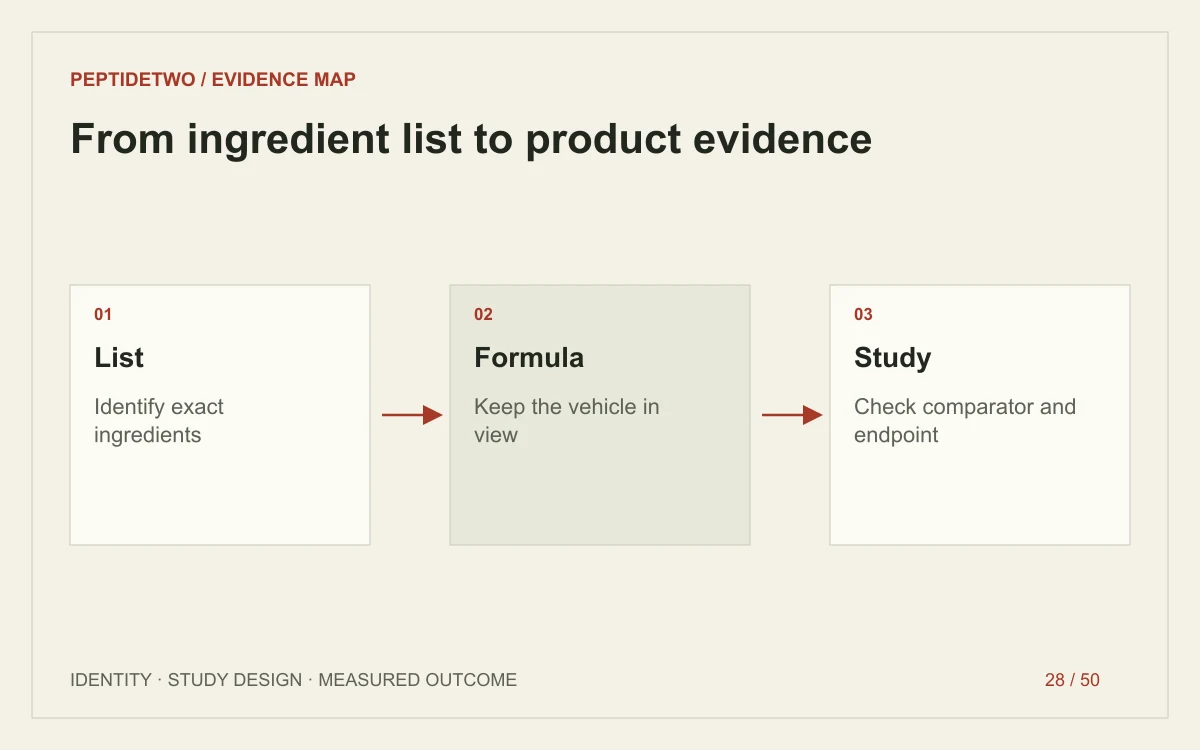
Multi-peptide serums contain more than one ingredient with a scientific-sounding name. Their evidence is best read at two levels: what is known about each named ingredient, and what has actually been tested for the complete finished formula. A longer peptide list does not itself establish a larger or more reliable cosmetic effect.
Identify names rather than counting peptides
The current Multi-Peptide + HA product record lists several peptide ingredients and a range of non-peptide components. The copper-peptide product record describes another formulation. These examples show why a trade name or headline is not a complete specification.
Ingredient nomenclature matters because similar marketing terms can describe different sequences, blends or modifications. Record the actual label and region, since manufacturers can update formulas. This is document review, not independent confirmation of a product’s contents.
Separate three types of claim
Scroll horizontally to read all columns.
| Claim type | Evidence to look for |
|---|---|
| Ingredient mechanism | The exact sequence and experimental model |
| Finished-formula performance | A study of that product with an appropriate comparator |
| Consumer perception | The question asked, sample, timing and response method |
| Comparative superiority | A directly relevant comparison with the alternative |
A product can have ingredient research without a published independent clinical trial of its current complete formula. That distinction should remain visible in a neutral review.
Why the vehicle is part of the intervention
The pal-KTTKS trial used the same moisturizer with and without the studied ingredient. That kind of comparator helps distinguish the added component from the vehicle’s effects. A simple before-and-after result for a moisturizing serum cannot make the same attribution.
Water-binding ingredients, texture and other components may contribute to how skin looks or feels. The study design, rather than an ingredient’s place in the marketing headline, determines whether its contribution was isolated.
One peptide’s trial does not cover the whole list
The Argireline trial addresses a specific preparation and wrinkle assessment. It does not establish that every formula containing that ingredient performs identically, or that adding several other peptides makes it more effective.
Combination effects are empirical questions. They can be additive, different from expectations or unresolved. A credible combination claim needs a comparison that can assess the mixture, rather than an arithmetic sum of unrelated study percentages.
What a useful evidence note should contain
Write down the exact product, ingredient version, study population, duration, comparator and endpoint. State whether the source is a published trial, an unpublished manufacturer test or a consumer questionnaire. Keep missing methods as a gap instead of treating the test label as sufficient evidence.
For focused ingredient reading, use Argireline evidence and palmitoyl-pentapeptide evidence. For a different outcome problem, read eye-serum claims. No products were purchased, clinically tested or ranked in this guide.