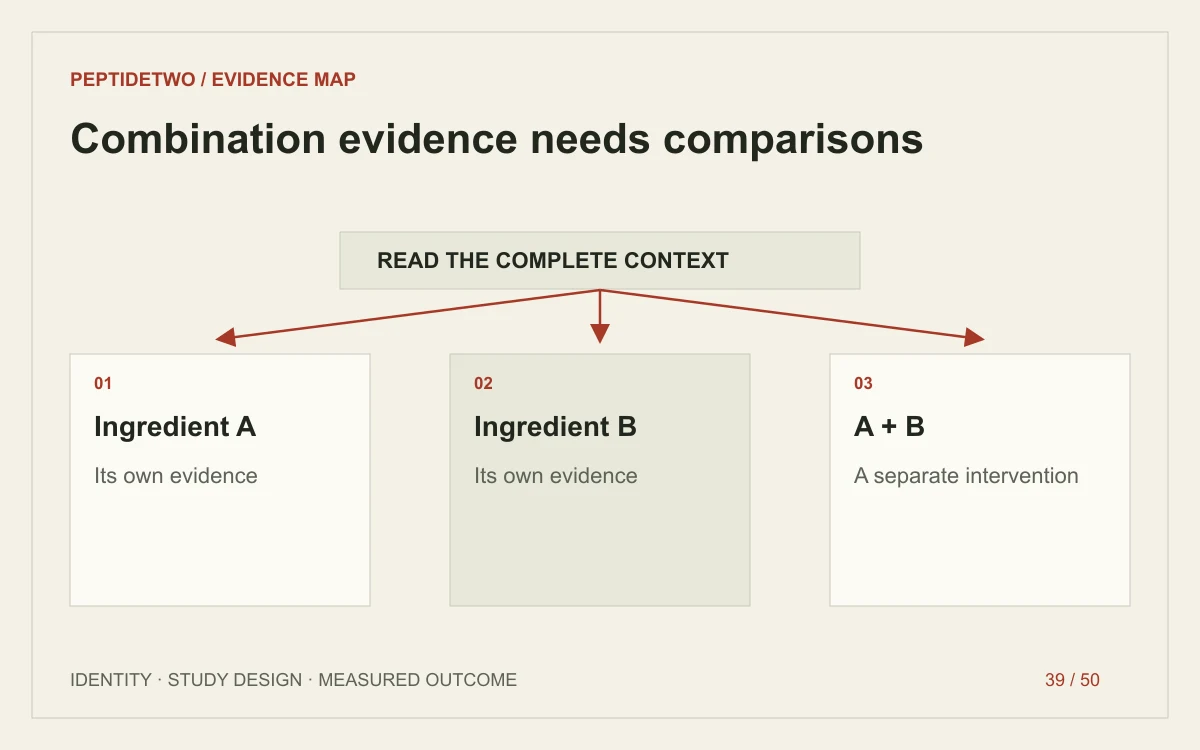
Peptide stacks are combinations, and a combination is a new evidence question. Two ingredients with separate studies do not automatically produce demonstrated synergy, a known safety profile or a predictable clinical outcome when combined. A popular nickname also does not specify the exact molecules in a product.
What synergy would actually need
To investigate whether a combination adds more than expected, a study needs suitable comparisons. Depending on the question, that can mean control, ingredient A, ingredient B and A-plus-B groups, with an analysis capable of examining the interaction. A before-and-after result for the mixture cannot isolate either ingredient.
Scroll horizontally to read all columns.
| Study arm or record | Question it helps answer |
|---|---|
| Control | What happens without the tested ingredients? |
| Ingredient A | What is A’s effect under these conditions? |
| Ingredient B | What is B’s effect under these conditions? |
| Combination | How does A plus B compare with the relevant alternatives? |
| Interaction analysis | Is the combination result different from the prespecified expectation? |
Simply adding percentages from unrelated papers is not an interaction analysis.
The small BPC-157/TB4 report is not proof of a stack
A retrospective knee-pain report contacted 16 people after treatment; four had received the combination described as BPC-157 and TB4. The groups were small, not randomized and not assessed with a shared controlled trial design. The report does not establish a reliable superiority or synergy estimate.
It also describes TB4, which should not silently become every retail material called TB-500. Our identity comparison explains why the exact molecular form matters.
More ingredients make attribution harder
If a clinical outcome or adverse event occurs after several exposures change, identifying the responsible component becomes difficult. Different formulations, routes and background treatments add further uncertainty. A label saying blend does not resolve those variables.
The same issue affects endocrine combinations. The CJC-1295 monotherapy research cannot by itself validate a mixture with a different secretagogue. Its hormone findings belong to its own intervention and population.
Quality and clinical evidence remain separate
A blend report should identify and assess its components, but chemical testing still cannot establish the clinical effect of the combination. Health Canada’s risk guidance explains why testing claims do not replace authorization, safety evidence or quality controls.
A purity figure for a mixture is especially easy to misunderstand if it does not state which component or analytical basis is represented. Read purity versus content for that distinction.
How to read a combination claim
Ask for the exact identities, full formulation, relevant comparator and measured outcome. Label anecdotes and exploratory reports accurately. Canadian research guidance distinguishes promising investigation from established human effectiveness.
For individual pathway context, read ipamorelin versus sermorelin. This article evaluates the evidence needed for a claim; it does not provide stack recipes, doses, schedules or administration instructions.