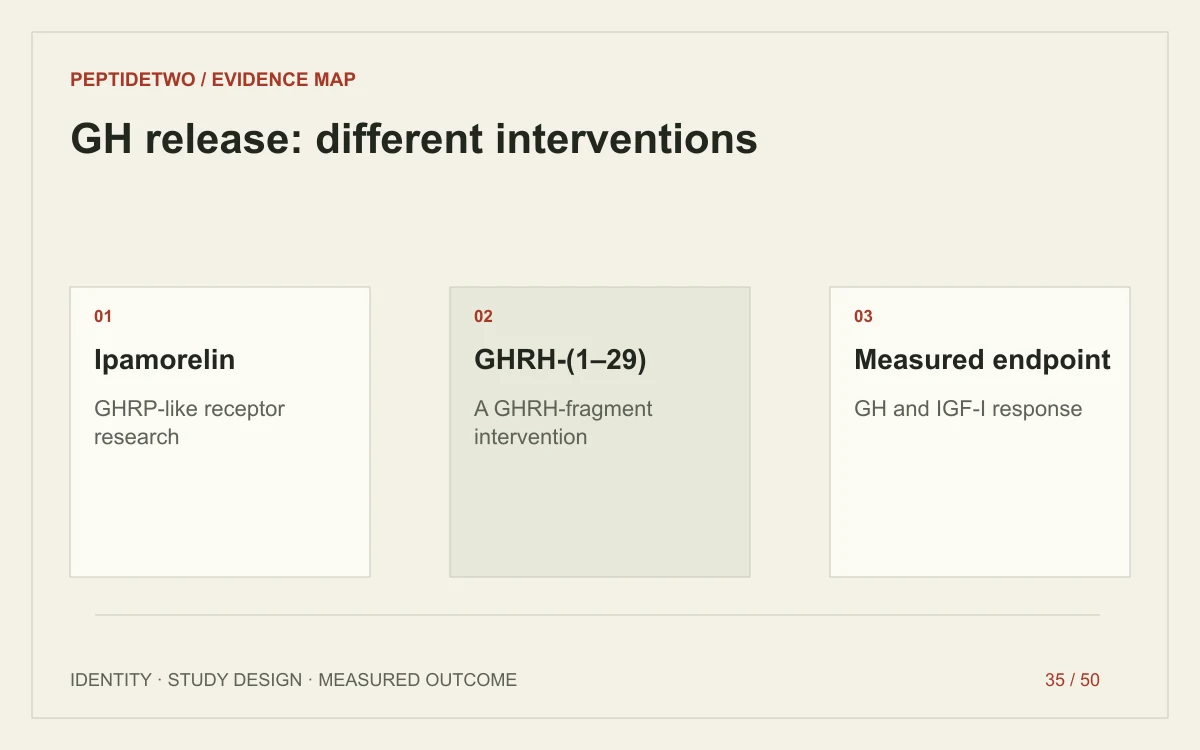
Ipamorelin vs sermorelin compares different approaches to stimulating growth-hormone release. The shared hormonal endpoint does not make the molecules, receptor pathways or evidence interchangeable. A fair comparison also distinguishes animal pharmacology from human endocrine observations and from unmeasured claims about muscle or aging.
What the original ipamorelin paper studied
The 1998 ipamorelin study describes a pentapeptide and a GHRP-like receptor pathway using laboratory and animal experiments, including rats and swine. Its selectivity findings concern the hormone responses measured in those settings.
That paper is not a large human trial demonstrating improved strength, longevity or general wellbeing. Describing a selective experimental hormone response as “no side effects” would also go beyond its design.
The GHRH-fragment evidence has another context
The Corpas study of GHRH-(1–29) examined endocrine responses in a small group of older men, with younger men providing baseline context. Its short intervention periods and GH/IGF-I measurements should stay attached to the result. These observations do not establish a universal anti-aging outcome.
Scroll horizontally to read all columns.
| Comparison | Ipamorelin source discussed here | GHRH-(1–29) source discussed here |
|---|---|---|
| Intervention | Pentapeptide secretagogue | GHRH fragment |
| Key context | Laboratory and animal pharmacology | Small human endocrine investigation |
| Measured question | Hormone release and selectivity | GH and IGF-I responses |
| Unresolved claim | Broad long-term clinical benefit | Broad long-term clinical benefit |
Why the comparison cannot be a clinical leaderboard
The cited studies did not randomize the same human population to ipamorelin versus sermorelin with a shared clinical endpoint. Different species, interventions and measurement periods prevent a direct numerical ranking.
Even within GHRH-related research, a long-acting analogue is another material. The CJC-1295 studies cannot be used as a substitute trial for every GHRH fragment or secretagogue. Identity remains part of the evidence.
Hormone markers and lived outcomes differ
A hormone concentration is relevant biological information. It does not independently establish improved mobility, fewer injuries, a particular change in body composition or longer life. Those outcomes require directly relevant studies with appropriate controls and safety follow-up.
Read muscle-growth evidence for the difference between a surrogate and a functional outcome. The endpoint guide explains how to interpret a study’s actual main question.
Keep the Canadian context visible
Health Canada’s peptide overview identifies ipamorelin among ingredients found in unauthorized products promoted for human use. The presence of an older pharmacology paper does not authorize a finished product or a combination.
For further reading, use GHRH versus GHRP and CJC-1295 identity distinctions. This article compares research concepts and does not recommend a treatment, combination, dose or administration method.