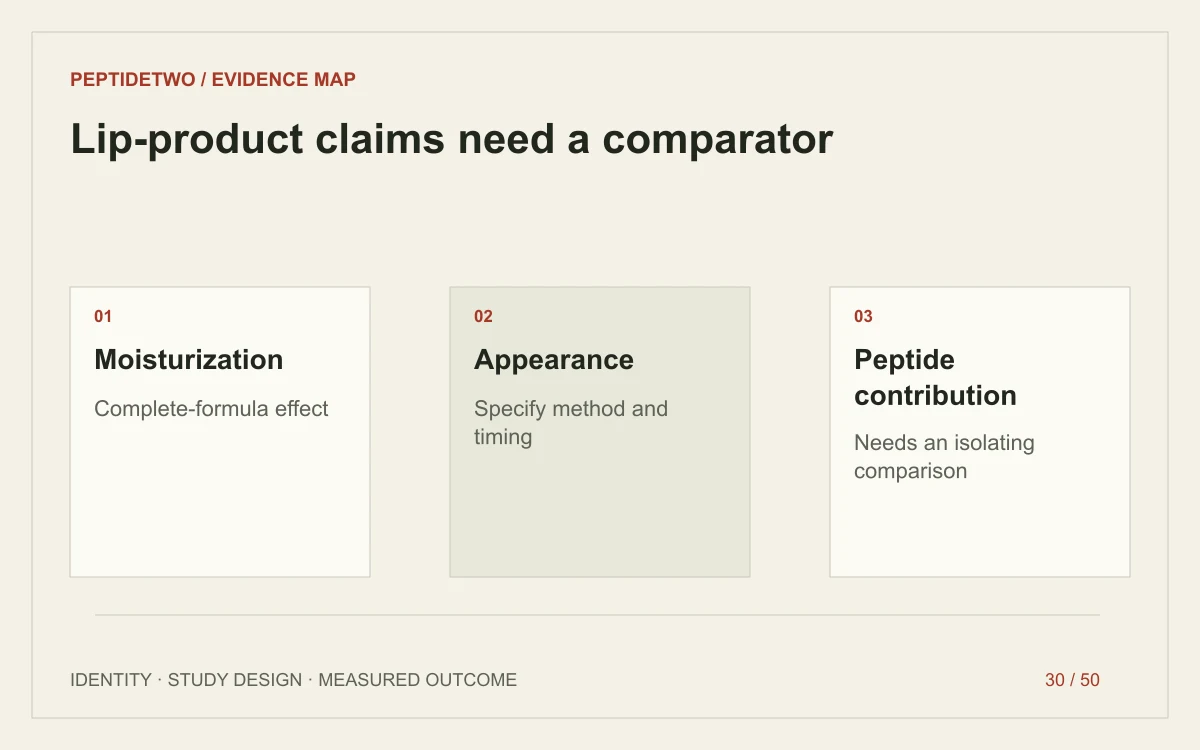
Peptide lip treatments are finished cosmetic formulas, not isolated peptide experiments. Softer-looking lips after using a balm may reflect the complete moisturizer or its surface film. To show that the peptide adds a specific benefit, a study needs an appropriate comparison with the same or a credible alternative base formula.
Hydration is a meaningful but specific claim
The American Academy of Dermatology’s lip-care guidance describes non-irritating moisturizers and ingredients that help protect dry lips. It also warns that burning or stinging should not be interpreted as a sign that a product is working. These are practical skin-care observations, not proof that a peptide repairs lip tissue.
A product can be useful as a moisturizer without having demonstrated an additional peptide-specific effect. A neutral review should allow that distinction instead of treating every positive user experience as evidence of a molecular mechanism.
What would different claims require?
Scroll horizontally to read all columns.
| Claim | Useful evidence | Common attribution error |
|---|---|---|
| Improved hydration | A defined hydration or water-loss measurement | All change is assigned to the peptide |
| Smoother appearance | Standardized images or blinded grading | Lighting differences are ignored |
| Longer-lasting change | Follow-up after product use | A temporary surface film is called structural repair |
| Added peptide benefit | A formulation comparison isolating the ingredient | Ingredient research is treated as a finished-lip-product trial |
Facial peptide papers do not automatically answer the lip question
The pal-KTTKS facial moisturizer trial concerns a defined peptide and facial skin assessment. It cannot by itself establish an effect for every peptide lip product. The application site, formula and endpoints differ.
Similarly, an ingredient list for a facial multi-peptide serum is not a recommendation to apply that product to lips. The site of intended use belongs to the finished product’s instructions. Ingredient familiarity does not replace those instructions.
Read before-and-after images carefully
Gloss, surface film, lighting, lip position and the time since application can change apparent texture or fullness. A credible comparison should standardize those conditions and identify whether the image shows the product still present.
A consumer-perception test can describe what participants thought. It cannot be recast as an instrument-measured percentage improvement unless that is what the study actually measured. A short observation also cannot establish a lasting structural change.
Keep the claim within its category
Canadian cosmetic regulation is distinct from drug authorization. A peptide on a cosmetic label does not establish treatment of a medical condition or suitability for an irritated individual. Persistent or concerning lip problems need appropriate assessment rather than a brand comparison.
For the underlying ingredients, read palmitoyl-pentapeptide evidence and Argireline evidence. For product-claim attribution, use multi-peptide serum claims. This article does not rank or independently test commercial lip treatments.