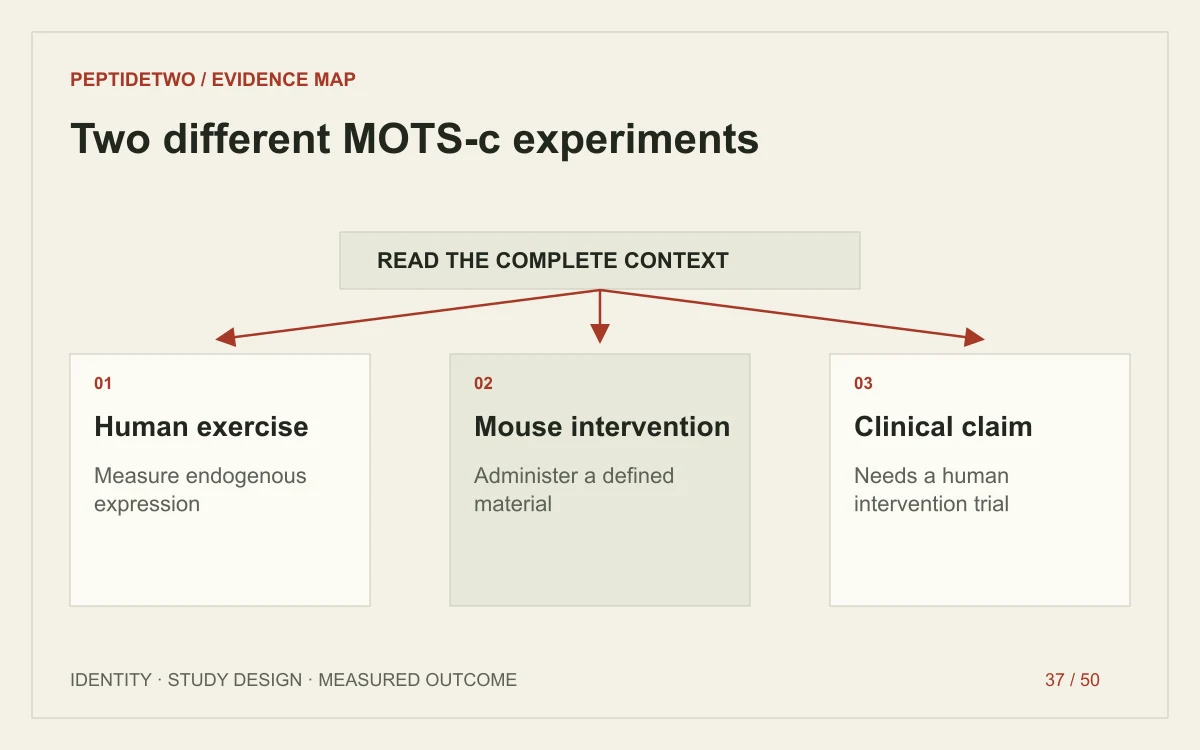
MOTS-c and exercise research contains two observations that are often merged incorrectly. Measuring an endogenous peptide after exercise in people is different from administering a peptide to mice and measuring performance. Neither observation alone establishes the benefits or safety of a commercial MOTS-c product in humans.
What the 2021 paper combined
The Reynolds study investigated mitochondrial signalling, muscle-related biology and physical performance. It reported performance-related findings after MOTS-c administration in mice and exercise-associated endogenous MOTS-c expression in human muscle and circulation.
Those are distinct parts of the paper. The human exercise observation should not be rewritten as a randomized human administration trial. Likewise, a mouse performance result should retain its species and experimental context.
Use the correct study label
Scroll horizontally to read all columns.
| Study component | What researchers do | What it can establish |
|---|---|---|
| Endogenous measurement | Observe the body’s own peptide response | An association with the exercise setting |
| Animal administration | Give a defined intervention in a model | An effect within that model |
| Mechanistic cell work | Study pathways in controlled conditions | A possible biological explanation |
| Human intervention trial | Compare assigned interventions with follow-up | A directly relevant clinical estimate |
A familiar molecule name does not bridge the differences between those designs.
Why “exercise mimetic” is a hypothesis-rich phrase
Exercise changes many physiological systems. Reproducing one signal or a performance measurement in a model does not demonstrate all the health effects of exercise. The phrase mimetic should therefore be interpreted in relation to the actual experimental features it describes.
A separate human MOTS-c metabolism study also needs to be read according to its own design and measurements. An endogenous biomarker relationship is not the same causal question as administering an external product.
Performance, healthspan and lifespan are different
A physical-capacity test, a muscle marker and survival are not interchangeable outcomes. Even when a paper discusses aging biology, a result should not be restated as a demonstrated extension of human life. The duration, model and exact endpoint remain necessary qualifications.
Our translation guide explains why mechanistic consistency can justify more research without establishing a human clinical benefit.
Product claims add another evidence gap
Health Canada’s October overview identifies MOTS-c among ingredients seen in unauthorized products promoted for human use. Its risk guidance separates testing claims from safety and authorization. An online label cannot establish equivalence to the intervention in a paper.
For the broader molecular context, read the MOTS-c dossier. For another aging-related biomarker question, see Epitalon and telomeres. This article does not propose an exercise substitute, an experimental regimen or administration instructions.