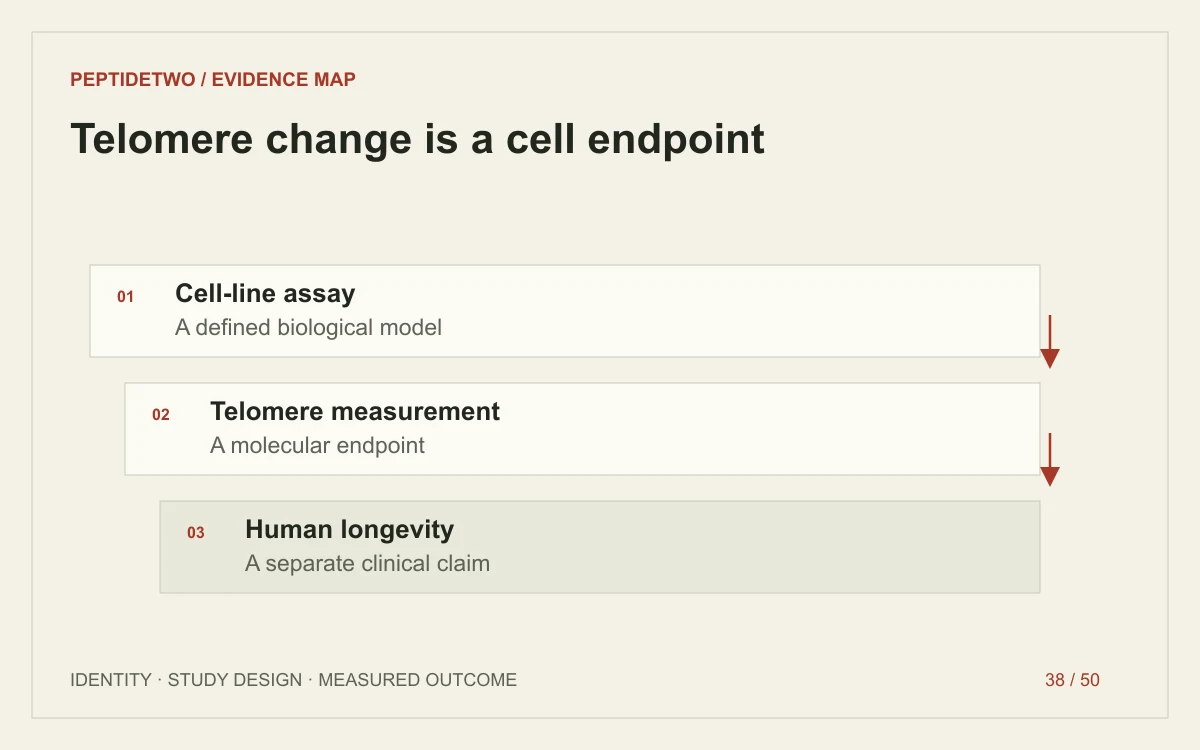
Epitalon and telomeres are linked in laboratory research, but a cell-line result is not proof of longer human life. Telomere length, telomerase-related activity and alternative lengthening pathways are biological measurements. They cannot be converted into years of life gained or a validated anti-aging intervention without directly relevant human evidence.
What the 2025 cell-line paper studied
The 2025 publication examined epitalon exposure in normal cell models and breast-cancer cell lines. It assessed telomere-related outcomes and proposed different pathway responses across those models. These are experiments on cells, not a trial assigning people to a longevity intervention.
The published correction replaces incorrect versions of Figures 1, 2 and 3. Those corrected figures belong with the original source record. This article describes the study setting and the authors’ abstract-level findings; it does not reproduce quantitative figure estimates or independently validate the assays. The correction is another reason to avoid treating a single publication as settled clinical evidence.
Why the cancer-cell component matters to interpretation
A biological pathway can operate in more than one context. A telomere-related effect in a cancer-cell model is not automatically a beneficial effect in a healthy person. Conversely, that cell experiment alone does not establish that an exposure causes cancer in humans.
Scroll horizontally to read all columns.
| Result type | What it addresses | What it cannot directly predict |
|---|---|---|
| Telomere assay | A molecular measurement in the model | Years of human life gained |
| Telomerase-related response | A proposed pathway | Universal clinical benefit |
| Cancer-cell response | Biology in that cell line | A human cancer event rate |
| Human clinical outcome | Health or survival under a defined intervention | Requires an actual clinical study |
Biomarker direction is not a complete health judgement
It is tempting to assign a good-or-bad label to a biomarker and assume that moving it in one direction must improve health. That shortcut ignores tissue context, measurement methods and unintended effects. A mechanistic result needs a clinical question, rather than serving as the final answer.
Our endpoint guide explains why a surrogate cannot stand in for every outcome people care about. Longevity claims require particular caution about the actual population and follow-up.
What stronger evidence would require
A relevant human study would specify the intervention and participants, appropriate controls, meaningful clinical outcomes and a long enough observation period. It would also need safety assessment and transparent participant accounting. A cell result can motivate that work, but cannot replace it.
Health Canada’s research guidance makes the same broad distinction between promising research and established human effectiveness or safety. The sequence name does not remove the translation problem.
The product-status question is still separate
The Canadian peptide overview identifies Epitalon among ingredients encountered in unauthorized products promoted for human use. Neither a biomarker paper nor an online anti-aging claim supplies a Canadian product authorization.
Read the Epitalon dossier for wider context and MOTS-c and exercise for another example of cell, animal and human observations requiring different labels. This article does not provide an anti-aging regimen or infer safety from a mechanistic finding.